Contaminants, including ink, detected in meteorites suggest sample preparation needs improving

The IBeA group of the EHU-University of the Basque Country is proposing new measures to safeguard the purity of extraterrestrial samples. Several contaminants, including traces of ink, originating in the preparation of subsamples, have been identified in Martian meteorites by the EHU’s research group. The finding highlights the importance of stricter protocols to prevent misinterpretations of the composition of these rocks and to ensure the reliability of future studies and Mars sample-return missions. The research is published in the journal Applied Geochemistry.

Live coverage: SpaceX to launch 1,000th Starlink satellite of 2026 on Falcon 9 rocket from Cape Canaveral

File: A SpaceX Falcon 9 rocket stands at Space Launch Complex 40 (SLC-40) at Cape Canaveral Space Force Station. Image: Adam Bernstein/Spaceflight Now SpaceX is set to launch its 1,000th Starlink satellite so far in 2026 with an early morning Falcon 9 rocket launch Tuesday morning from Cape Canaveral Space Force Station. The Starlink 10-24 mission will send 29 broadband internet satellites into low Earth orbit. This is SpaceX’s 37th dedicated Starlink mission of the Continue ReadingLive coverage: SpaceX to launch 1,000th Starlink satellite of 2026 on Falcon 9 rocket from Cape Canaveral

Information from starquakes provides theoretical evidence for ‘fossilized’ magnetism in stars

For the first time, new theoretical models, published in Astronomy & Astrophysics, connect the magnetism at the surface of long-dead stellar remnants (white dwarfs) with recent evidence of magnetism at the cores of their dying progenitors (red giants). The team, led by astrophysicists at the Institute of Science and Technology Austria (ISTA), argues that these magnetic fields might originate early in the stars’ lives, and survive their entire evolution, emerging as “fossil fields” at the surfaces of older remnants. A better understanding of these processes can also help to better understand our own sun’s future.

Orbit is filling up fast. Now comes the awkward bit: pre-empting and handling a crisis.

Earth’s orbit is “on track for a catastrophe.” That was the rather alarming prediction of the authors of a recent piece published in The Conversation. As the argument goes, orbit is filling up fast, and both nation-states and private companies plan to add tens of thousands of spacecraft to the thousands already there. This has […] The post Orbit is filling up fast. Now comes the awkward bit: pre-empting and handling a crisis. appeared first on SpaceNews.

The path to $50 billion in new space investment

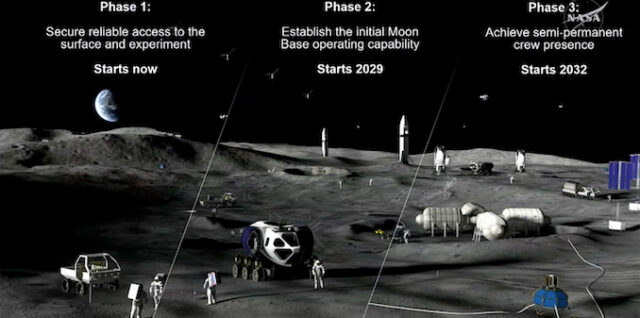
The future of space is commercial, with American companies critical to establishing a moon base and developing a vibrant economy in low Earth orbit (LEO) and beyond. The Trump administration has set a goal to attract at least $50 billion of new investment in American space markets by 2028. Sure, $50 billion is a big […] The post The path to $50 billion in new space investment appeared first on SpaceNews.

Spring fever pitch: Three questions to listen for this Space Symposium

A historic mission to the moon. A record-setting budget for the Space Force. Billions of dollars in new valuations. As the 41st Space Symposium opens in Colorado Springs, optimism is bountiful for the space industry. At the same time, leaders are emphasizing speed, near-perfect execution and new ways of working together across government and industry. […] The post Spring fever pitch: Three questions to listen for this Space Symposium appeared first on SpaceNews.

Aerospace to support industry with government furnished talent

The Aerospace Corp. plans to offer industry access to its expertise and facilities through a new program called government furnished talent (GFT). By providing companies with access to the Federally Funded Research and Development Center’s talent, technology, expertise and laboratory infrastructure, Aerospace intends to help accelerate development of space capabilities, Aerospace CEO Tanya Pemberton told […] The post Aerospace to support industry with government furnished talent appeared first on SpaceNews.

Phantom Space eyes edge in orbital data race with thermal deal

Phantom Space believes it now has the key pieces of a vertically integrated model to compete on the edges of the emerging orbital data center market, where industry giants are already staking claims to meet soaring AI-driven demand. The Tucson, Arizona-based satellite and rocket developer recently acquired what it sees as a critical missing piece: […] The post Phantom Space eyes edge in orbital data race with thermal deal appeared first on SpaceNews.

Q&A: Heather Pringle on what to expect from Space Symposium

The global space community is looking to build on a wave of momentum to expand its civil and national security sectors and sustain the industry’s resurgence well into the future. Heather Pringle, the Space Foundation’s chief executive officer and a retired Air Force major general, previewed the nonprofit’s annual Space Symposium, now in its 41st […] The post Q&A: Heather Pringle on what to expect from Space Symposium appeared first on SpaceNews.

President Trump signs legislation reauthorizing SBIR

COLORADO SPRINGS – President Donald Trump signed the Small Business Innovation and Economic Security Act April 13, reestablishing key sources of funding for early-stage space companies. The legislation reauthorizes the Small Business Innovation Research (SBIR) and Small Business Technology Transfer (STTR) programs through Sept. 30, 2031, and enhances screening of applicants to ensure they do […] The post President Trump signs legislation reauthorizing SBIR appeared first on SpaceNews.

Are Neutrinos Their Own Evil Twins? Part 3: Dirac’s Direct Solution

Neutrinos have mass — yet they never flip between left- and right-handed states the way every other massive particle does. The most logical fix is Paul Dirac’s: invisible right-handed neutrinos that interact with nothing whatsoever. The math works. It even produces a beautiful explanation for why neutrino masses are so absurdly tiny. But it requires believing in particles that are permanently, in-principle undetectable.