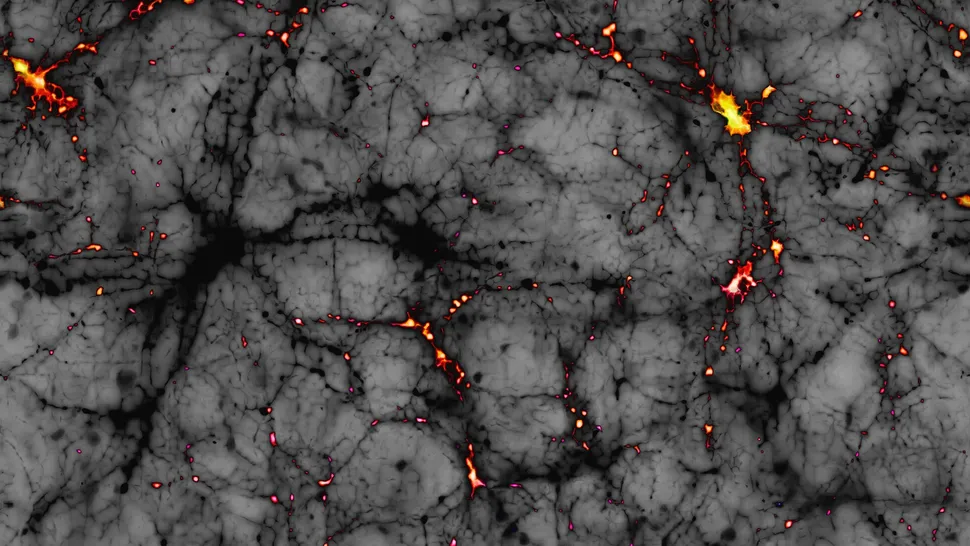

Roughly 80% of the mass of the universe is made up of dark matter but what is it? (Image credit: MARK GARLICK/SCIENCE PHOTO LIBRARY via Getty Images)
The universe holds mysteries that have challenged humanity’s greatest scientists for centuries. However, the greatest challenge may be one that exists all around us already, but no one can see, hear, smell, taste, or touch! Dark matter gives weight and gravitational effects to galaxies across the universe, and while astronomers have been able to measure the effects it has on those galaxies, none have yet been able to define exactly what dark matter is.
First theorized in 1933 by astrophysicist Fritz Zwicky, dunkle Materie or “dark matter” was given as the answer as to why stars at the outer edge of a galaxy moved at approximately the same speed as those near the center. When we measure the speed of how fast the planets in our Solar System orbit the Earth, one rule seems to always apply; the closer you are the Sun, the faster you orbit. Mercury, the closest planet to the Sun for example, takes just about 88 Earth days to travel one entire trip around the Sun. Something that takes the Earth 365 days to complete (that is a called a year to call back to your high school science class days.) A year on Jupiter is equal to 12 years here on Earth and by the time you get all the way out to Neptune, one year lasts about 165 Earth years!
But that rule breaks down when we zoom out to the galactic level. And if there is one thing scientists hate, it is a rule that applies in one situation, but not in another. The laws of physics should be ‘universal’ (pun intended) and what is good for the Solar System, should be good for the galaxy as a whole. But that is just not the case.
To account for why the stars at the edge of a galaxy move faster than what you might expect based on what you could observe, Zwicky theorized that there simply must be more matter there than he could observe. Since this matter could not be observed or light simply did not interact with it enough to make it visible, it must be invisible or “dark.” But just because it was invisible, did not mean that Zwicky and others could not measure it.
Like any good scientific theory, it had to be tested by someone else and that someone else must also logically come to the same conclusion as Zwicky: in steps Vera Rubin and her team took a few decades later. Using the technological progress that 30 years of development can bring, Rubin and her team double checked Zwicky’s work and confirmed what had been suspected – that if the orbit of galaxies were as fast as we had measured, then there must be more matter present than is visible. About six times as much dark matter than visible matter, to be exact. Imagine being in an airplane and looking down at a parking lot with five cars in it. Then someone coming along and telling you there were not just five cars there, but thirty, it is just that the other 25 are invisible!

Dark matter theory is not without its critics, however. Some recent ideas have attempted to explain away the gravitational effects without the need for dark matter. One of the stronger ideas comes with a cool acronym – MOND (or MOdified Newtonian Dynamics.) Supporters of MOND conclude that if we modify some of the original rules about gravity first introduced by Isaac Newton, we do not need to add dark matter to the equation, or at least, not as much as we currently add. While MOND offers some compelling ideas, more evidence would be needed for the scientific community to abandon dark matter.
The evidence currently gathered that opposes dark matter could fill a textbook or two. The evidence that supports dark matter, however, fills entire bookshelves!
Two plus two is four. Grass is green and the sky is blue. Barring some extraordinary circumstances, these rules remain true and the scientific laws that govern them are easily proven and accepted. However, not all the mysteries of the universe can be so easily proven. There are still some questions that remain unanswered or only partially proven. Why is it then, that the gravitational rules that govern our Solar System fall apart when we try to apply them to the galaxy? The technical answer may be long, complicated, and confusing.
Dark matter is an invisible type of matter that throws traditional rules out of the window and forces us to find new ways of explaining the universe. Although not a perfect theory, and there are new ideas that challenge it every day, dark matter remains the most researched and widely accepted answer for one of the greatest challenges the astronomical community has yet to encounter.
About the Author