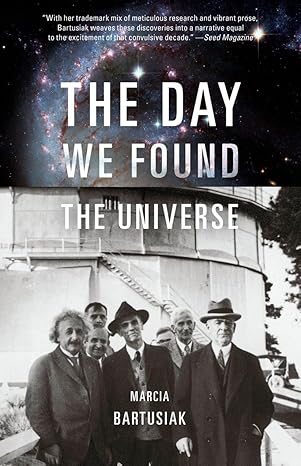
One may be forgiven for thinking that the idea of science beginning with discovery shapes one’s perception of the history of astronomical study. I, myself, once propagated that very idea. Upon reading The Day We Found the Universe, however, it may be more pertinent to state that science first begins with theory. Theory drives research. Research yields discovery. Discovery leads to confirmation, and with that confirmation, what has been determined to be scientific becomes reality. So is that tale told through this work, and it’s expertly done.
From its beginning, the book narrates the events and ideas that led to our understanding of the size and nature of the universe, and tells the lives and characteristics of the scientists who played a role in that understanding. Each chapter is devoted to one or, at times, two influential scientists or astronomers. The author, Marcia Bartusiak, begins each chapter by introducing the champion and their background: where they grew up, their family members, where they went to school, and sometimes their interests and hobbies. The author then ties this person to the larger narrative, which evolves continuously throughout the book. That narrative – how scientists determined what galaxies were, how far away from the Milky Way they were, and the rate of universal expansion itself – becomes clearer with the compliment that each new character adds.
It begins with the construction of the Lick Observatory by its benefactor, for whom it was named. A businessman, James Lick, sought to find immortality through the way of a grand telescope atop a mountain that would not only endure long after he had shuffled off his mortal coil but would further cement his name in history by answering the questions of the universe. The observatory hosts numerous scientists and serves as the initial stage of the book’s narrative.
The discoveries and achievements of Lick and the scientists who work there are too great to fit within the confines of this review. It is sufficient to say, though, that with the work done at Lick, other observatories follow. A prequel to the mid-twentieth-century space race unfolds as new, larger, and more complex telescopes are built across the country, and a bidding war for the scientists and astronomers who would study with them begins.
The persistent topic of debate and discussion among the astronomical community at the time was what exactly the spiral collections of light in the night sky were that astronomers saw in their telescopes. Today, we know these to be galaxies, much like our Milky Way. Great homes to trillions of stars, planets, and other universal wonders spanning tens of thousands of light-years. The prevailing theory of the time, however, was that these were a type of nebula, a collection of cosmic gas, dust, and perhaps clumps of matter. Some theories advanced the idea that these were stars in the early stages of development, before their matter could gravitate close enough to each other to form a neat, tight ball like our sun. Different ideas held that they were a collection of already-made stars, yet part of the Milky Way, and relatively close by cosmic standards. Still, some argued that these great celestial spirals were entire universes unto themselves, much like our own Milky Way, and that the light we were collecting from them had traveled for millions of years before reaching Earth.
This argument persists throughout the book, with champions from all sides given pages upon pages to explain their research and the reasons for their conclusions. The backdrop for all of this is essentially a turn-of-the-century United States of America. It was still a young country and eager to take its place among the great nations of the world. Astronomy and astrophysics are seen as among the surest ways for a nation to earn credibility on the global scientific stage. American scientists and their financial benefactors are eager to be considered leaders in this endeavor, alongside the old, respectable powerhouses in Europe.
With success emerging from the Lick Observatory, new telescope technology continually developing, a new industry of astronomical programs at American universities, and the formation of astronomical societies, and no shortage of opportunities, the cast of progressive and energetic American astronomers grows. A great rival to Lick, the Mount Wilson Observatory, was built, and the largest telescope in the world found its home there. Behind that telescope is the book’s protagonist (if there had to be a single main character at all), Dr. Edwin P. Hubble. As much time is spent describing Dr. Hubble as a person and the character he sought to craft as is his research. That is understandable, though. Dr. Hubble seemed to invent himself over several years, and his persona could at least be partially credited with the media attention and spotlight that followed his great discovery. As a person, second only to Albert Einstein – another character in this story, his image leaps off the page and is easily visualized. But it is more about what Dr. Hubble discovers while at Mount Wilson, which is the culminating arc of this story.
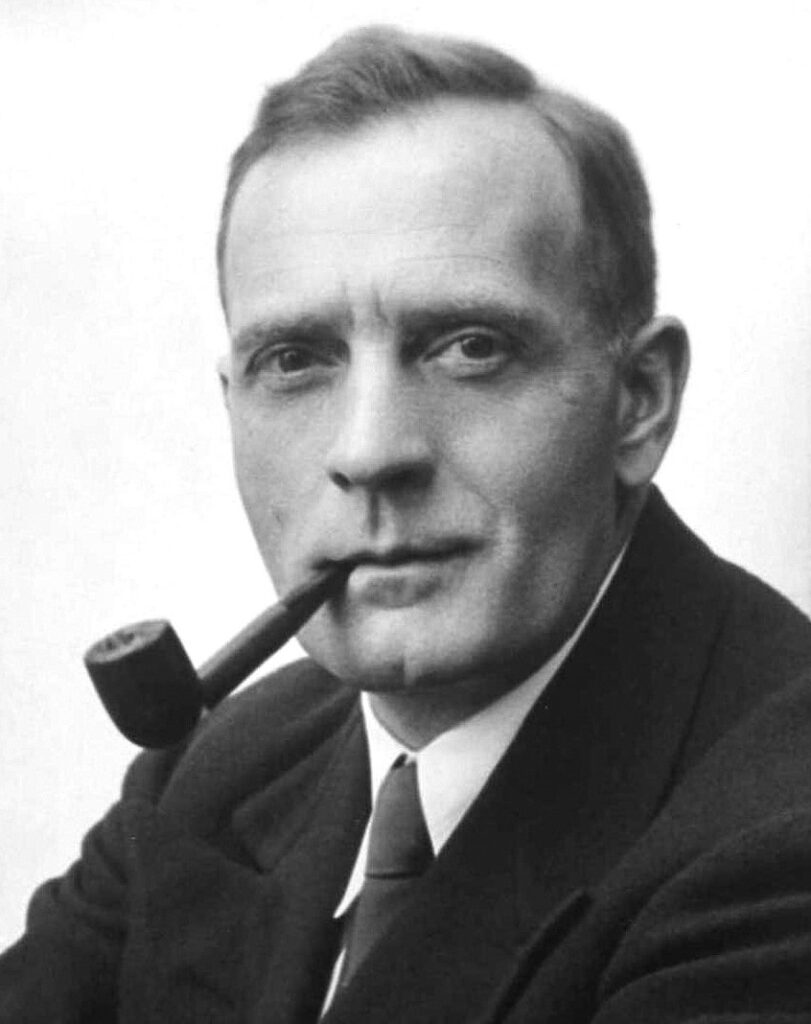
Through patience and repeated observations of the Andromeda Galaxy, Hubble eventually identifies several Cepheid variables, a type of star that pulsates at regular intervals, and determines a more accurate distance to the wondrous spiral nebulae. At the distance Hubble calculates and for them to be the size they are when observed from Earth, there can be no doubt that these aren’t nebulae at all, but instead, island universes like the Milky Way. The news of the discovery sweeps through astronomical circles and eventually the world. Later, Hubble’s measurements are refined, and the actual distance is even greater than initially thought. The universe may not have been discovered that day, but its exact size was finally realized, and the tiny corner we inhabit became clear.
The Day We Found the Universe is organized in such a way that each chapter builds on the one read just prior. One could almost line up entire chapters of this book to pages in an American or scientific history book. It takes a logical and chronological step from one person and idea to the next to tell its story. While it does meander from time to time into its characters’ personal lives, it feels pertinent to understand what motivates a particular character, what shapes their perspective on the universe, or the questions they pose. The reader does not require extensive scientific knowledge nor an advanced degree in astronomy or astrophysics. Complex topics are elegantly and eloquently described to make them approachable to most readers. The chapter on Hubble’s discovery is energetic, keeping the reader from putting it down and holding their attention at the peak of drama or action in a fictional story. For non-astronomers, it provides an overview of early twentieth-century astronomical history. For astronomers, it helps us to see the giants, upon whose shoulders we stand.
About the Author