
Our Solar System contains planets, moons, and other types of celestial bodies that present multiple opportunities for study. Of particular interest to some are the bodies known as comets, asteroids, and meteorites.
Some of the largest reservoirs of these bodies are the asteroid belt, which lies between the planets Mars and Jupiter; the Kuiper belt, a disk-like object composed of icy bodies just beyond Neptune; and the Oort Cloud, a cloud of icy bodies that exists well beyond the orbit of Neptune.
However, there are pockets of gravitational stability throughout the Solar System, where some of these bodies become trapped and maintain their positions for millions or even billions of years. These points of gravitational oasis are called Lagrange Points, and there are five at relative positions among any two bodies in orbit around the same mean point of gravity.
Some of these Lagrange Points trap asteroids and comets in their gravity wells and present themselves as an excellent point to study different bodies that may have formed at other places or at various times in the age of the Solar System, but now have all been collected at the exact location.
Jupiter boasts the most incredible collection of these Lagrange Point bodies at its L4 and L5 positions. These asteroids are collectively referred to as the “Greek” and “Trojan” asteroid groups, respectively. While Jupiter possesses the largest group to study, other planets in the Solar System, including Earth itself, have asteroids and other celestial bodies that they have trapped in their Lagrange Points.
This article attempts to catalogue some of the more significant examples of these Lagrange Point bodies and to explore how their composition and age may help scientists and astronomers better understand the formation and history of the Solar System.
What are Lagrange Points?
In celestial mechanics, Lagrange points are defined as relative points of gravitational stability that exist between any two bodies in orbit around the same mean point of mass. For example, while it is sometimes understood that the Earth orbits the Sun, in reality, both the Earth and Sun orbit each other around their mean center of gravity, which is the point at which their gravitational forces balance.
The Sun is much more massive than Earth; thus, that means the point of mass is buried deep within the Sun, at nearly its center, and it appears that the Earth is orbiting the Sun itself. In this example, when these two massive bodies are in orbit, their combined gravitational force and their centrifugal force act to balance each other out at specific points, relative to the position of the two central bodies.
Three of these points (L1, L2, and L3) were identified by Leonhard Euler in 1750. The remaining two (L4 and L5) were discovered by Joseph-Louis Lagrange shortly after. In a paper published by Lagrange later that discussed the equations for determining these points mathematically, thereafter lending his name to all five of them.
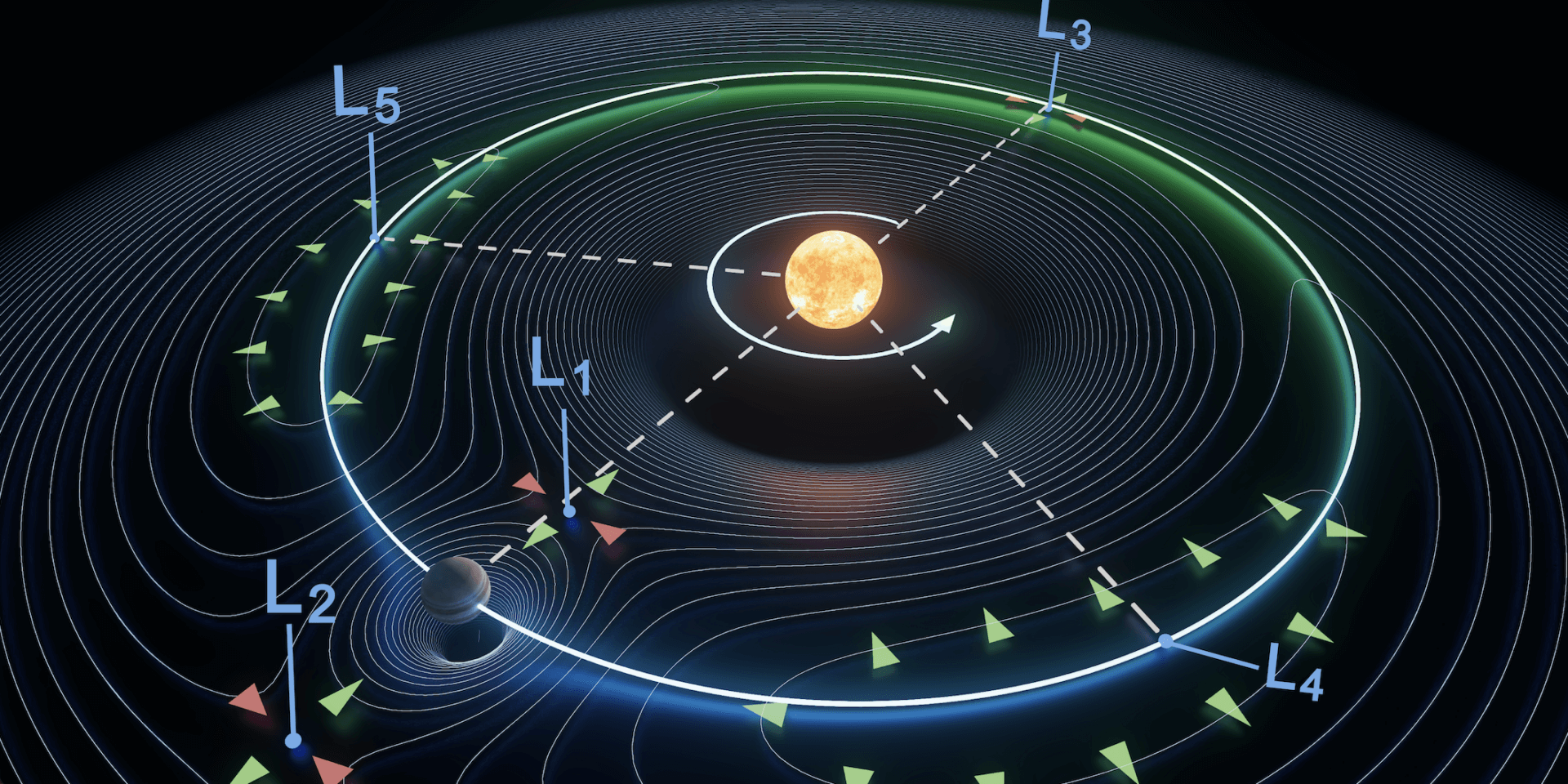
The formulas for calculating the relative position of these points exceed the scope of this article and will not be discussed in great detail. However, an image depicting the locations for these points around two bodies is presented below for visual reference.

Here, the two bodies are depicted as a larger white body and a smaller white body. L1 lies in the region between these two bodies. L2 is a point on the far side of the smaller body, at the same relative distance as L1 is from the smaller body.
So, for example, if L1 was one million miles away from the smaller body between itself and the larger body, L2 would be one million miles away from the smaller body on its far side. L3 lies at the point along the orbital plane that is equal to the smaller body’s position.
For example, if the smaller body were five million miles away from the larger body, the L3 would be five million miles away from the larger body at exactly 180 degrees from the smaller body’s current position. These three points represent points of marginal stability. An object that comes to rest at these three points may persist for an extended period of time, however, the inherit marginal stability of these points means that the object at these points will have its position degrade and it may be lost to other gravitational perturbations given enough time.
L4 and L5 are significantly more stable. These points like approximately 60 degrees ahead of the smaller body’s orbital path and 60 degrees behind the small body’s orbital path, respectively. Taken in conjunction with the mass of the smaller body and the larger body, these two points create an equilateral triangle, causing their positions to be more stable and less prone to gravitational interruptions than the three points previously discussed.
Trojan Objects
The asteroids, comets, or other natural objects that are found at the L4 and L5 points are frequently referred to as “Trojan objects”. The Trojan asteroids was the name given to the asteroids that were discovered orbiting the Sun at the Sun-Jupiter L5 point, trailing the orbit of Jupiter along its elliptical plane. While the objects discovered orbiting at the Sun-Jupiter L4 point, ahead of the Jupiter in its orbital path are called the “Greek objects”, most commonly “Trojan” is meant to refer to both objects at the L5 and L4 positions around any two bodies.

The National Aeronautics and Space Administration (NASA), as well as other space agencies, have made use of the Lagrange points in the Sun-Earth system, as well as the Earth-Moon system for the application of astronomical telescopes, tools, other artificial satellites, and even the possibility of habitats. That topic is worthy of its own discussion, but exceeds the confines of this article. This article will discuss the natural satellites that can be found at Lagrange Points across the Solar System.
Sun-Earth
The Sun being the most massive object in the Solar System, accounting for much of the gravitational force in the system, and the Earth likely being the most familiar object in the system to most readers of this article, makes the Sun-Earth Lagrange system the prime topic for the discussion of natural objects found at the points in this system.
The Sun-Earth L4 position is home to the first natural satellite discovered at any of the Lagrange points in the Sun-Earth Lagrange system. Here, 2010 TK7, a small asteroid only a few hundred meters in diameter was discovered in 2010 by the NASA Wide-field infrared survey explorer. No spectral date currently exists on 2010 TK7, so its composition remains unknown. But it is the first Trojan asteroid discovered near Earth.

L4 is also home to the second of the two known objects to orbit in the Sun-Earth Lagrange system. 2020 XL5, as its name suggests, was discovered in 2020 by the Pan-STARRS 1 survey mission in Hawaii. It is nearly two kilometers in diameter, over three times the size of 2010 TK7, making it the largest known Sun-Earth Trojan object.
Theia
Theoretical objects are also thought to have been at the Sun-Earth L4 or L5 points in the distant past. The giant impact hypothesis describes a scenario for the creation of the Moon in which a large planetary body formed alongside, or was captured near Earth that orbited along the same orbital plane as Earth in the early Solar System. The Earth and this body, named Theia, collided with each other, adding mass to the primordial Earth and the remaining material then collecting into what is now the Moon.

Earth-Moon
The Earth-Moon Lagrange system also is home to objects at the most stable of the points in its system. While L4 and L5 of the Earth-Moon are more stable than other points, they are not relatively stable as larger points like those around Sun-Earth system. In Lagrange point calculations, the size of the point is not absolute. Instead, it is relative in size to the gravitational force of the main two bodies in the system.
Sun-Earth having a much large combined gravitational force than Earth-Moon, means that the size of the Lagrange points around Earth-Moon are smaller than those around Sun-Earth. Solar forces, both gravitational and in the form of solar rays and waves further affect the Earth-Moon system. Still, at the Earth-Moon L4 and L5 points, clouds of dust can be found collected. These clouds of dust are called Kordylewski clouds after the Polish astronomer, Kazimierz Kordylewski who discovered them in the 1960s.
It is uncertain if the relative size of the Earth-Moon points or the influence of solar interference on the two body system ever prevented the dust clouds from collecting into a larger, more condensed body.
Sun-Mars
The inner Solar System has another Sun-planet system with extremely stable L4 and L5 points. The Sun-Mars systems boasts four Trojan objects at the relative L4 and L5 points. 5261 Eureka was discovered in 1990 at the Sun-Mars L5 point.
Shortly after, 1998 VF 31 and 2007 NS2 were also discovered at the L5 point and 1999 UJ7 at the L4 point. Spectral analysis of the L5 bodies have determined that the bodies may contain similar material as Mars itself, indicating that these bodies may have been part of the original material present at the beginning of the early Solar System and indeed the birth of Mars itself.
In contrast, analysis of 1999 UJ7 at the L4 points suggest its composition is not only different that the L5 bodies but also different than Mars, hinting at the possibility it is a captured object that came to rest in the Sun-Mars system well after the other bodies originally formed.
Sun-Jupiter
The Sun-Jupiter Lagrange system is the largest in the Solar System and as discussed previously, the larger that mass of the two main bodies in a Lagrange system, the larger their relative points are. Indeed, more objects are found at the Sun-Jupiter L4 and L5 points than at all Lagrange points in the Solar System combined.
The objects at the Sun-Jupiter L4 and L5 points were the first to be discovered in the Solar System at Lagrange points and to date, more than a million such objects have been identified and catalogued at either the L4 or L5 points. The Sun-Jupiter Lagrange system is so well defined, that there is even a collection of approximately 5,000 asteroids residing in the more comparatively unstable Sun-Jupiter L3 point called the Hilda group, named after the first asteroid discovered at that point over one hundred years ago, Hilda.

Greek Camp and Trojan Camp
The Sun-Jupiter family of asteroids are divided into two large camps, at the L4 and L5 positions. At the L4 point, leading Jupiter’s orbit along its path are the “Greek Camp” of asteroids. At present, more than 60,000 objects have been identified in the Greek Camp and that number is likely to increase as observations continue.
The earliest were identified in 1906 and the most recent as late as 2019. The second family of asteroids trail Jupiter’s orbit in the L5 position. These are known as the “Trojan Camp”, as they stand opposed to the Greek camp just as the Trojans and Greeks were opposed to each other in the Trojan War. The Trojan camp too has more bodies present than have been identified. Of the tens of thousands already known, the earliest were identified as far back as 1906 and the most recent as of 2020.
Interestingly, the composition of the both the Trojan and Greek camp of asteroids in the Sun-Jupiter system indicate surprising uniformity in the chemical make-up, including water, water-ice, and other carbon based organic compounds. This drives two principal theories on their origin. One prevailing theory is that the material that comprised both Jupiter and its family of asteroids were all present at the formation of the Solar System and the planet itself.
The stellar disk of material being so great that it formed not only the largest planet in the Solar System, but had so much remaining that the matter collected into the asteroids we observe today. The second theory is a theory of capture, that during a period of planetary migration, billions of years ago, Jupiter captured stellar debris in its Lagrange points as it migrated further away from the Sun until it reached its current distance.
Enough data has been collected on the composition, size, distribution, and location of the Sun-Jupiter Trojan asteroids that it would be impossible to summarize within the confines of this research article.
Sun-Neptune
It is uncertain at the moment why there are few, if any, Trojan asteroids around the Sun-Saturn and Sun-Uranus systems. Jupiter’s gravitational influence is likely to play a role to some extent, but the speculation for that is not available at this time. The final study for this article will instead focus on the Sun-Neptune Lagrange system, which has a fairly large contingency of Trojan type asteroids.
In fact, the Sun-Neptune system is home to the third largest grouping of asteroids in the Solar System behind the main asteroid belt and the Sun-Jupiter Lagrange system. At least twenty-eight individual objects have been identified in the Sun-Neptune system. While they are numerous, the distance that these asteroids are from Earth observations make them difficult, if not impossible, to accurately measure spectrographically.
The observations that are present of the Neptunian Trojans show a greater number of larger asteroids than found in the Sun-Jupiter system. The current prevailing theory is that the gravitational force of Jupiter is strong enough that it prevent, or even disassembles, larger asteroids that are near it.

Conclusion
In conclusion, as discussed previously, the compositions of asteroids and other bodies found at Lagrange points around the Solar System are as diverse as the planets they orbit, but can be remarkably uniform at certain positions.
The tendency of the material composition to match that of the planet in which the body is in alignment with tells a story in which the planet and the Trojan objects likely share an origin and were probably present at the same place and time in stellar history. Scientists can then study the material of these objects to help them understand the possible composition of the core and inner layers of some the planets that we currently do not have the technology to study directly.
Conversely, when the composition is significantly different that the planet or other bodies immediately surrounding it, tell a story of a captured traveler, that formed somewhere else or at some other time and has since come to rest at a point where a strong enough Lagrange point and the body itself crossed paths.
Understanding these differences and these bodies help scientists and astronomers understand the formation and evolution of the Solar System.
About the Author