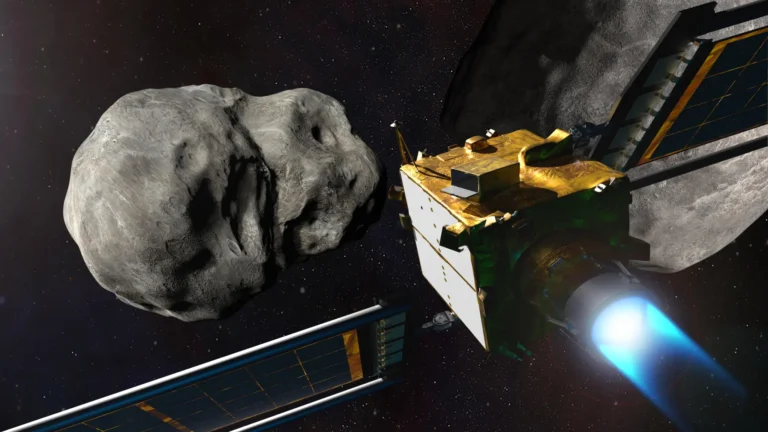
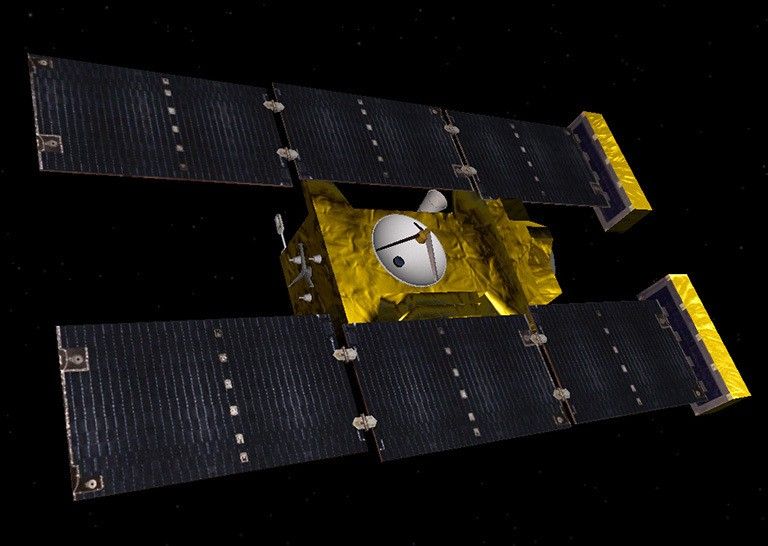
An illustration of NASA’s Stardust / Stardust NExT spacecraft. Credit: NASA/JPL-Caltech
Launched in February 1999, Stardust was a historic mission for NASA and the astronomical community. Its mission was to visit the Comet Wild 2, collect samples in a new and ingenious way, and return them safely to Earth for further study. The goal of these samples was to help scientists understand the formation of the Solar System by collecting bits of material that may have been present at the very beginning.
While on its journey, Stardust would collect interstellar dust particles as well as fly by and study another asteroid. While these smaller missions were important for calibrating the tools on Stardust and verifying that it was operationally ready, the primary mission was to visit the comet Wild 2 and collect fragments of its nucleus as they were blown off the comet into the coma. Wild 2 is a 5-kilometer-wide comet discovered in 1978. Its orbital period is approximately 6 years. Images taken by Stardust of Wild 2 revealed deep impact craters, hinting at its violent past. Some of these depressions would be 1 kilometer or 2 kilometers wide with kilometer-high sheer walls. NASA had estimated to find at least one gas vent on Wild 2. Gas vents form when the comet is heated by the Sun, vaporizing ice within it that then trails behind it as it moves. Instead, Stardust identified at least ten active gas vents, providing an ample supply of dust and material for Stardust to collect.
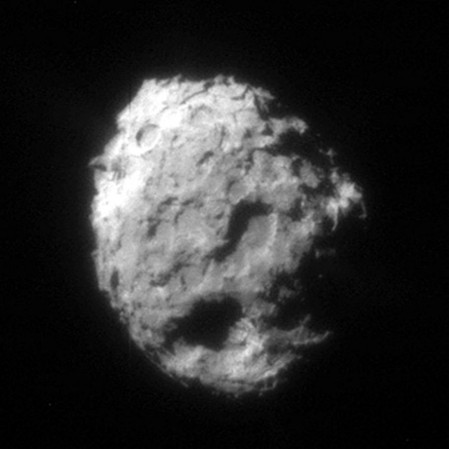
Wild 2, as photographed by Stardust. NASA NSSDCA photo gallery, 2016.
How Aerogel Captured Particles Traveling Faster than Bullets
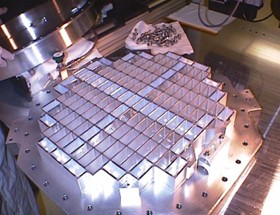
Stardust itself was not only a first-of-its-kind mission, but its instruments were unique as well. Particularly, the method for collecting samples from Wild 2 was novel and proved successful. As Stardust approached Wild 2, it would deploy a tennis-racket-sized collector. This collector resembled a tennis racket, but the space between the grids would be filled with a new, low-density, silica-based material called aerogel. Aerogel is an ultra-light gel in which the liquid part of the gel has been replaced by air. This results in the material being impressively light, nearly transparent, yet dense enough to capture and hold small particulates of dust and rock, without compromising their integrity or contaminating the sample. The aerogel collector would then stow itself within the body of Stardust after its collection mission had ended and reenter Earth’s atmosphere and safely land back on Earth, having not compromised the material it collected from Stardust.
Aerogel dust collector under construction. NASA JPL, 2005.
Some of the other equipment on board Stardust played a complementary role to the primary mission of dust sample collection. A dust analyzer served as a mass spectrometer, detecting and analyzing some of the samples collected in the aerogel in real time. A dust flux monitor could sense the size and distribution of the particles collected, with internal instruments so fine that they could detect samples as small as a few micrometers. The camera that imaged the comet used phase angles to create multidimensional images to better understand the size and depth of some impact craters on Wild 2. The camera assembly itself was a relic of the Voyager program and was the last mission to use historically significant optical machinery.
What Stardust Discovered about the Early Solar System
Stardust and the samples it collected in its aerogel chamber returned to Earth in January of 2006, nearly seven years after its launch. The samples were in better condition than originally anticipated, some of which were large enough to be seen unaided by microscopes. The samples paint a picture of a violent and ever-changing early formation of the Solar System, in which elementary particles are heated during the Sun’s formation and then blasted out into the Kuiper Belt, one of the coldest and furthest regions of the Solar System. Here, these particles collected together and the body that they formed, the comet itself, would wander the outer Solar System, being pounded and hit by other smaller bodies in the process for thousands or millions of years. Stardust now lives at the National Air and Space Museum in Washington, D.C.
Why Stardust Still Matters Today
Stardust proved that humanity could travel across the Solar System, collect material from a comet, and safely return it to Earth for study. The mission helped pave the way for modern sample-return efforts like OSIRIS-REx and continues to shape how scientists study the origins of the Solar System, the formation of planets, and even the chemical building blocks that may have helped life emerge on Earth.
About the Author