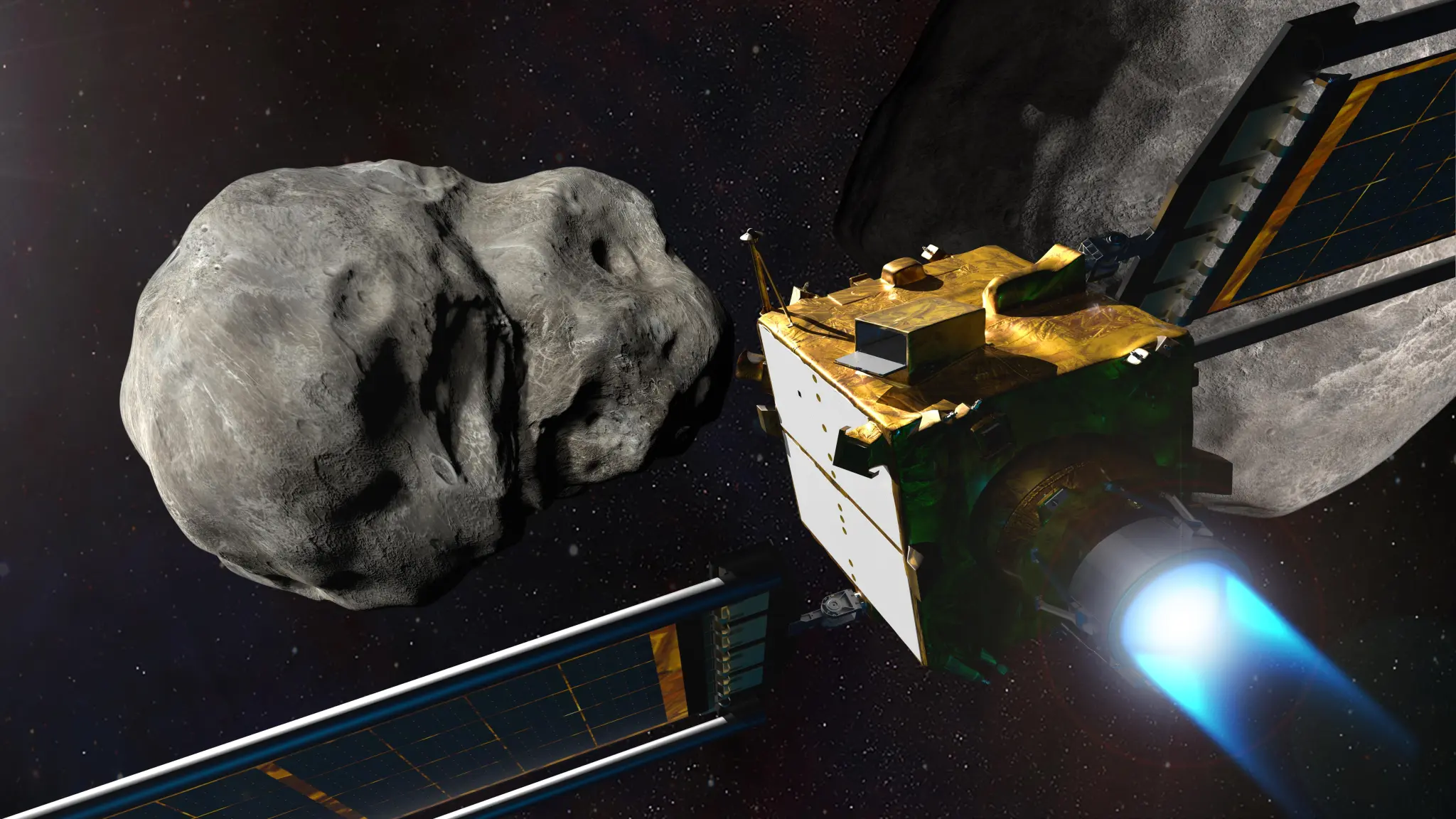
Free DART mission image from NASA
The Chicxulub crater was formed by an asteroid approximately ten kilometers wide. It crashed into Earth some sixty-six million years ago. With it, it took most of the plant and animal life, set the world on fire, and boiled away the oceans. Over the tens of millions of years that have passed, life has found a way to regenerate itself, and now a new species of animal is the predominant species on the planet: humans. Now humanity must contend with the same threat that the dinosaurs did: what to do if a planet-killing, or at the very least, a species-destroying asteroid comes crashing into Earth again. NASA’s Planetary and Defense Coordination Office aims to research and answer that question before the threat becomes a reality.
One of the current missions aimed at finding a solution to a massive asteroid or comet impactor on Earth is NASA’s Double Asteroid Redirection Test (DART). DART visited the asteroid system Didymos and attempted to alter the orbit of its moonlet, Dimorphos, by directly impacting the moonlet. While DART was conducting surveys of the system itself, the European Space Agency (ESA) had its probe, Hera, visit Didymos and Dimorphos after the DART impact to measure the crater formed by the impact and to study how the trajectory of Didymos or the orbit of Dimorphos was changed by the impact.
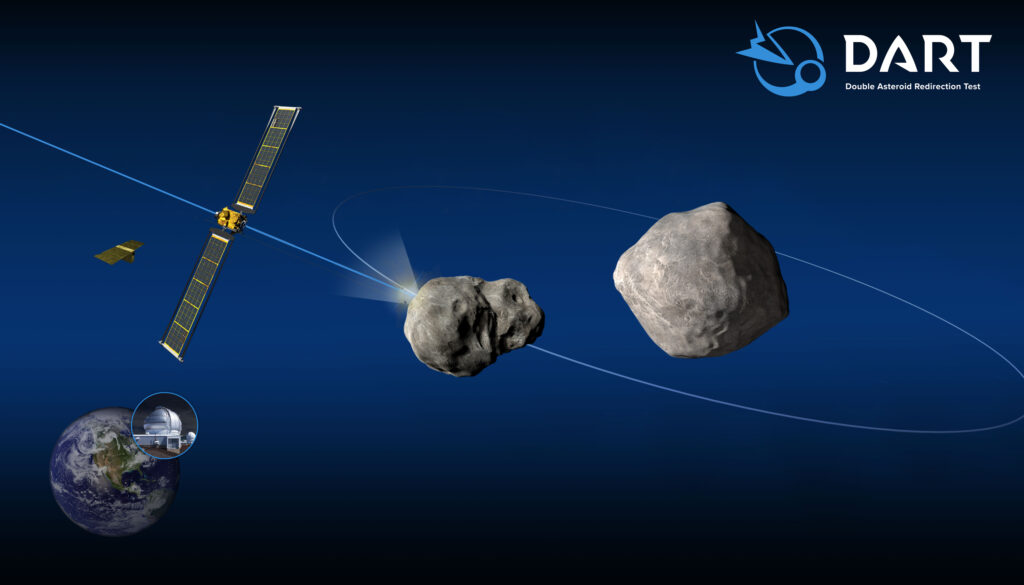
Free DART mission image from NASA
DART was not just a projectile, though. On board, it carried a smaller CubeSat, the Light Italian CubeSat for Imaging Asteroids (LICIACube), which deployed just days before the impact to capture images of the impact and monitor its movement toward the impact site. DART also carried its own imaging system to photograph the asteroid prior to the deployment of LICIACube, as well as an ion engine, an advanced solar array for power generation, and an antenna to communicate back to Earth for trajectory adjustments as impact drew near. The DART impactor itself weighed over 1,000 pounds at impact, and its goal was to accelerate Dimorphos’s orbit around Didymos by several measurable minutes. This was the primary measure of effectiveness used to determine if the mission was a success.
The information and data collected did not end after the DART impactor’s impact on Dimorphos, however. A few years after the impact, ESA’s Hera mission will visit the asteroid and its moonlet and study the crater left behind by the DART impactor by November 2026. Here, a second set of data will be collected to measure whether the DART impactor had the desired effect on Dimorphos and whether it is possible to extrapolate that data to larger asteroids or those on a direct collision course with Earth itself.
The results of the DART mission exceeded NASA’s expectations and marked the first successful demonstration of planetary defense through asteroid deflection. On September 26, 2022, the DART spacecraft intentionally collided with Dimorphos at roughly 14,000 miles per hour, successfully altering the moonlet’s orbit around the larger asteroid Didymos. Before impact, Dimorphos completed an orbit in about 11 hours and 55 minutes. After the collision, its orbital period was shortened by approximately 33 minutes! Far surpassing NASA’s minimum success threshold of just 73 seconds. The impact also produced a massive plume of debris, revealing that the ejecta amplified the collision force and transferred even more momentum to the asteroid than expected.
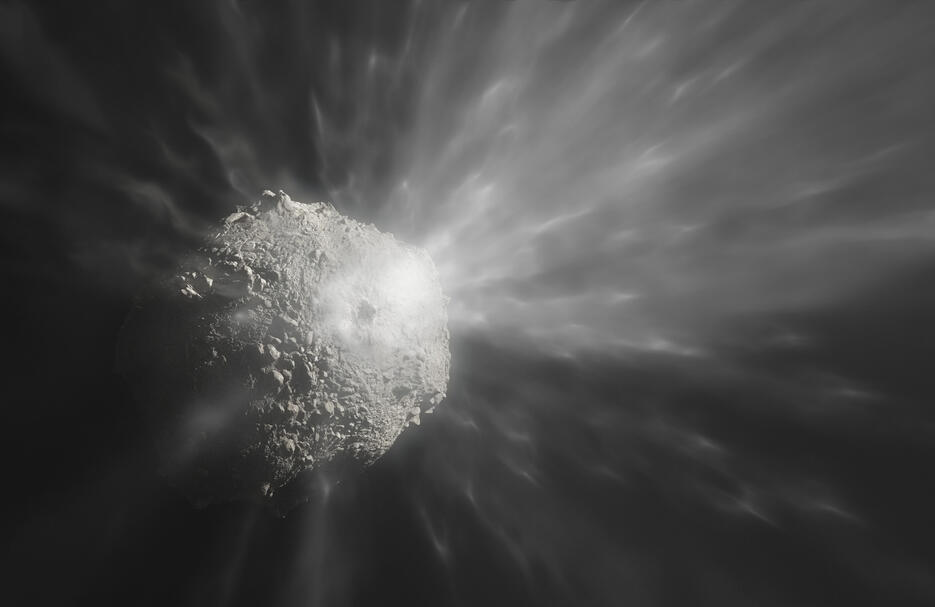
Free DART mission image from NASA
Together, these results proved that humanity possesses the technological capability to measurably alter the motion of a natural object in space, an important milestone in the development of future planetary defense systems.
NASA’s Planetary Defense Coordination Office does not exist only to slam satellites into asteroids, however. The office has a broad mission scope that requires it to monitor Near Earth Objects and collect information on their locations, composition, trajectories, and potential impacts on Earth and elsewhere in the Solar System. The office first searches for asteroids and comets, detects their movements, and tracks them through the Solar System. Then they attempt to characterize how those asteroids or comets behave based on their composition. They then plan a mission that may or may not physically visit the asteroids of greatest interest. Then, finally, the office assesses the mission results and plans a new mission or adjusts the current mission to meet the desired intent if it was not met earlier.
In the end, the Planetary Defense Coordination Office is charged with standing on guard for possible species-ending or planet-killing bodies that have already destroyed life here on Earth once, and hopefully, will not again.
FUN NOTE: If you go to Google and type in “Dart mission” in the search bar, it will show an animation of the DART probe slamming into an image on your screen and tilting the window!
About the Author