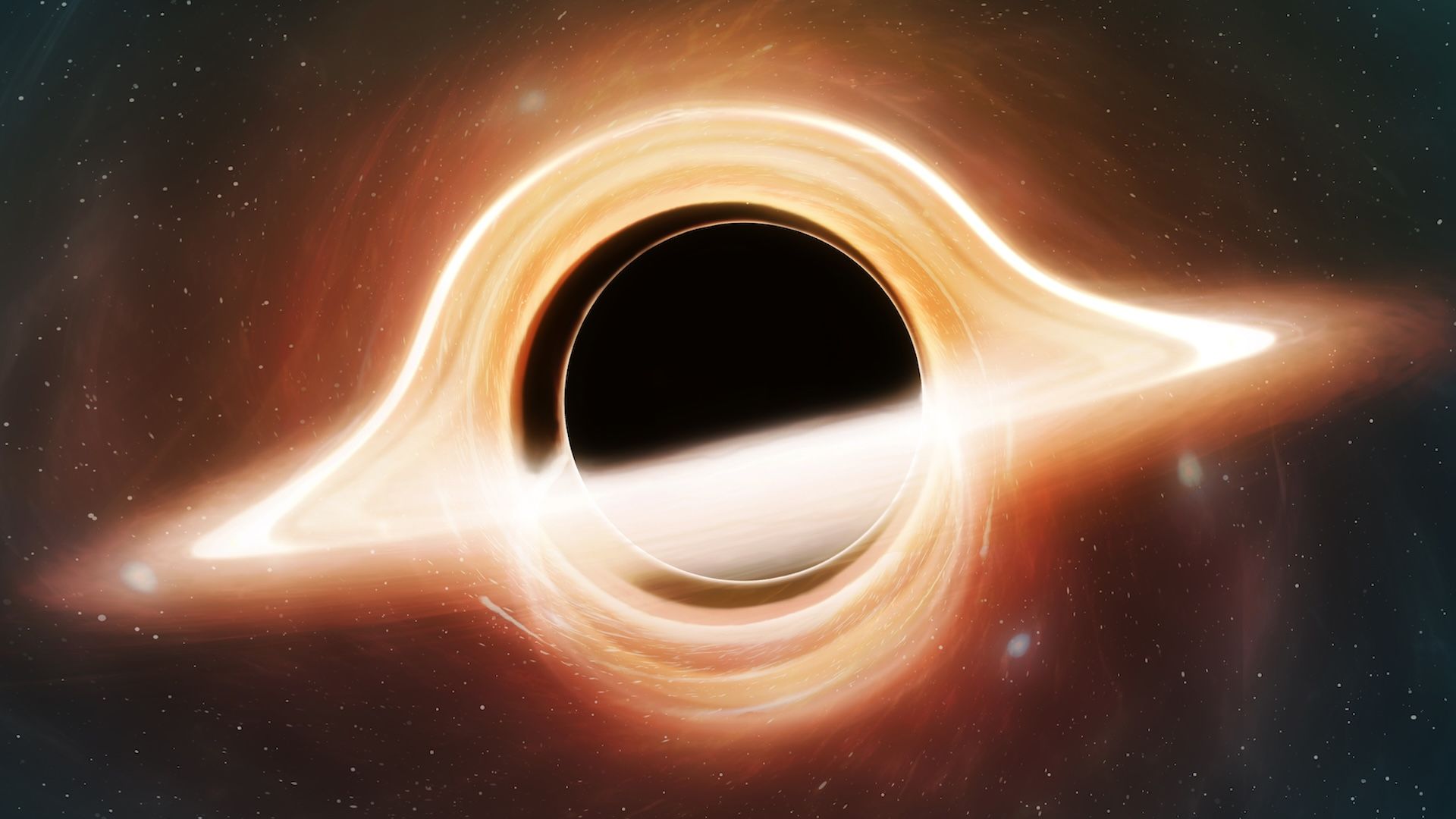
Illustration of a black hole. A black hole is a region of spacetime where the gravity is so powerful that not even light can escape them. They are created when massive stars die. This one is surrounded by an accretion disc of material, the light from which is warped by the strong gravity. Both the front of the disc and the portion behind the black hole are visible.
Given the breadth of information and depth of understanding that exists in popular culture about black holes, one could be forgiven if it is assumed that we understand nearly all there is to know about them. That is wrong, however. What is widely understood about black holes may fill an entire public library, but they are still an iceberg of mystery, of which we have only just scratched the surface. It could not be more fitting then to learn that even the origin of the term “black hole” is clouded in mystery and misunderstanding. The etymological origin creates as many competing explanations and solutions as the object itself.
Let us travel back in time to over 250 years ago. Set yourself in the untamed and nearly impenetrable jungles of Calcutta, India. There, 144 British Soldiers are taken captive by a local leader and then are thrown into a cramped and hellish cell called the “black hole”. In this desperate and suffocating environment, it was assumed that those who entered would never come out (well, come out alive at least.) That was the case for most of the British Soldiers captured there, as well as what can only be assumed to be an untold number before and after that terrible night. Thus, the “black hole of Calcutta” entered the lexicon of Western civilization.
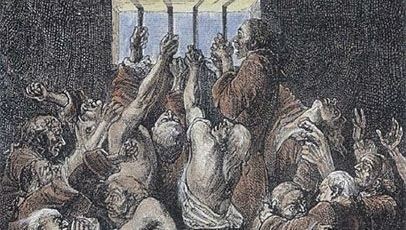
“Black Hole” British Heritage. Heydt, B. (2021)
As you might have guessed, this is probably the earliest reference to a place where what goes in never comes out. How it came to refer to those great gravitational objects that mark the fabric of space-time itself is an interesting subject. Cursory research might reveal the name of physicist John Wheeler, who is sometimes credited with lending the term “black hole” to these objects. In the book Dispatches from Planet 3: Thirty-Two (Brief) Tales on the Solar System, the Milky Way, and Beyond, author Marcia Bartusiak recounts the tale of how Wheeler began using this term. In his own admission, Wheeler admits that while using the previously common term to refer to these objects, “gravitationally collapsed objects”, during a lecture in 1967, someone in the audience suggested that he simply use the term “black hole” as a shorthand. While that may explain some of its use, it does force the question of where that suggestion had found its own origin.
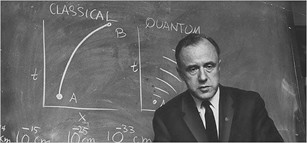
Dr. John Wheeler, source: Overbye, D. (2008). The New York Times.

Dr. Robert Dicke, source: Happer, W. (2021). Princeton University
We can trickle through other recorded uses of the term, both in print and in lecture predating that 1967 lecture, until we arrive to Robert Dicke, an astrophysicist and professor at Princeton University during the late 1950s and early 1960s. According to his biography, referring to things lost and never seen again as having fallen into the “black hole of Calcutta” was a favored expression of his. Not only did he use the term to describe an environment where gravity was so strong that neither matter nor light could escape, but also where household items had gone when misplaced or lost. Such a vivid and apt description easily spread into the common terminology of the scientific community at the time and eventually made its way to John Wheeler’s lecture several years later.
We can not be certain that Dickie was the earliest to refer to these massive gravitational objects as black holes. Perhaps he had been reading about the British conquest of the Indian sub-continent around the same time as the then theorized black holes were coming onto the scene, and joined the two identities in “holey matrimony.” Forever creatively linking the two ideas in the same way that natural philosopher Robert Hooke did in 1665, when he described the smallest functional unit of life as sharing striking similarities to the windowless and box-like rooms monks lived in. That latter being cellula, the former being “the cell”. What can be certain is that shortly after Wheeler’s use of the term, it exploded across the common scientific lexicon and forever embedded itself in the vocabulary of describing these complicated objects. Today, one can study stellar black holes, intermediate black holes, supermassive black holes, and miniature black holes. There are primordial black holes that appeared shortly after the Big Bang, and even theoretical micro black holes that exist at the quantum level.
Wheeler may not have invented or coined the term black hole in his famous 1967 lecture, but Bartusiak argues that he gave us all permission to use this less complicated and more easily understood abbreviated term. His status in the astronomical field lent the term credibility and after that lecture, he went on using the term as if everyone had agreed on it and “as though no other name ever existed” as quoted by Caltech physicist Kip Thorne. “Black hole” would not be the last attempt to summarize a complicated and informationally dense subject into an easily digestible and vividly appropriate shorthand. By the 1970s, the theory that all matter in the universe was created in a single point in the remote past through a massive explosion of material and energy became colloquially known as “the Big Bang”. One can discuss the hypothetical heat death of the universe in which no thermodynamic energy continues to exist by using “Big Chill”. It begs the question of what delightfully simple term we will use to invoke a precise set of theories, principles, or ideas in the future?
About the Author