
![[Aggregator] Downloaded image for imported item #59059](https://astrobitica.com/wp-content/uploads/2026/05/20260521_Starlink_10-31_liftoff_MC-1.jpeg)
Update May 21, 7:36 a.m. EDT (1136 UTC): SpaceX confirms deployment of the 29 Starlink satellites.
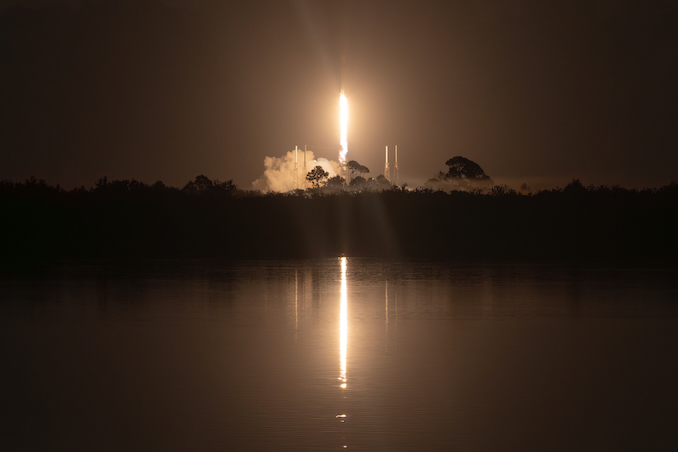
SpaceX launched a batch Starlink V2 Mini Optimized satellites on a Falcon 9 rocket from Cape Canaveral Space Force Station about 20 minutes before sunrise Thursday morning. The morning lighting illuminated the plume of the rocket in a so-called ‘jellyfish effect’ for those viewing the launch from the East Coast of the United States.
The Starlink 10-31 mission added another 29 broadband internet satellites to the low Earth orbit constellation that consists of more than 10,000 spacecraft. This was the 46th mission supporting SpaceX’s Starlink program.
Liftoff from Space Launch Complex 40 happened at 6:04 a.m. EDT (1004 UTC). The Falcon 9 rocket flew on a north-easterly trajectory.
The 45th Weather Squadron forecast a 90 percent chance for favorable conditions at liftoff. Meteorologists said they’re tracking a small chance for interference from cumulus clouds.
“A slow-moving disturbance over the Bahamas is helping supply this moisture and may also generate some convection in the early morning hours,” launch weather officers said. “These showers and associated clouds will be our main concern for violation of weather constraints on both the main and backup windows with focus on the Cumulus Cloud Rule.”

SpaceX launched the mission using the Falcon 9 first stage booster with the tail number B1077. This was its 28th flight following missions, like NASA’s Crew-5, CRS-28, and NG-20.
Nearly 8.5 minutes after liftoff, B1077 landed on the drone ship, ‘A Shortfall of Gravitas.’ This marked the 150th landing on this vessels and the 613th booster landing to date.
About the Author
