
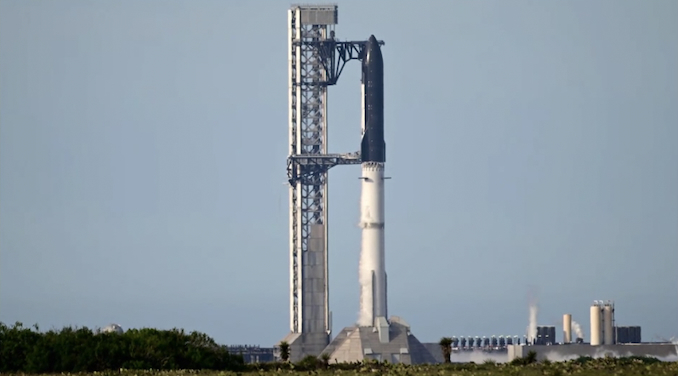
Update May 21, 8:03 p.m. EDT (0003 UTC): SpaceX scrubbed the mission after dipping in and out of multiple holds at T-minus 40 seconds.
SpaceX stood down from its first attempt to launch the third generation of its Starship rocket Thursday, May 21, from its company town in southern Texas, called Starbase.
The company ran into multiple issues during the final minute of the countdown and ultimately scrubbed the mission at about 6:40 p.m. CDT (7:40 p.m. EDT / 2340 UTC) after exhausting the remaining troubleshooting time.
“The hydraulic pin holding the tower arm in place did not retract,” SpaceX founder and CEO Elon Musk wrote on his social media site, X, shortly after the scrub. “If that can be fixed tonight, there will be another launch attempt tomorrow at 5:30 CT.”
When all is ready, the 407-foot-tall (124 m) two-stage rocket will fly on a suborbital mission dubbed Flight 12. The mission will see the Super Heavy booster (Booster 19) splashdown in the Gulf of Mexico and the Starship upper stage (Ship 39) meet its own aquatic end in the Indian Ocean.
Liftoff is scheduled during a launch window that opens at 5:30 p.m. CDT (6:30 p.m. EDT / 2230 UTC) on Friday, May 22, if all goes well with the overnight repairs.
Following five flights of Starship Version 2 in 2025, the company progressed to the next block upgrade of the rocket after extensive testing, including two separate explosive set backs on the test stand, which destroyed a Super Heavy Booster and a Starship.
Because this is the introduction of a new version, Booster 19 will not return for a catch attempt back at Pad 2. Instead, it will land in the Gulf about seven minutes after taking off.
In a filing with the U.S. Securities and Exchange Commission (SEC) on Wednesday, SpaceX noted that it invested more than $15 billion into Starship development. The company said it was ramping up the research and development work on the rocket, which is designed to be fully reusable.
“In 2025, our Space segment generated a loss from operations of $657 million and Segment Adjusted EBITDA of $653 million, including the impact of funding [$3 billion] in research and development expense for our next-generation Starship launch vehicle program,” the company wrote.
SpaceX expects Starship to be capable of carrying 100 metric tons or more of payload into orbit eventually with Version 3.
For this 12th test flight, 20 Starlink simulator satellites will be deployed on a sub-orbital trajectory over a roughly 10-minute period, starting about 17 minutes into the flight. Two additional satellites, described by SpaceX as “modified Starlinks” will be released to “attempt to scan Starship’s heat shield and transmit imagery down to operators to test methods of analyzing Starship’s heat shield readiness for return to launch site on future missions. Several tiles on Starship have been painted white to simulate missing tiles and serve as imaging targets in the test.”
Like on recent Starship flight, SpaceX also plans to perform a relight of one of the Raptor engines on Ship 39 while it’s in a coast period. That will happen nearly 39 minutes into the mission.
This engine demo will help inform future deorbiting burns once SpaceX begins launching Starship on orbital trajectories.
Finally, Ship 39 will target a controlled splashdown in the Indian Ocean more than an hour after launching from Texas. SpaceX previously said that if all goes well with Flight 12, Flight 13 may be an orbital launch, but that has yet to be determined.
This post was originally published on this site