D2D services are at risk of becoming too complicated and siloed

At the recent Mobile World Conference 2026 in Barcelona, the strong presence of Direct-to-Device (D2D) satellite services and the avalanche of press releases related to contracts signed between D2D satellite service providers and Mobile Network Operators (MNOs) gave the impression that large scale implementation of D2D services by MNOs is imminent. However, the truth is […] The post D2D services are at risk of becoming too complicated and siloed appeared first on SpaceNews.

Live coverage: SpaceX attempts 600th Falcon booster landing amid West Coast Starlink mission

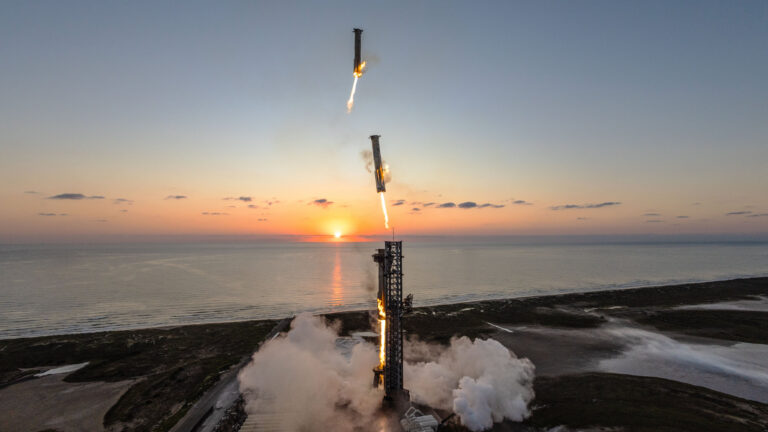
File: SpaceX’s Falcon 9 rocket stands at Space Launch Complex 4 East at Vandenberg Space Force Base ahead of the Starlink 17-31 mission on March 13, 2026. Image: SpaceX SpaceX is positioned to complete its 600th Falcon booster landing during a Starlink mission planned for Saturday morning. The Falcon 9 rocket will fly on a south-southwesterly trajectory upon departure from Vandenberg Space Force Base. The Starlink 17-22 mission will add another 25 broadband internet satellites Continue ReadingLive coverage: SpaceX attempts 600th Falcon booster landing amid West Coast Starlink mission

How a Black Hole and a Shredded Star Could Light Up a Galaxy

In 2014, a strange cloudy object called G2 made a close approach to Sagittarius A*, (Sag A*) the supermassive black hole at the heart of the Milky Way Galaxy. Astronomers were pretty excited, partly because they thought it might get torn apart by Sag A*’s intense gravitational pull. That didn’t happen, and the event was a cosmic fizzle. Instead, G2 skipped around the black hole. Various observations showed that it wasn’t just a gas cloud. It was likely a dusty protostellar object encased in a dusty cloud. Or perhaps several merged stars. But, it survived the flyby and continued on a shortened orbit.

Small Trojan Asteroids Defy Expectations

Understanding the beginning of the solar system requires us to look at some very strange places. One such place is at the so-called “Trojan” asteroids that share Jupiter’s orbit in front of and behind it. But for a long time, these cosmic time capsules have held a mystery for astronomers: why are they color-coded? The populations of larger asteroids are very clear split into two distinct groups – the “reds” and the “less reds”, because apparently they’re all red to some extent. A new paper from researchers in Japan tried to solve this mystery by taking a close look at even smaller asteroids, and their findings, published in a recent edition of The Astronomical Journal, actually brings up a completely different question – why don’t smaller Trojan asteroids have the same color-coding?

Life Beyond Biosignatures: A New Method In The Search For Life

Researchers from the Earth-Life Science Institute (ELSI) and National Institute for Basic Biology have developed a new method to detect extraterrestrial life without relying on traditional biosignatures. By modelling how life might spread between planets, they demonstrate that life could be detected through statistical patterns across planetary populations rather than on individual planets. This “agnostic biosignature” approach could assist in guiding future searches for life beyond Earth.

Comet R3 PanSTARRS at Perihelion

We’re one comet down, and one to go for spring season 2026. We recently wrote about prospects for sungrazer C/2026 A1 MAPS and comet C/2025 R3 Pan-STARRS in April 2026. While the bad news is, Comet A1 MAPS disintegrated like so many sungrazers before it during its blistering close perihelion passage on April 4th, comet R3 Pan-STARRS put on an amazing dawn showing for early rising astrophotographers.

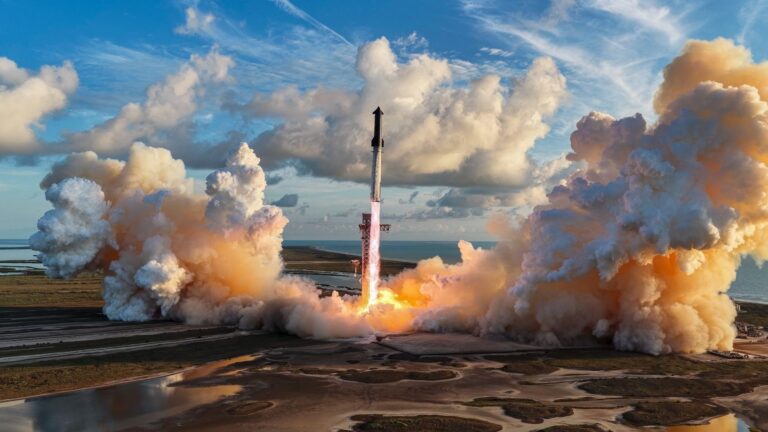
Rocket Report: Starship V3 test-fired; ESA’s tentative step toward crew launch

Welcome to Edition 8.37 of the Rocket Report! NASA is still climbing down from the high of the Artemis II mission, the first flight by humans to the Moon since 1972. What a mission it was! Now, attention turns to completing development of a lander to get astronauts down to the Moon’s surface. Among other things, we chronicle the latest progress of NASA’s two lunar lander contractors, SpaceX and Blue Origin, in this week’s Rocket Continue ReadingRocket Report: Starship V3 test-fired; ESA’s tentative step toward crew launch