Science begins with discovery. The discovery of some new thing, insight, or question drags us forward into unknown territory, fraught with hurdles, obstacles, and more questions. But as we progress in these new lands of discovery, we will inevitably encounter objects once mysterious and unfamiliar. It is the duty then, of all scientists to understand, describe, and organize these new findings so that the scientists who follow us can build on our knowledge and drive us ever forward.
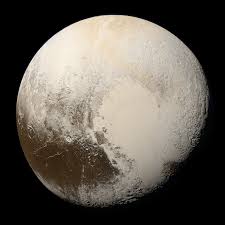
Such was the case with our once beloved ninth planet, Pluto. Prior to its discovery, what astronomers were looking at in the sky had few definitions. There were stars, of course, and planets, and even comets. Then what else could this rather small body be except a planet? But what begged astronomers to consider was the discovery of other similar bodies in the Solar System at different distances from the Sun. Afterall, if Pluto was a planet, what about Ceres, or Eris that is bigger and more massive than Pluto, or even the Moon which is bigger still for that matter?
By the 1990s, the number of objects being identified in the Solar System had begun to skyrocket, and theories about just how much was to be discovered in the Universe continued to grow. It became apparent that not everything that broadly met the current definition of planet could remain so. Then in 2006, astronomers from around the world met in Prague to settle the issue once and for all (at least for now) on just how many planets our Solar System had and how we could characterize, classify, and catalog those objects.
Three rules about what could be considered a planet came out of that meeting.
One, it had to orbit the Sun. In the future, we will likely apply that to celestial bodies orbiting other stars. Though that does leave one strike against rogue planets, or planets wandering the galaxy between the stars.
Two, it had to have enough mass to assume a round or nearly round shape. Asteroids and their numerous and nearly snowflake-like ability to take on every unique shape imaginable were off the list.
Finally, three, it had to be so dominant in its orbital path that it cleared away any other massive body that could challenge its stature as a planet in that neighborhood.
Pluto did not make the list. Neither did Ceres, nor Eris, nor the Moon. The Solar System had eight planets: Mercury, Venus, Earth, Mars, Jupiter, Saturn, Uranus, and Neptune. A rather large contingent of asteroids orbited the Sun in the asteroid belt between Mars and Jupiter, of which they could now count Ceres as the most massive of these asteroids; a “dwarf planet” as a consolation prize. The Kuiper belt of icy trans-Neptunian objects would be home to other dwarf planets, Pluto, and Eris, among them. The Moon was ruled out completely as a planet, as it orbited the Earth and not the Sun directly.
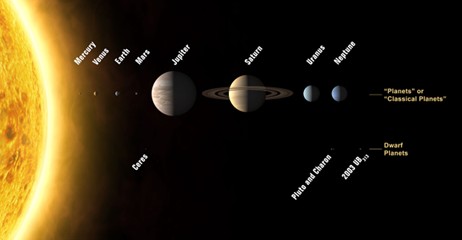
The Solar System’s eight planets and some dwarf planets. Source: IAU, 2006
It was rule three that led to the demise of Pluto. While the dwarf planet did orbit the Sun and was so massive as to form a nearly round shape, it was the orbital path that demoted it. Pluto’s path intersects with other massive bodies in the Kuiper belt and even the ice giant of Neptune. To classify Pluto as a planet then would call into question Neptune’s status, and almost no one would question a world as great as that as being a planet or not.
The important thing that came out of the Prague meeting in 2006 however, was not whether Pluto was a planet or not, but that scientists had examined the evidence and through a logical and empirical method set out a series of rules that they would all follow in the future to define the world around them. The “taxonomy” of celestial bodies entered a new phase and scientists had a new starting point to begin the cataloging of the new worlds that were being discovered every day.
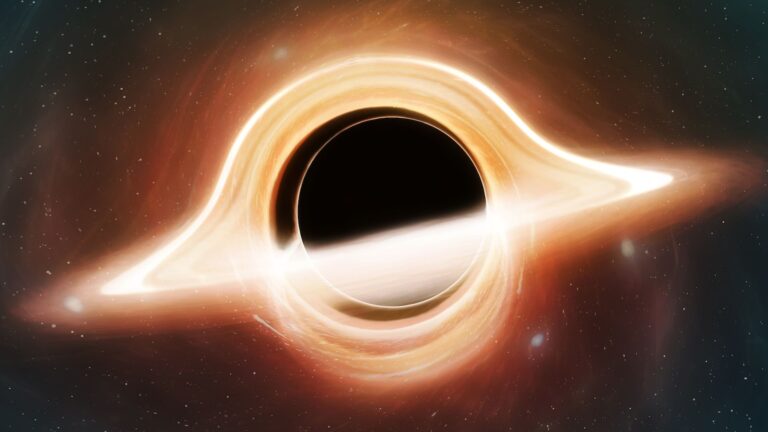
Now, as the exploration of not only our Solar System, but systems of planets and stars across the galaxy, and across the universe for that matter, accelerates, we may be forced to create new rules and new definitions of the things we are sure to discover. As hinted earlier, what of rogue planets? Planets shot out of their star systems and now wander the interstellar and intergalactic voids between systems? If they are not orbiting a star, can we call them a planet? Are they now just extremely large asteroids? What if they are the size of Jupiter? Do we lump all interstellar objects into one family regardless of size? That does not seem very scientific. What of bodies that orbit binary star systems or black holes even? Does it require a single star at the center of a system to qualify objects around it as planets or is it any object so gravitationally massive that it can hold a Jupiter in orbit? These questions, and more that have even yet to be dreamed of, will have to be answered at some point in the future. It will be the duty of those scientists in the future to stand on the shoulders of their predecessors and create the rules that will define the strange new worlds we discover in the future.
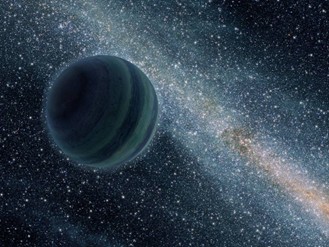
A rogue planet wonders interstellar space. Source: NASA, 2021.
Pluto may have met the definition of the planet in the past. But science is not static. As we learn more about the world around us and new information becomes available to us, we must sometimes reexamine what we assume to know. If we begin from a point of scientific integrity and earnestly attempt to bring order to a sometimes unorderly world, we can be assured we are doing a genuine service to the generations of thinkers, learners, and explores that come after us.
About the Author