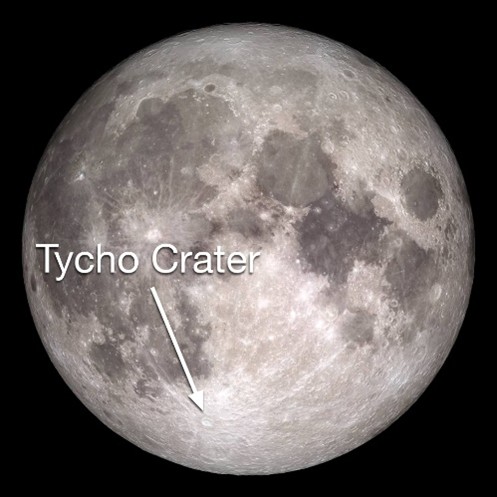
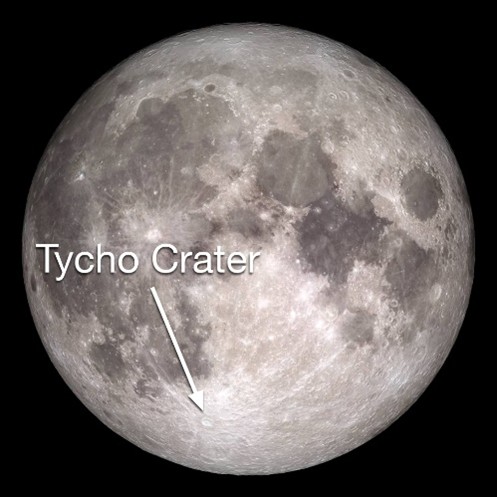
One of the brightest and most prominent features on the Lunar surface that is visible from a Terran perspective is Tycho Crater. Appearing on Lunar maps as early as the 17th century, and likely identified and gazed at for centuries before then, the crater is one of the most easily identifiable and clearly visible impact craters that humanity can study.
Located in the southern highlands of the Moon, Tycho Crater has clearly defined characteristics, such as steep ridges around the perimeter of the original impact and bright rays stretching hundreds of kilometers in all directions. The central peak of the crater, where a large amount of the ejecta fell neatly back into the center of the impact, stands high enough off the Lunar surface that it is even visible to the naked eye from the surface of the Earth. This is because the crater is likely only 108-109 million years old. A fraction of the Moon’s nearly 4-billion-year-old history. “Younger” craters like Tycho are still so clearly visible due there being less geological erosion, where older craters or impact basins get smoothed over and their features less defined. Additionally, younger craters are less likely to have been covered by the ejecta from impacts that happened after them.
Large impacts blast tons of pulverized and sometimes molten material up, and that comes crashing down on the surface of the body of the original impact. This ejecta can cover up older craters and features and it may not be possible to even view those older craters without digging below the surface. That Tycho happened so recently, in a relative galactic time scale, means that its features remained mostly intact, until some larger impactor comes along in a few million or billion years to cover them up. Further, Solar rays can degrade the clarity and brightness of some of the rays that reach out from the crater. Another testament to the “youth” of Tycho, in that so many of the rays have not been fully degraded by Solar weather.
The origin of Tycho crater is still unknown and it may be impossible to ever know exactly what impactor created such a brilliant and thoroughly studied crater on the Moon. The gravitational effects from the Solar System’s inner planets can cause dynamic shifts in the orbits of inner Solar System asteroids. With that being the case, it may be difficult to determine the origin of an asteroid or comet that would have had the size significance to create an impact as large as Tycho.
The Apollo 17 Moon landing mission briefly studied whether a landing at Tycho crater would have been feasible. However, given the crater’s youth, as detailed above, it was determined that the site was likely still very rough, making a lunar landing hazardous and thus a significant concern. The Taurus-Littrow Valley, approximately 2,000 kilometers away from Tycho, was the eventual landing site for Apollo 17. That is not to say that studying Tycho at such close range was eliminated. One of the rays emanating from Tycho stretched through the Apollo 17 landing site, and samples collected there are believed to be from the original impact that created the crater more than one hundred million years ago.
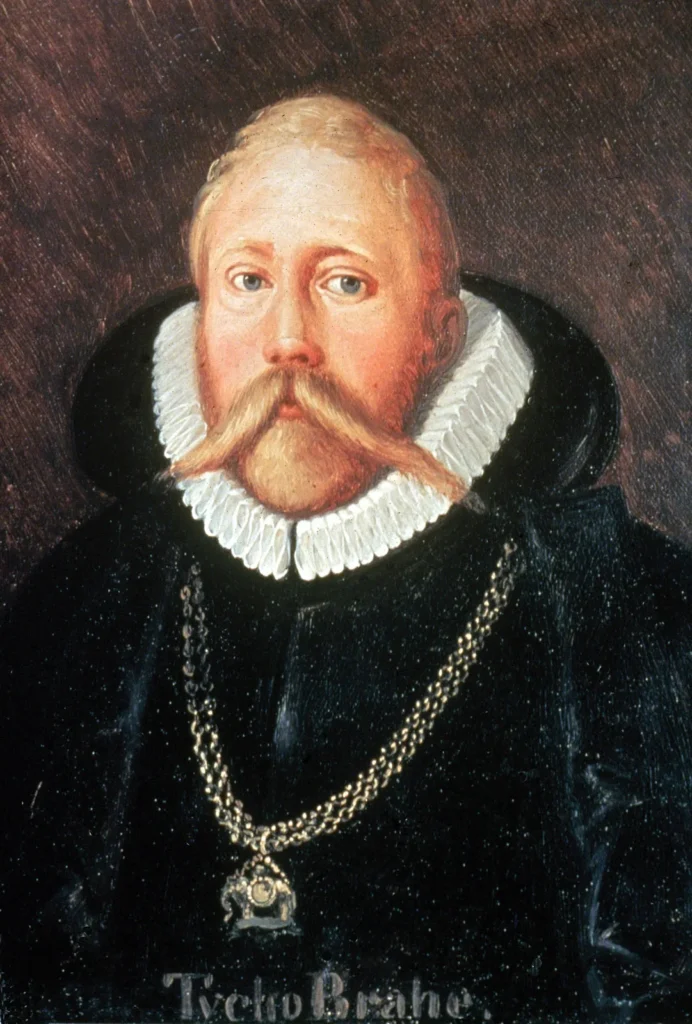
Finally, contrary to the widely accepted belief, the crater was not discovered or named by the Danish astronomer Tycho Brahe. The Jesuit astronomer Giovanni Riccioli created a naming system for geographical and geological observations made of the Moon and named the crater after Brahe some fifty years after the astronomer’s death.
About the Author