Update Sept. 16, 9:40 p.m. EDT (0140 UTC): SpaceX landed the booster on the droneship.
Update Sept. 15, 9:05 p.m. EDT (0105 UTC): SpaceX scrubbed the launch attempt for the mission prior to fueling; targets backup opportunity on Wednesday, Sept. 16.
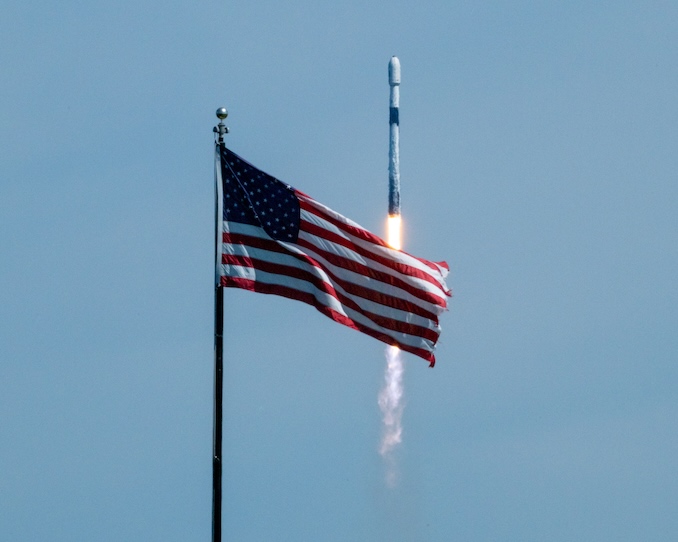
SpaceX launched a Falcon 9 rocket from Vandenberg Space Force Base in California Wednesday night on a national security mission for the U.S. Space Force. The mission reset after a Tuesday launch attempt was scrubbed prior to fueling due to an unexplained issue.
Liftoff of the USSF-259 mission happened at at 6:07:56 p.m. PDT / 9:07:56 p.m. EDT on Sept. 16 (0107:56 UTC on Sept. 17). The rocket flew on a southerly trajectory upon leaving Space Launch Complex 4E.
The mission’s classified payload is expected to be deployed into a low Earth orbit, inclined roughly 80 degrees from the Equator. It will be SpaceX’s third launch in a month procured by the U.S. Space Force’s Space Systems Command (SSC) through the National Security Space Launch (NSSL) Phase 3 Lane 1 contract.
To date, SSC has declined to confirm any details about these missions, which also included USSF-366 (launched Aug. 15) and USSF-153 (launched Sept. 10). Those missions were identified as R1 and R2 in public documents and each flight carried 23 satellites. USSF-259 is identified in the same documents as TH-1. A mission designated R-3 is scheduled for Sept. 27.
SpaceX launched the mission using the Falcon 9 first stage B1097. This was its 13th flight after previously launching NROL-172, Twilight, Transporter-17, Sentinel-6B, and eight batches of Starlink satellites.
Nearly 8.5 minutes after liftoff, B1097 landed on the droneship, Of Course I Still Love You, positioned in the Pacific Ocean. This was the 224th landing on this vessel and the 661st Falcon booster landing to date.
About the Author