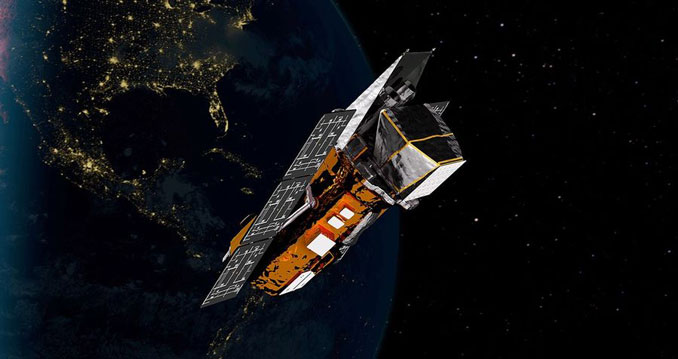
A satellite designed to live two years and named for its speed is ending its life slowly and then with a blistering pace. Unable to steer and unable to observe, NASA’s Neil Gehrels Swift Observatory is sinking a few miles a day toward an uncontrolled reentry expected this week.
As of Monday, the U.S. Space Force predicted Swift would re-enter Earth’s atmosphere at approximately 3:30 a.m. EST Wednesday, Nov. 4, somewhere within about 21 degrees north or south of the equator — a band that is mostly ocean.
According to NASA, most of the roughly 1.6-ton spacecraft will burn up during reentry, when Swift will live up to its name one last time as it slams into the atmosphere at about 17,000 mph.
“NASA expects most of the spacecraft to burn up as it travels through the atmosphere, but some components are expected to survive re-entry,” Elizabeth Shaw, an agency spokesperson, said in a statement. “The risk of harm coming to anyone on Earth is unlikely, approximately 1 in 2,100. NASA and the Space Force will continue to monitor the re-entry and update predictions.”
Swift has no engine. Hundreds of miles up, the air is thin but not empty, and each molecule Swift strikes costs it speed, dropping it into denser air that slows it faster still. The sun hastened the fall. Solar activity heats and swells the upper atmosphere, and this cycle produced more drag than expected, NASA said.
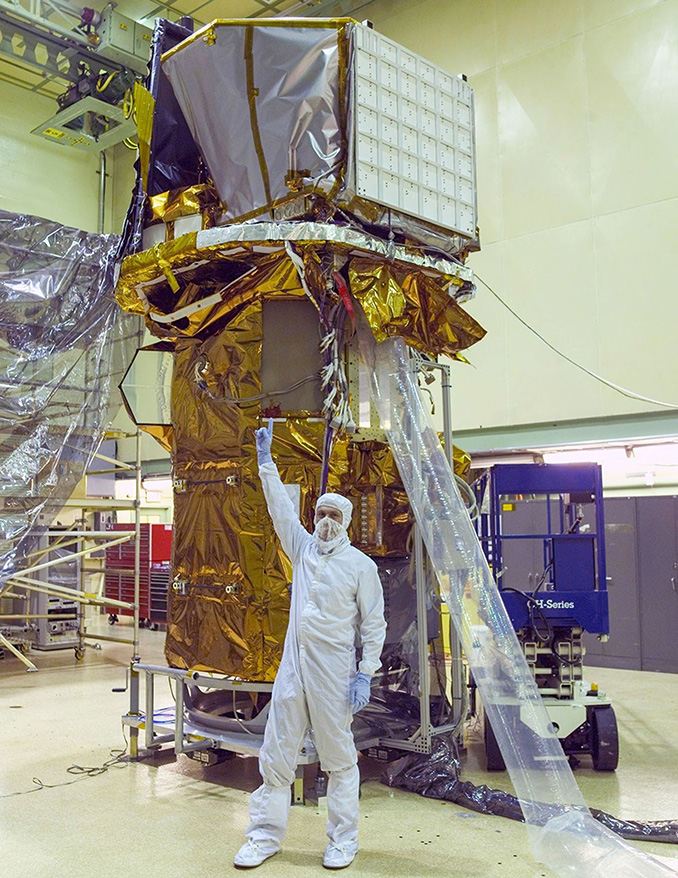
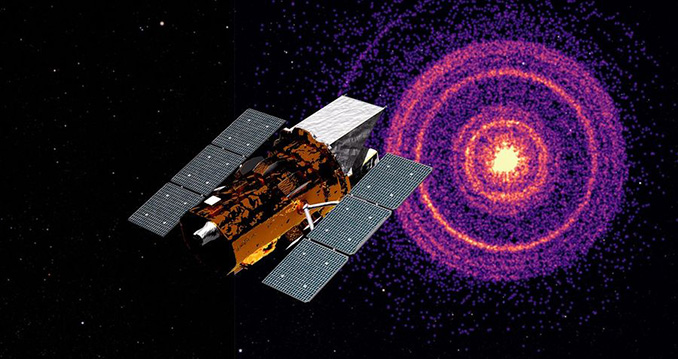
For nearly 22 years, Swift was the telescope NASA counted on to react first when gamma-ray bursts — the most powerful explosions in the universe — lit up the far reaches of space outside the Milky Way, acting as a kind of space-based finder scope for Earth-based observatories and furthering breakthrough research cited in thousands of scientific papers. The agency has named no successor to Swift, which employed a gamma-ray detector, an X-ray telescope and a combination ultraviolet/optical telescope.
Penn State operators bought Swift time by halting most science from February to late August and turning Swift to slip through the thin air, hoping to keep it high enough for a planned rescue. NASA had paid Katalyst Space $30 million to send a robotic spacecraft to grab Swift and push it higher, but the Katalyst-built tug lost control of its orientation weeks after its July 3 launch, and NASA called off the capture Aug. 19.
Swift made its final observation Oct. 20. At an altitude 171 miles above Earth, it fell into safe mode, and Penn State sent a command that effectively ended Swift’s mission.
When the observatory rocketed to space atop a Delta II rocket more than two decades ago, that primary mission to pinpoint gamma-ray bursts was only set to last two years. Far outlasting that initial time frame, Swift would go on to observe more than 2,000 gamma-ray bursts, study more than 1,400 supernovas and examine everything from active galaxies to asteroids and comets.
“Swift delivered an incredible, lasting return on investment for the nation, designed for a two-year primary mission but productive for more than 10 times as long,” Shawn Domagal-Goldman, director of the Astrophysics Division at NASA Headquarters, said. “In that time, Swift played a major role in advancing our understanding of the changing universe and was part of a revolution in astrophysics that showed how critical rapid-response observations are to the entire community.”
After Swift made its final observation last month, Swift principal investigator and NASA Goddard Space Flight Center astrophysicist Brad Cenko reflected on the spacecraft’s unique capabilities, especially its rapid-response role.
“Swift was designed as a satellite dedicated to studying gamma-ray bursts, outbursts that came and went so quickly that no one could target them with large telescopes to learn more,” Cenko said last month. “Swift needed to detect and locate gamma-ray bursts, communicate their position to other observatories, and then swing its telescopes around to image the burst locations before their afterglows faded out. This typically took Swift about a minute to do.”
Swift’s archive, about 12 terabytes of data cited in roughly 7,000 scientific papers, holds some of the era’s signature astronomical discoveries.
In 2005, Swift caught the first afterglow ever seen from a short gamma-ray burst, a flash lasting three-hundredths of a second, supporting the idea that such bursts come from colliding neutron stars. In 2008, it spotted a burst 7.5 billion light-years away that briefly grew bright enough to see with the naked eye. And in 2017, after gravitational-wave detectors sensed two neutron stars merge, Swift observed unexpectedly bright ultraviolet light from the wreckage.
NASA’s Hubble Space Telescope takes at least a day or two to turn toward a new target, while Swift could follow up on “things that go bump in the night within minutes,” Cenko said.
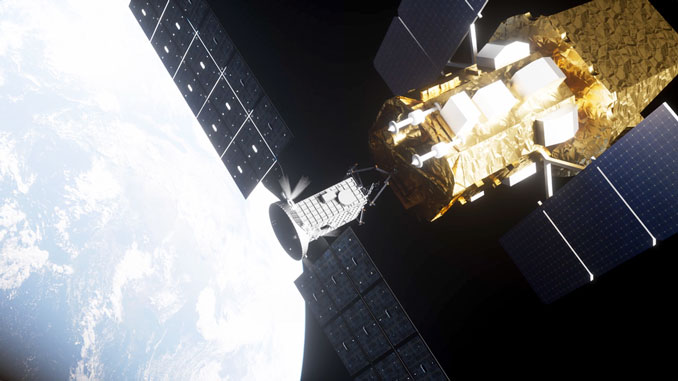
That unique capability helped push NASA to pursue a rescue mission.
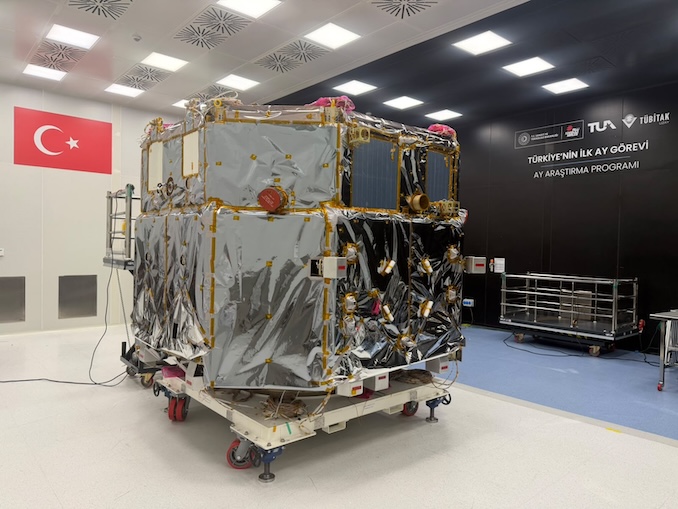
Katalyst, the firm tapped in 2025 by NASA to pull it off, built its LINK spacecraft in less than a year and launched it on the last Pegasus XL rocket, dropped from a jet near Kwajalein Atoll in the Marshall Islands because Swift’s low, tilted orbit is hard to reach from launch sites like Kennedy Space Center in Florida. The rescue plan called for LINK’s three robotic arms to clamp onto a fitting used to handle Swift on the ground, then for its electric thrusters to push the pair about 370 miles high, thus buying Swift more time in low Earth orbit.
About a week into the mission, however, a power switch tied to LINK’s reaction wheels failed, LINK principal investigator Kieran Wilson told a National Academies committee in September. By late July, the spacecraft was tumbling once every 40 seconds. Engineers stopped the spin with its thrusters, and in early September LINK unfolded all three arms and closed within about 7 to 9 miles of Swift before it, too, fell from orbit.
“This is not the outcome we were working toward, but it does not change why this mission was worth attempting,” NASA Administrator Jared Isaacman said at the time.
The doomed Swift rescue was, according to NASA, meant to advance commercial satellite servicing, especially with an eye toward other famed spacecraft such as Hubble, and a successful capture would have marked the first time a commercial robot rendezvoused with and grabbed a government satellite never designed to be serviced.
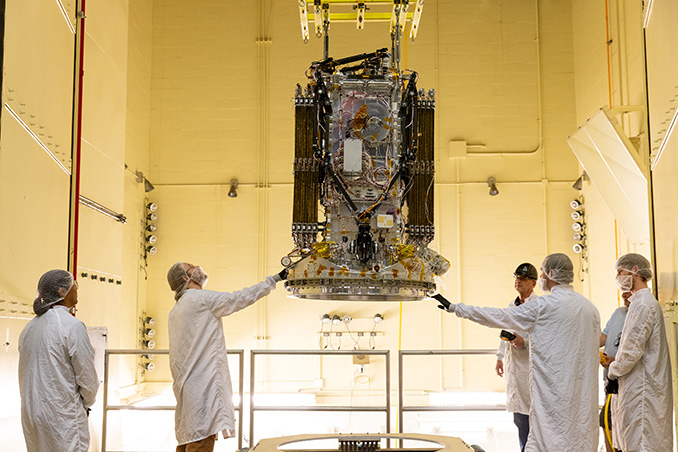
Image: NASA/Scott Wiessinger.
“This collaboration may open the door to extending the life of more spacecraft in the future,” Clayton Turner, who leads NASA’s space technology directorate, said when the Katalyst contract was awarded in 2025.
Hubble, which has spent the past 36 years making landmark scientific discoveries while completing more than 200,000 revolutions around the planet, is also engineless and falling. Since June 2024, it has operated on a single healthy gyroscope, holding a second in reserve.
Weeks before LINK launched, Domagal-Goldman told an agency advisory committee that reboost costs were “lower than I think I anticipated” and that “we are open to a reboost of Hubble.”
In terms of what comes next after Swift succumbs to the inevitable pull of Earth’s atmosphere and gravity later this week, NASA officials have said only that the agency will use “current missions to fill the gap.”
With NASA expecting Hubble to fall back to Earth sometime between 2033 and 2034, the agency on Oct. 29 asked companies how they might boost Hubble to a higher orbit, service it or steer it to a controlled re-entry, saying a mission would need to fly by 2032.
“Hubble still has important science ahead of it,” Isaacman said.
Ahead of Swift’s approaching fall from orbit, agency officials were quick to celebrate its legacy of achievement — one which far outstripped initial predictions both in duration and substance.
“During nearly 22 years of science operations, Swift served as a multi-tool for exploring the universe – observing a wide range of light, rapidly pointing at short-lived outbursts, and sending alerts to other facilities to help coordinate follow-up observations,” Shaw said. “Swift has broadened our understanding of a wide variety of cosmic objects and events, from active galaxies powered by supermassive black holes and stars undergoing X-ray flares, to supernova explosions and comets and asteroids in our own solar system.”
About the Author