![[Aggregator] Downloaded image for imported item #86730](https://astrobitica.com/wp-content/uploads/2026/09/09172026.png)
Looking for a sky event this week? Check out our full Sky This Week column.
September 16: Triangle in the sky
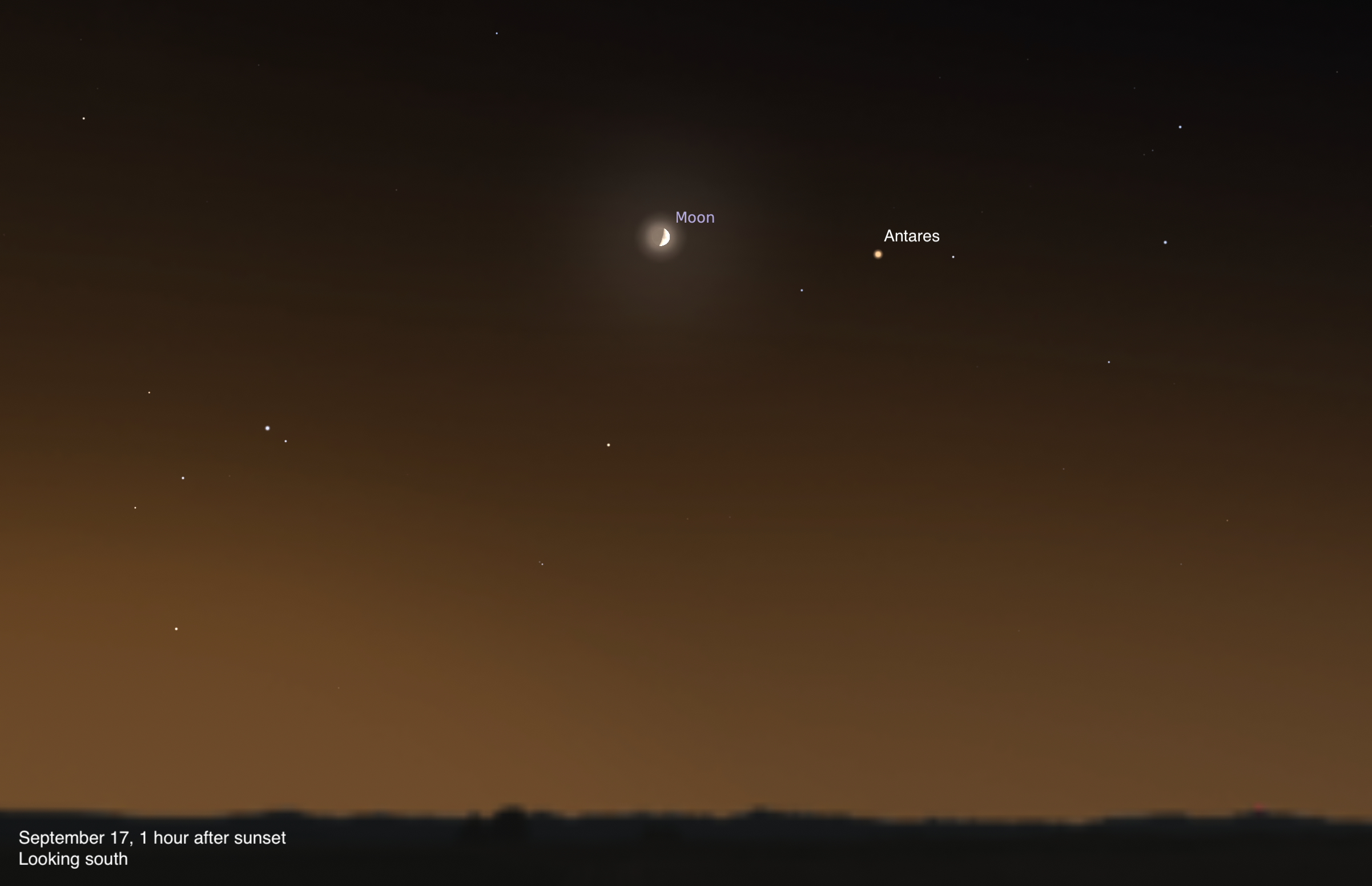
The Moon passes 0.6° south of the bright star Antares at 9 A.M. EDT. By evening, our satellite sits near the border of Scorpius and Ophiuchus, some 6° east (to the upper left) of Antares. They make a lovely pair: a bright red giant star and the waxing crescent Moon, some 15° high in the south an hour after sunset. Once it’s fully dark, see if you’re able to make out the entire long, curving form of Scorpius, with its claws to the right of Antares and its tail to the lower left, closer to the horizon. Antares, Scorpius’ alpha star, is often envisioned as the Scorpion’s heart.
Antares and the Moon remain visible for roughly three hours after sunset, setting around 10:15 P.M. local daylight time. Red giant Antares glows visibly orange-red and is often mistaken for the planet Mars. The Red Planet, however, is currently a morning object, rising around 1:30 A.M. local daylight time and visible in the hours before sunrise.
By the hour, the Moon is moving east, crossing southern Ophiuchus and pulling away from Scorpius and its heart. Our satellite covers an average of 13° per day on the sky as it orbits Earth, appearing to track quickly across the constellations over the course of a little more than a month. It is heading for Sagittarius next, and will sit just off the spout of that constellation’s Teapot asterism tomorrow night.
Sunrise: 6:43 A.M.
Sunset: 7:05 P.M.
Moonrise: 1:41 P.M.
Moonset: 10:29 P.M.
Moon Phase: Waxing crescent (43%)
*Times for sunrise, sunset, moonrise, and moonset are given in local time from 40° N 90° W. The Moon’s illumination is given at 10 P.M. local time from the same location.
Alison Klesman is senior editor of Astronomy magazine. She holds a Ph.D. in astronomy and has studied a variety of topics, from minor planets to supermassive black holes.
About the Author