The Sky Today on Friday, May 22: Busy moons around Jupiter

Looking for a sky event this week? Check out our full Sky This Week column.  May 21: Check in on Saturn and Mars Tonight we’re focused on Jupiter, as two of its Galilean moons cross the planet’ disk this evening. East Coast observers can zoom in on the gas giant shortly after sunset to see Io aloneContinue reading “The Sky Today on Friday, May 22: Busy moons around Jupiter” The post The Sky Today on Friday, May Continue ReadingThe Sky Today on Friday, May 22: Busy moons around Jupiter

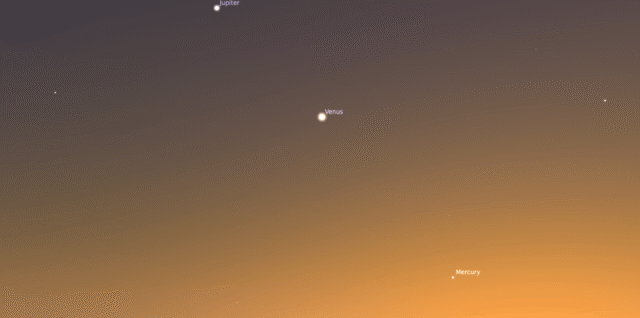
The Sky This Week from May 22 to 29: Mercury reappearing

Sky This Week is brought to you in part by Celestron. Friday, May 22Uranus is in conjunction with the Sun at 10 A.M. EDT, so it is not currently visible in our sky. It will return in June, when it will appear in the predawn hours.  The famous Summer Triangle asterism, bounded by the brightContinue reading “The Sky This Week from May 22 to 29: Mercury reappearing” The post The Sky This Week from May Continue ReadingThe Sky This Week from May 22 to 29: Mercury reappearing

July 2026: What’s in the sky this month? Venus and Jupiter are visible in the evening, plus a conjunction of Mars and Uranus before dawn

Venus and Jupiter remain visible in the evening sky soon after sunset early in July, although Jupiter fairly quickly drops out of sight. In the morning sky there’s lots of planetary action: Saturn rises earlier now, placing it in a dark sky for a couple of hours. Neptune joins it in Pisces. There’s a wonderfulContinue reading “July 2026: What’s in the sky this month? Venus and Jupiter are visible in the evening, plus a conjunction Continue ReadingJuly 2026: What’s in the sky this month? Venus and Jupiter are visible in the evening, plus a conjunction of Mars and Uranus before dawn

Discover deep-sky gems in Ophiuchus

The constellation Ophiuchus (pronounced off-ee-OO-cuss) the Serpent-bearer isn’t all that easy to pick out, primarily because of its large size and the relative dimness of its brightest star, Rasalhague (Alpha [α] Ophiuchi). This giant white star emits about 25 times the light of the Sun, but sits some 50 light-years away, so it glows atContinue reading “Discover deep-sky gems in Ophiuchus” The post Discover deep-sky gems in Ophiuchus appeared first on Astronomy Magazine. Continue ReadingDiscover deep-sky gems in Ophiuchus

Observe the deep sky in Ara

The constellation ARA (pronounced AIR-uh) the Altar was one of the “original” constellations of the Greeks. It appeared in Phaenomena, a 3rd-century-b.c. work by the Greek poet Aratus. He based it on a work written a century earlier by Eudoxus of Cnidus. The constellation’s position is easy to locate directly beneath the tail of Scorpius.Continue reading “Observe the deep sky in Ara” The post Observe the deep sky in Ara appeared first on Astronomy Magazine. Continue ReadingObserve the deep sky in Ara

No place like home

Distance from Earth (logarithmic scale) — Moon 1 mi 10 mi 100 mi 1,000 mi 10,000 mi 100,000 mi Moon 1M mi 10M mi 100M mi 1B mi At the end of the classic 1939 film The Wizard of Oz, after defeating the Wicked Witch of the West, Dorothy Gale squeezes her eyes tightly shut,Continue reading “No place like home” The post No place like home appeared first on Astronomy Magazine. Continue ReadingNo place like home

Spend some time in Auriga

The constellation Auriga (pronounced or-EYE-guh) the Charioteer, a star pattern known by this name for several thousand years, is easy to recognize primarily because of its brightest star, Capella (Alpha [α] Aurigae). This luminary is the sixth-brightest nighttime star and shines with an intense yellow light. The constellation’s Beta star, magnitude 1.9 Menkalinan, is 40thContinue reading “Spend some time in Auriga” The post Spend some time in Auriga appeared first on Astronomy Magazine. Continue ReadingSpend some time in Auriga

July 2026: What’s in the Southern Hemisphere sky this month?

As July begins, three planets adorn the early evening sky. Look toward the northwest and you’ll see Venus. The planet shines brilliantly at magnitude –4.1 and shows up easily 30 minutes after sunset. It creeps slowly away from the Sun and into a darker sky as July progresses. Venus also becomes more attractive through aContinue reading “July 2026: What’s in the Southern Hemisphere sky this month?” The post July 2026: What’s in the Southern Hemisphere Continue ReadingJuly 2026: What’s in the Southern Hemisphere sky this month?

What’s that in the sky?

One night, out at the Miami Valley Astronomical Society’s observatory near Dayton, Ohio, I saw a bright light hovering in the sky to the southeast. It appeared stationary, just hanging there. Watching closely, I saw it drift to the side … and then came the sound of jet engines as it flew overhead, nothing moreContinue reading “What’s that in the sky?” The post What’s that in the sky? appeared first on Astronomy Magazine. Continue ReadingWhat’s that in the sky?

How can I get a rock tested to see if it’s a meteorite?

How and where are rocks tested to see if they’re meteorites? Can a member of the public get one tested? Kenneth TempletonNorth Augusta, South Carolina Numerous people collect rocks and suspect they’re meteorites, either because they look odd or because they believe they have seen a “fall” and have recovered an object. But it’s virtuallyContinue reading “How can I get a rock tested to see if it’s a meteorite?” The post How can I get Continue ReadingHow can I get a rock tested to see if it’s a meteorite?

How can a young blue giant have a white dwarf companion star that’s billions of years older?

Sirius is a blue giant, which burns through its fuel quickly and lives only a relatively short period of time. Yet it has a white dwarf companion (Sirius B) and white dwarfs are the end result of stars like our Sun, which live for billions of years. How can a young blue giant have aContinue reading “How can a young blue giant have a white dwarf companion star that’s billions of years older?” The post Continue ReadingHow can a young blue giant have a white dwarf companion star that’s billions of years older?

How do planets clear out objects on the other side of their orbit?

To be a planet, NASA says an object must be big enough that its gravity has cleared away any other objects of a similar size near its orbit around the Sun. I can understand how something can clear objects close to itself, but how does it clear something 180° away in its orbit? Rebecca SmithWashougal,Continue reading “How do planets clear out objects on the other side of their orbit?” The post How do planets clear Continue ReadingHow do planets clear out objects on the other side of their orbit?

Ground system issue scrubs first launch of SpaceX’s Starship V3 rocket

SpaceX got within 40 seconds of launching the first flight of a taller, more powerful version of its Starship rocket Thursday, but a pesky problem with the launch tower kept the vehicle bound to Earth for at least one more day. Clouds and rain showers cleared the area around SpaceX’s launch site in South Texas, leaving mostly sunny skies over the Starship launch pad Thursday afternoon. SpaceX pushed back the launch time by one hour, but the countdown appeared to proceed smoothly once propellants began loading into the rocket. That was true, at least, until the countdown clock paused 40 Continue ReadingGround system issue scrubs first launch of SpaceX’s Starship V3 rocket

Posted in Uncategorized

Both Hemispheres of 3I/ATLAS Observed Simultaneously by JUICE and Europa Clipper

The Southwest Research Institute-led Ultraviolet Spectrograph (UVS) instruments aboard ESA’s Jupiter Icy Moons Explorer (Juice) spacecraft and NASA’s Europa Clipper made unique observations of interstellar comet 3I/ATLAS in late 2025. SwRI leads the UVS instruments on both spacecraft, simultaneously imaging both hemispheres of the comet and detecting the comet’s ultraviolet emissions.

Posted in Uncategorized

A cosmic bubble

Dave Doctor from Las Cruces, New Mexico The emission nebula Sharpless 2–284 lies roughly 15,000 light-years away in Monoceros, where hot young stars are carving a cavity in the surrounding gas and sculpting dense pillars of dust. The bright emission in the region is also cataloged as LBN 985/6/7. The imager collected 23 hours 35Continue reading “A cosmic bubble” The post A cosmic bubble appeared first on Astronomy Magazine. Continue ReadingA cosmic bubble