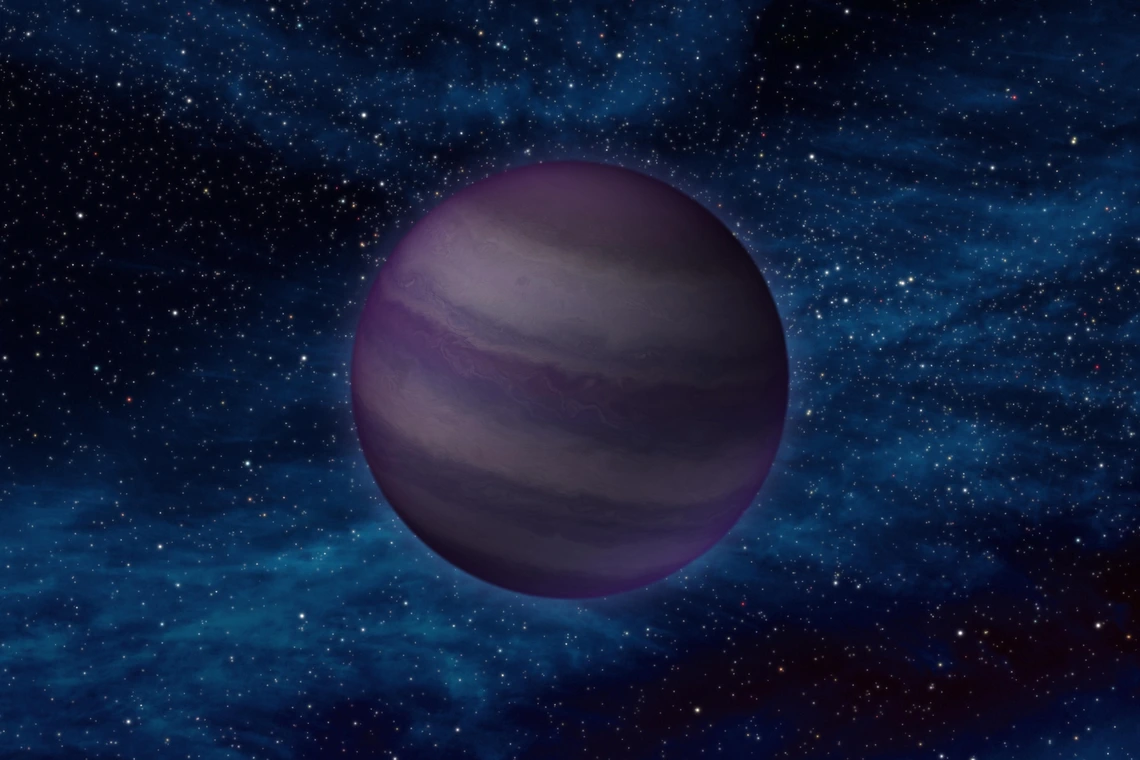
When picturing a star, typically people think of giant balls of burning gas in the sky that emit enough light they are hard to miss. Planets, on the other hand, come in one of two general categories – rocky worlds like Earth or gas giants similar to Jupiter. But there is a third category of astronomical object that doesn’t really fit either of those descriptions, and also doesn’t exist in our own solar system. Known as a brown dwarf, they are sometimes called a “failed star” as they form the same way stars do, but never reach the critical mass of material to create active fusion in the cores. They are also much too massive to be considered a regular planet. But a new paper from researchers led by Brittany Miles of the University of Arizona describes one similarity between the coldest known brown dwarf and some of the planets in our solar system – it has water-ice clouds.
Discovered in 2014 by Kevin Luhman, using NASA’s Wide-field Infrared Survey Explorer (WISE), WISE J085510.83-071442.5 – which the astronomy community has thankfully shortened to just WISE 0855 – is the third closest “system” to our own solar system, sitting just 7.2 light years away in the constellation Hydra. It also holds the title for the coldest known brown dwarf in the universe, sitting at an average upper atmosphere temperature of around 265 K (-8℃). This squarely puts it in the category of a “Y” dwarf, the coldest category of brown dwarfs, most of whom fall into categories that are much hotter.
So how did we find this object if it’s not a star, and it’s not orbiting a star to reflect its light or gravitationally pull on it? Brown dwarfs themselves, even the cold ones, emit infrared radiation, otherwise known as heat. With that signature, we can track WISE 0855 as it moves throughout the galaxy. We also know that it is about the same physical size as Jupiter, but weighs between three and ten times our largest planet’s mass. It also sits in a unique position in atmospheric physics.
[embedded content]
Fraser talks about how phosphine was found in a brown dwarf.
Normally we refer to a “Goldilocks zone” when referring to an exoplanet’s orbit around its parent star – where liquid water is possible on its surface. But in atmospheric physics, there is also a “Goldilocks zone”, where an atmosphere is too cold for molten iron to form clouds, but just cold enough for water vapor to form ice clouds, and warm enough that ammonia stays as a gas. That temperature is precisely where WISE 0855 lies. But astronomers have been questioning for a decade whether WISE 0855 actually does have water clouds.
The problem comes down to data interpretation. WISE 0855 is just a single point of light to our sensors. Astronomers can split the infrared light it emits into a rainbow of wavelengths to track which chemicals are absorbing light at specific wavelengths, in a process known as spectroscopy. However, there has been a debate over whether the spectral signature of this frigid world could be explained by water clouds that were blocking light from warmer, deeper layers, or something called “disequilibrium chemistry”, where updrafts cause the upper atmosphere to be flooded with chemicals like carbon monoxide, carbon dioxide, and phosphine, which could also mimic the spectral signature that WISE 0855 gives off.
To solve this mystery, the research team turned to the James Webb Space Telescope. They managed to get an astonishing 11 hours of time on the Near-Infrared Spectrograph (NIRSpec) instrument, utilizing its Bright Object Time-Series (BOTS) mode. Every 15 minutes, the instrument would record a new infrared spectrum between 2.87 and 5.27 microns in wavelength.
[embedded content]
Fraser talks to Dr. Joanna Barstow about exoplanet atmospheres.
Lining up those 44 back-to-back snapshots allowed the researchers to watch as WISE 0855’s brightness changed over time. There were three very noticeable discoveries to come from this time series. First, the strongest brightness swings over the 11 hours happened between 4.5 and 4.8 microns in wavelength – right where carbon monoxide absorbs light. As the brown dwarf rotated, this band swung up or down by 10%.
The second discovery was that, in spectral regions that weren’t blocked by common upper-atmospheric gases like methane or ammonia, the team saw lots of variations from carbon dioxide and phosphine. A third discovery was that the spectral signature of water didn’t really change brightness at all.
From this data, the researchers isolated two separate patterns that operated at different depths of the atmosphere. First, accounting for around 60.5% of the object’s variability of its brightness, there’s an apparent dimming and brightening pattern that accounts for the overall surface temperature variation, which wobbles between 0.6 to 1.3 degrees, and, potentially, changes in water ice clouds. A second pattern, accounting for around 4.7% of the variability, appears in the absorption bands of carbon monoxide and phosphine, which differs from the overall brightness curve, meaning this feature is probably coming from much deeper in the atmosphere.
[embedded content]
Fraser talks about the discovery of the first “steam world”, discussing it with guest Eshan Rual
With those data points, the team tested two cutting-edge atmospheric computer models – PICASO and coolTLUSTY. Both models clearly showed that including water clouds fit the data vastly better than any model without them. Specifically, it appears that when we are looking at WISE 0855, we are looking at patchy water clouds located near the top of the atmosphere at a pressure of around 1 to 4 bar. Meanwhile, much further down toward the object’s surface, updrafts are pulling carbon monoxide, carbon dioxide, and phosphine up from the depths.
In terms of how WISE 0855 would physically appear if we were allowed to see it up close, with a pair of infrared goggles, it would show up as a striped world with fast-moving equatorial jet streams wrapped in frigid water ice clouds. But, unfortunately, we still don’t know how fast it is rotating. Gas moving around its surface obscured the object’s actual rotation. But the researchers think they can determine WISE 0855’s rotational speed, if only they can get around 20 more hours of time on the JWST’s instrumentations. Given the demand for time on the world’s foremost infrared telescope, that’s a tall ask. But there’s a chance we can unlock even more secrets about this close-by cool neighbor if they do manage to get that time – and doing so would provide even more information about how these cool brown dwarfs work.
Learn More:
U Arizona – Discovery marks the first detection of variable water clouds outside of our solar system
B. E. Miles et al – Water Cloud and Chemical Modulations in the Coldest Brown Dwarf
UT – SPHEREx Just Took the Fingerprints of Failed Stars Across Our Cosmic Neighborhood
UT – Phosphine Discovered In A Brown Dwarf’s Atmosphere For The First Time
About the Author

Source: Universe Today