JAXA, the Japan Aerospace Exploration Agency, has finally launched its Martian Moons eXploration (MMX) mission. The launch occurred at 04:41:03 JST on October 20, 2026 from the Tanegashima Space Center, Japan’s primary spaceport. 17 minutes after lift-off, MMX separated from its launch vehicle and began its journey to Mars and Phobos, the largest of the planet’s two moons.
MMX will reach Mars in August 2027 and enter an orbit around the planet. After about one month, it will transfer to an orbit around Phobos. MMX consists of the main orbiter and a small lander named Idefix, developed by Germany and France. The mission will place Idefix on the surface of Phobos, where it will perform science operations and help find a suitable landing for the main part of the MMX mission: sample collection.
Idefix will simply be dropped onto the surface of Phobos from between 40 and 100 meters above. The small moon’s gravity is so weak that the rover won’t be damaged. Regardless of how it lands, it will right itself and get to work.
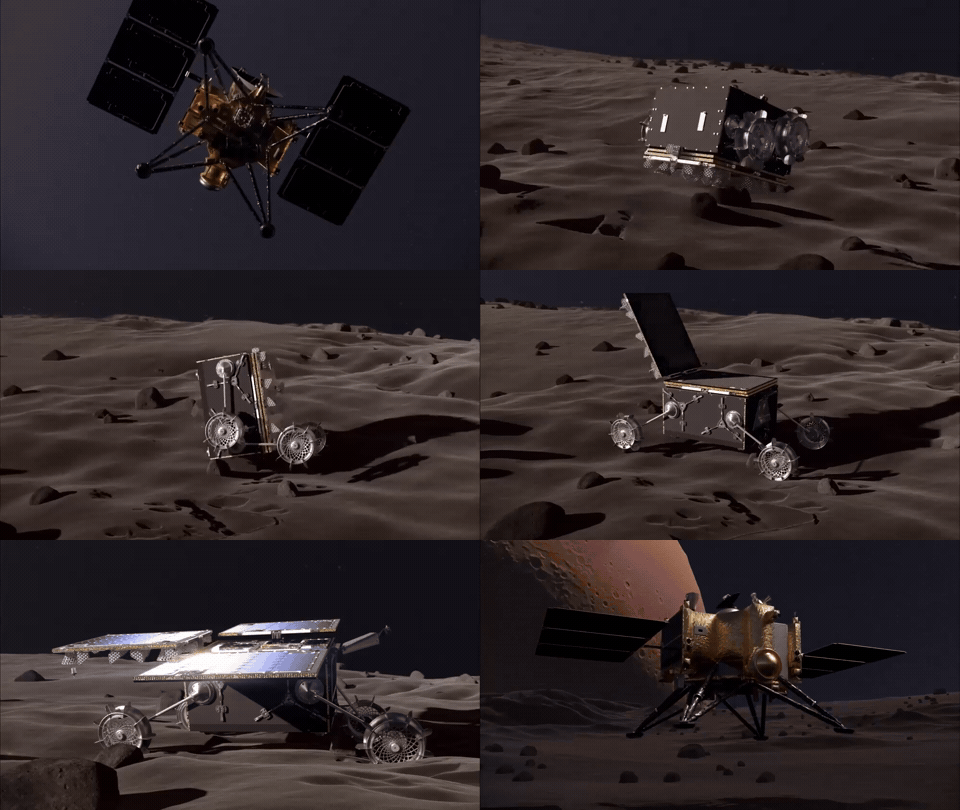
Credit: DLR 2024
In 2030, MMX will then land on Phobos, either once or twice, and collect regolith samples. The goal is to collect at least 10 grams of material. Then MMX will perform flybys of Mars’ other moon, Deimos, before sending the sample back to Earth in a capsule. The sample, if collected successfully, should be back on Earth in 2031.
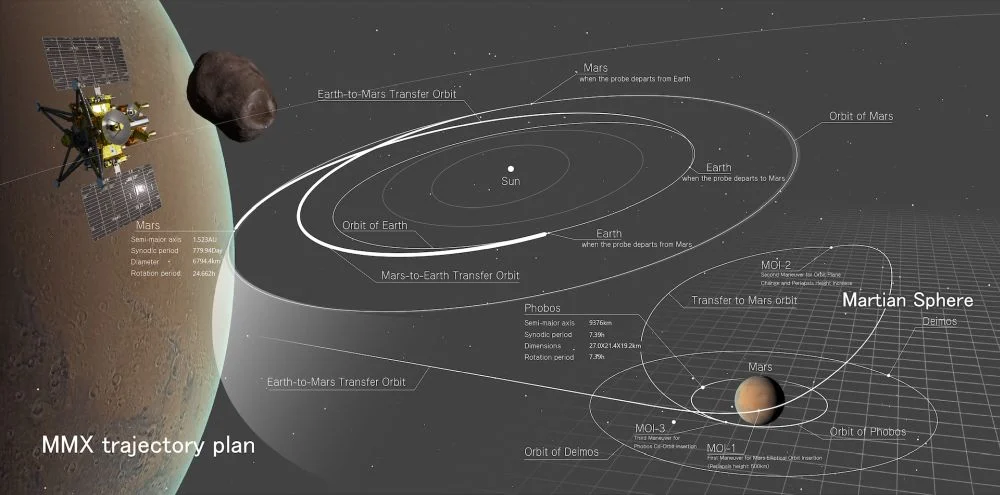 This figure highlights the different parts of MMX’s mission to Mars and Phobos. Image Credit: JAXA.
The sample return capsule will be inside MMX’s Return Module, which will separate from the Exploration Module. The Exploration Module, which contains the lander’s legs, rover deployment system, and science instruments, will be left to its fate. The capsule containing the samples will separate from the Return Module and be sent to the Woomera Prohibited Area in South Australia to be retrieved, while the Return Module will burn up in Earth’s atmosphere.
JAXA has completed two successful sample return missions already. Hayabusa returned a sample from Asteroid 25143 Itokawa in 2010, and Hayabusa 2 returned a sample from Asteroid 162173 Ryugu in 2020. Their track record suggests that MMX will be successful, too.
If MMX is successful, it will return our first ever sample from the Mars system. The sample will hopefully provide answers to some stubborn questions regarding the Martian moons.
The origins of Mars’ two moons is a subject of vigorous debate in planetary science. There’s tangible hope the MMX and its samples can resolve it.
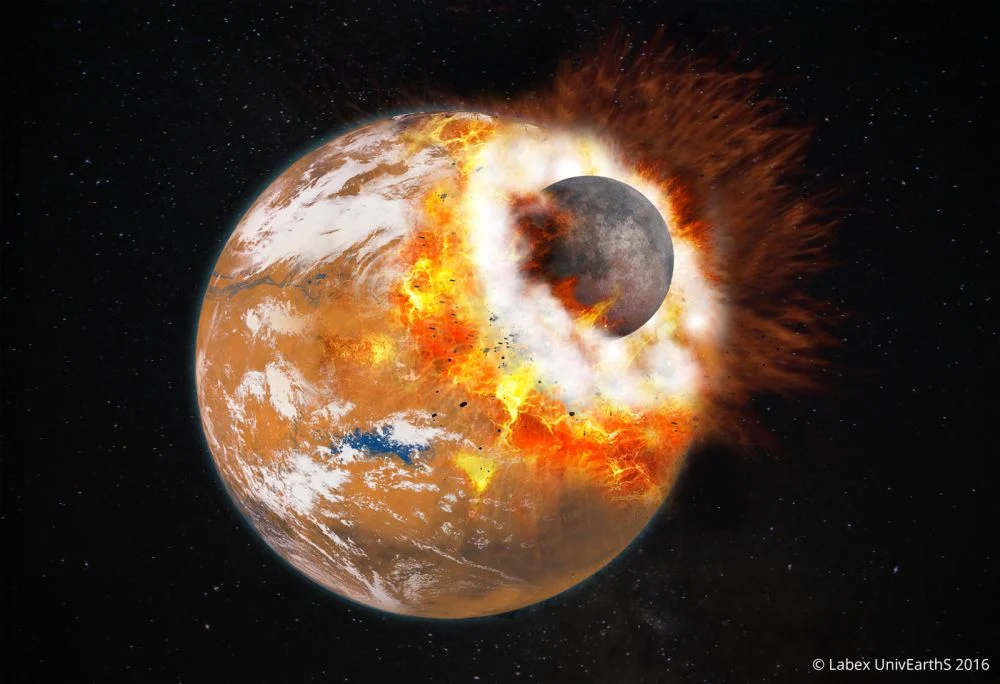
One theory is that a giant impact on Mars’ surface early in the Solar System’s history created the moons. The powerful impact created a debris ring around Mars, and both moons coalesced out of that debris. Because the moons follow orbits that are near-circular and near-elliptical, that theory is well-supported. But there’s also a problem with it. Debris rings tend to form close to the bodies that were impacted, and Deimos is much further away than Phobos. Some research shows that the chance of an impact creating both moons is less than 3%.
This artist’s illustration shows a body about one-third the size of Mars slamming into the planet. The collision could’ve created a debris ring, out of which Phobos and Deimos formed. Image Credit: Paris Diderot / Labex UnivEarthS
Another theory is that both moons are captured asteroids. Phobos and Deimos appear to be made of different material than Mars, which not only goes against the impact theory, but supports the asteroid capture theory. But both moons orbit within 2 degrees of the Martian equator, which makes two separate asteroid captures unlikely. But some research shows that this is still more likely than the impact scenario.
A third possibility is that Mars captured a single asteroid. That asteroid was shredded by the planet’s gravity, forming a debris ring. Both moons formed from that debris, which could explain why they seem to have a different compositon than Mars, but also follow very similar near-equatorial orbits.
Another possibility is even more complex. It starts with a body one-third the size of Mars slamming into the planet and creating a very wide debris disk. In the inner part of this disk, a large moon formed, 1000 times larger than Phobos. Gravitational interactions with this large moon created more moons in the disk, including Phobos and Deimos. In a few thousand years Mars had a retinue of ten small moons, and the one massive moon. The debris disk dissipated after millions of years, and Mars’ tidal effects brought most of the moons crashing down onto the planet, including the large moon. Only Phobos and Deimos remain.
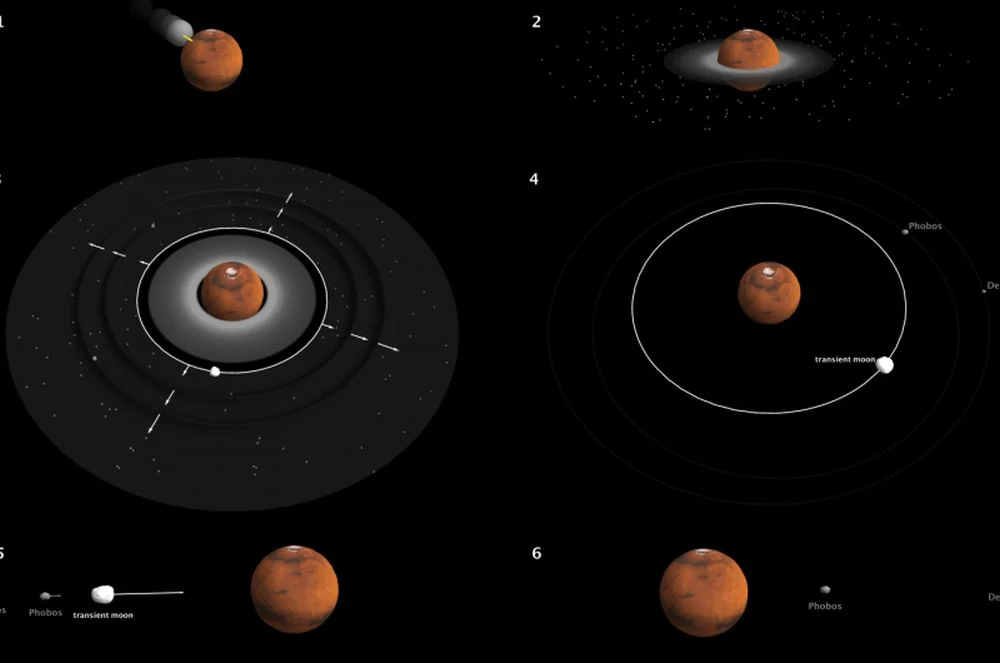 This illustration explains the scenario described above. A massive object slammed into Mars creating a wide debris disk. A massive moon formed that helped drive the creation of 10 smaller moons. All of those moons slammed into Mars and are gone, while only Phobos and Deimos remain. Image Credit: Antony Trinh / Royal Observatory of Belgium
It’s possible that a mere 10 grams of regolith from Phobos could settle the debate, with help from MMX’s remote-sensing data.
If the material clearly matches Mars’ mineralogy and isotopic ratio, that supports the giant impact scenario. If the material more closely matches asteroidal material, with different isotopic ratios and mineralogy than Mars, that supports the captured asteroid scenario. In the partial capture or hybrid scenario, the sample material should be asteroid-like, but have some differences in bulk composition and volatile content. The fourth and final scenario is much more difficult to resolve.
In any case, nearly every sample returned to Earth, and every other mission or space telescope, generates some surprises. There may yet be a surprise waiting in the sample, when it returns. Perhaps a surprising answer, or more surprising questions.
For that, we must wait until 2031.
About the Author

Source: Universe Today