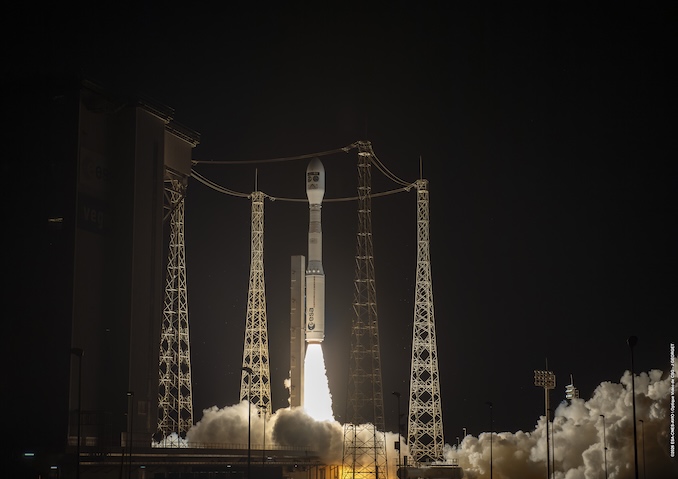
An Avio Vega-C rocket zipped off the launch pad Monday night from Europe’s Spaceport in French Guiana. This was the eighth launch to date of the 34.8-meter-tall (114.2 ft.) rocket and the second of 2026.
Onboard the launch with the designation VV30 were two spacecraft: the ocean- and atmosphere-monitoring Copernicus Sentinel-3C, managed by the European Organisation for the Exploitation of Meteorological Satellites (EUMETSAT), and the plant health-monitoring Fluorescence Explorer (FLEX), managed by the European Space Agency (ESA).
Liftoff of the four-stage rocket from Ensemble de Lancement Vega at Europe’s Spaceport in French Guiana is scheduled for 10:21 p.m. local time (9:21 p.m. EDT / 0121 UTC / 3:21 a.m. CEST).
“Today’s success confirms Avio as a reliable Launch Service Operator for Vega-C launches. The launcher performed flawlessly, putting in orbit two strategic satellites for Europe, that demonstrate how space technologies have become essential in addressing the environmental and climate change challenges,” said Giulio Ranzo, CEO of Avio, in a post-launch statement. “The satellites will provide very important data to better understand our planet.”
✅ Signals acquired. FLEX and Sentinel-3C are in orbit and healthy.
Following launch on Vega-C, the two Earth observation satellites now begin commissioning. Together, they will advance our understanding of Earth’s vegetation and support the continued monitoring of our oceans,… pic.twitter.com/QVcgpuXHzE
— European Space Agency (@esa) September 15, 2026
Deployment of the Sentinel-3C happened about an hour after liftoff with acquisition of signal happening minutes later. Nearly an hour later, FLEX sent on its way with signal acquired shortly after.
The VV30 mission was just the second Vega-C launch managed solely by Italian company, Avio, and not jointly with Arianespace.
Eyes on the sea and skies
The primary payload onboard the VV30 mission and the first to be deployed was the Copernicus Sentinel-3C spacecraft. Clocking in at 1,143 kg (2,513 lbs.), the third in the Sentinel-3 series separated from the AVUM+ upper stage one hour and 49 seconds after liftoff.
According to EUMETSAT, the Sentinel-3 satellites are designed to provide “high-accuracy optical, radar, and altimetry data for marine and land services. It measures variables such as sea-surface topography, sea– and land-surface temperature, ocean colour and land colour with high-end accuracy and reliability.”
“The instruments are also used to monitor the atmosphere, including aerosols and cloud properties and it is an important tool for monitoring wildfires in near-real time via measurement of fire radiative power,” the EUMETSAT website stated.
The Sentinel-3C follows the launches of Sentinel-3A, launched on Feb. 16, 2016; and Sentinel-3B, launched on April 25, 2018. Both spacecraft were launched on Russian Rokot launchers.
With both 3A and 3B past their expected lifetimes of 7.5 years each, the Sentinel-3C is designed to take over from Sentinel-3A once on orbit and following a commissioning period. Sentinel-3D will replace 3B in 2029.
“This launch will assure this essential service and related datasets can continue well into the 2030s and particularly when you’re assessing climate impacts, this long continuity of data is really important,” said Phil Evans, Director-General of EUMETSAT during a prelaunch news briefing.
“The oceans are absolutely at the heart of this story. They absorb around 90 percent of the excess heat generated by human activities, shielding us from even greater impacts of warming. But the oceans are paying a price with rising temperatures, changes to ecosystems, accelerating sea level rise, and systems such as Sentinel-3C are critical and essential infrastructure that can provide us with consistent information about what’s going on in the oceans,” Evans added.
He mentioned that roughly 30 million Europeans live in coastal floodplains that are threatened by sea-level rise, which is not only increasing, but accelerating.
“These are no longer distant environmental issues. They are issues that have a direct consequence on our societies today,” Evans said. “Climate change is making extreme weather events more frequent and more intense and in this context, climate protection and disaster risk management is crucially important.”
To perform its ocean and atmospheric monitoring, the Sentinel-3C spacecraft is outfitted with a series of scientific instruments:
- Sea and Land Surface Temperature Radiometer (SLSTR)
- Ocean and Land Color Instrument (OCLI)
- Dual-frequency (Ku and C band) Synthetic aperture radar (SAR) Radar Altimeter (SRAL)
- Microwave Radiometer (MWR)
- Laser Retro Reflector (LRR)
- Détermination d’Orbite par Radio-positionnement Intégré par Satellite (DORIS)
The Sentinel-3 spacecraft fall under the European Commission’s Copernicus program. Mauro Facchini, Head of the European Commission’s Earth Observation Unit, said the next steps for Copernicus are already in work.
“Six Copernicus expansion missions are under development and they are planned to be launched from 2027 on. Among these, we’ll put a lot of attention in the CO2M (carbon dioxide monitoring) satellites, those that are devoted to the observation of CO2 and the future anthropogenic emissions,” Facchini said. “For us a key step is also the preparation of the next multi-annual financial framework, meaning that will be the budget of the European Union from 2028 on. And we hope and expect that this budget will be at the level necessary to support Copernicus and ensure its continuity and evolution.”
Monitoring plant health
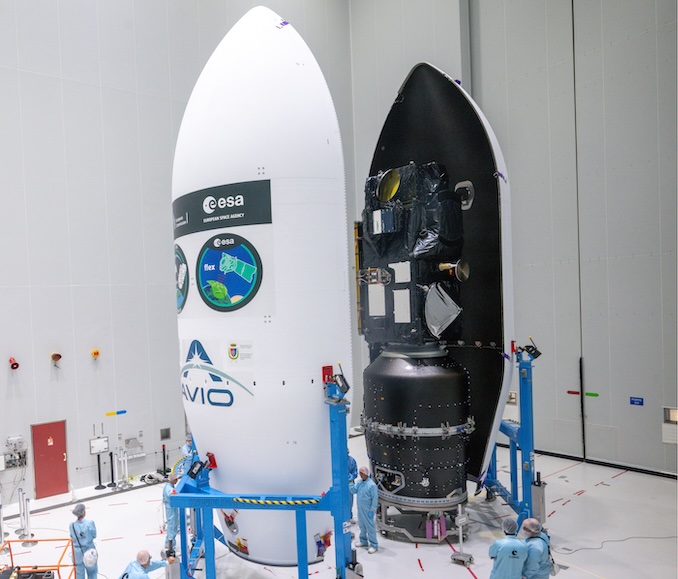
Also onboard the Vega-C rocket, nestled under the secondary payload adapter called Vespa, was FLEX. The 397 kg (875 lbs) spacecraft was the eighth in a series of Earth Explorer missions developed through ESA’s FutureEO program.
Over the course of a roughly 3.5-year planned mission, FLEX will use its Fluorescence Imaging Spectrometer (FLORIS) to help researchers understand “how carbon moves between plants and the atmosphere and how photosynthesis affects the carbon and water cycles,” according to ESA.
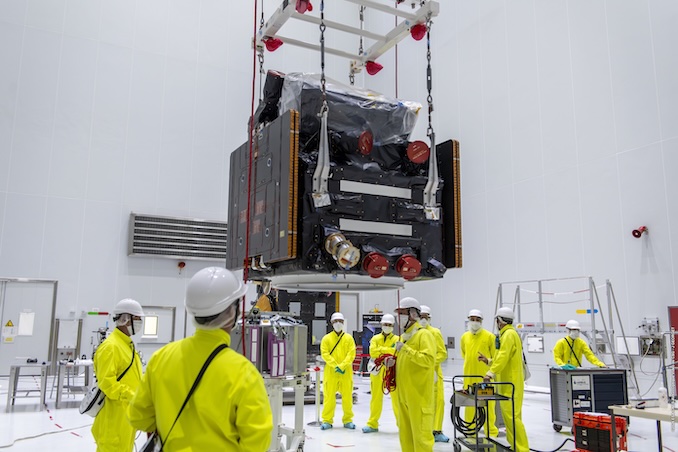
Simonetta Cheli, ESA’s Director of Earth Observation Programmes, said that this mission is about technology innovation, given that the FLORIS instrument will be operating in the 500-780 nanometer spectrum range, flying in tandem with Sentinel-3C.
“That’s also why we launch them together because each one of those two satellites will provide relevant information: one more on the status of the health of the vegetation. The other one more on the atmospheric context and all what is surrounding it,” Cheli said. “They will fly one kilometer apart from one of the other with a few minutes, I would say seconds apart. And this FLEX mission will have a revisit period of 27 days. It’s foreseen to live three and a half years, but as you have seen, most of the Earth Explorer mission have lived well beyond their initial lifetime.”
FLEX has about 30 kg of propellant onboard, but needs to reserve about half of that in order to perform its de-orbit maneuvers when it approaches the end of its operational life. Mission managers will work to preserve as much fuel as possible to get the most out of the spacecraft.
About the Author