The NASA/ESA/CSA James Webb Space Telescope continues to reveal hidden parts of the cosmos with its advanced suite of infrared instruments. In a newly released image, Webb revealed many stars previously hidden by the dust clouds of NGC 7129, a stellar nursery about 3,300 light-years from Earth in the constellation Cepheus. The image is already improving our understanding of how new stars are born and evolve with time.
The life cycle of stars begins in dense molecular clouds of cold dust and gas, otherwise known as nebulae. Within these cocoons, the gas and dust slowly coalesce and build up mass, eventually triggering gravitational collapse and the birth of a new star. Because of the dusty environment, young stars are often impossible to see with telescopes that cannot capture infrared light. Thanks to Webb’s sensitivity to the near- and mid-infrared parts of the spectrum, astronomers could peek inside NGC 7129 and see many stars less than 1 million years old.
Over 130 stars have been identified in this cluster, which are in different stages of development based on their mass, with the more massive stars evolving faster and exiting their main sequence sooner. The most massive and mature is the region’s central star, LkH(alpha) 234, a pre-main-sequence star of about 5 to 8 Solar masses. As the name suggests, stars at this stage have largely finished gathering mass and begin fusing hydrogen in their interiors shortly thereafter.
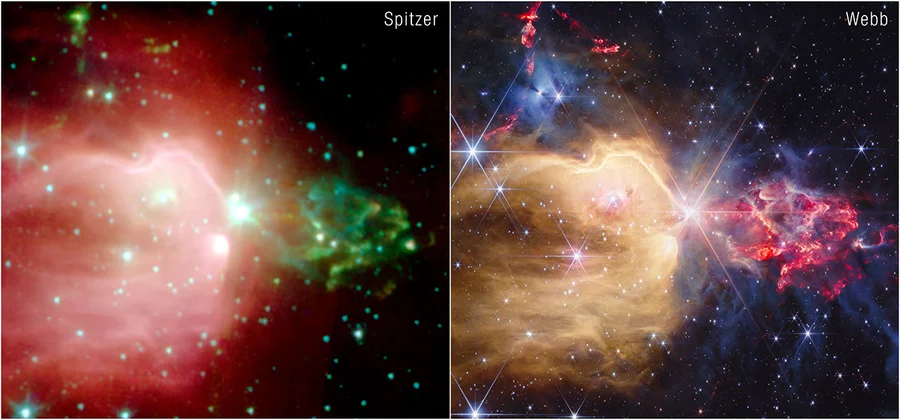
Images of NGC 7129 taken by NASA’s retired Spitzer Space Telescope and the NASA/ESA/CSA JWST. Webb’s improved resolution shows more detailed gas and dust filaments, along with many background galaxies. Credit: NASA/ESA/CSA/STScI/NASA-JPL/Alyssa Pagan (STScI)
This raises their temperatures, warming the surrounding gas and dust and illuminating it enough for astronomers to see inside. In this image, hot atomic hydrogen gas appears in the golden region to the left. Cooler gas, shocked by outflows from embedded protostars, appears in red to the right, with smaller clouds lingering in the upper left. Outflows triggered by LkH(alpha) 234’s birth also created the cavity visible on the left side of the image. The shock of these outflows largely dispersed the hydrogen gas but also compressed regions, causing more stars to form within the cavity.
Several of these stars are also pre-main-sequence and emit stellar winds, creating nearby bow shocks that lead to other smaller cavities. The stellar winds also push against the colder, denser gas outside the cavity, creating the sharp ridge visible at the top. Beyond the cavity, the pressure creates a boundary known as the photodissociation region, where hydrogen molecules are broken down into atoms.
To the upper left, a bright blue nebula is illuminated by a protostar surrounded by a torus-shaped disk of material, with outflows also visible nearby. Webb’s high-resolution optics also identified many rich structures in the stellar nursery, which builds on previous research by NASA’s now-retired Spitzer Space Telescope. The ongoing study of this region will offer insight into how these stars and protostars shape their surroundings, eventually eroding the molecular clouds over the coming eons.
Further Reading: NASA
About the Author

Source: Universe Today