Binary stars are common in the Milky Way. Up to 40% Milky Way stars are binaries, though there’s a lack of absolute certainty. Sirius, which is the brightest star in the night sky, is actually a binary star.
Astronomers know that in some situations, binary stars share common envelopes (CEs). It means that a body of gas surrounds both stars, but the gas doesn’t move with either one separately. These envelopes are transitory; the CE creates drag that slowly draws the planets together, sometimes ending in an explosion. But it’s difficult to predict when that will happen, and when astronomers should observe a particular binary star to learn more about it.
It all begins with common envelope evolution (CEE), a critical stage in the evolution of binary stars. No two stars in a binary system are the same. One evolves and puffs up, overflowing its Roche lobe. Mass begins to pile up on its companion. That process becomes unstable, and the two stars become engulfed in a common envelope of gas.
The common envelope exerts a powerful drag on both stars, and they’re drawn closer together. After that, the CE is ejected and the two stars are left behind in a compact binary. The pair of tightly-bound stars can remain as a compact binary, or they can merge and cause an explosion, called a luminous red nova(LRN). Whether they merge and explode, or whether they remain as a compact binary, depends on how soon the CE is ejected. If the CE isn’t dissipated soon enough, the continued drag forces the stars closer together until they merge and erupt.
This simple graphic shows how common envelopes evolve. At first, on star fills its Roche lobe. Then, the companion is engulfed and both stars orbit one another inside the common envelope. Then, either the common envelope is ejected and the stars remain as a binary, or the common envelope isn’t ejected, and the stars are forced to merge. Image Credit: By Philip D. Hall – Own work, CC BY-SA 4.0, https://commons.wikimedia.org/wiki/Special:Redirect/page/55287112
This is a coarse overview of the process. Astronomers know it can happen, and they’d like to learn more about it. But they need to observe them, and that’s tough to do. Not only are they difficult to predict, but they’re also relatively rare.
Observations with the JWST and other telescopes have found one CE situation where a main sequence star a little less massive than the Sun spiralled into its CE partner, a puffy supergiant star, and erupted as a LRN. This happened in our neighbouring galaxy, Andromeda. The observations and details are in new research in Nature titled “An inspiral of a star inside a common envelope with its giant companion.” The first author is Viraj Karambelkar, a NASA Hubble Fellow at Columbia University in New York.
“The formation of compact stellar binaries requires rapid orbital tightening of their progenitor binary stars,” the authors write. “This is theorized to happen via Common Envelope Evolution, when the stars orbit in a loosely bound, shared convective envelope, triggering an inspiral due to frictional drag.”
That much is known by astrophysical theory. But nobody’s observed the end of the inspiral and the eruption yet. “Here, we present observations of AT 2025abao, a transient eruption in the Andromeda Galaxy,” the researchers write.
Astronomers have lots of observations of AT 2025abao with multiple telescopes because it’s been experiencing brightness changes for several years and has attracted their attention. They’ve become familiar with AT 2025abao and now simply refer to it as ‘Bao’.
“Stellar mergers are very, very difficult to observe in real time because they are hard to predict,” said first author Karambelkar. “However, we noticed something unusual was going on in 2023 and continued to monitor the system to see what it would do. Then, in 2025, it erupted! Webb observed Bao only 47 days after the stars’ eruption peaked, the earliest ever follow-up of an event like this. The telescope’s data helped us characterize what the system looked like before, during, and immediately after the merger, which is absolutely mind-blowing.”
Stars in these situations orbit each other for thousands of years with little change, and that was true of AT 2025abao. But once they contacted each other, things changed. Other stars in CEs take thousands of orbits before they merge. But this one was different from other CE binaries. The pair merged after only 7 orbits (about 7 years.)
Observations go back as far as 2018, and between then and early 2025, the star gradually brightened in optical light. After that, it gradually faded in optical light, but its infrared light continued to brighten. Then, in October 2025, it erupted. It brightened by 100 times in the r-band over a period 25 days, and its temperature jumped to about 8000 Kelvin. Then, for about 80 days it plateaued and cooled down to about 3000 Kelvin. The JWST observed it during this period, only 47 days after its peak.
“We thought an outburst from a such an extended star would take years,” said co-author Nadia Blagorodnova, an associate professor at the University of Barcelona in Spain. “One day, its brightness started rising and within a week, it peaked!”
“When a companion star begins to interact with the outer surface of the primary star, it produces a subtle effect — a slow brightening, which we clearly saw in Bao’s data,” said co-author Kishalay De, an assistant professor at Columbia University in New York. “As the companion continues its orbit, it keeps peeling off the primary star’s outer layers, and that gas flows away into the surrounding space.”
This was when the CEE began. The primary star engulfed the companion star in a common envelope, and drag stole its momentum, forcing it to spiral inward. This is when the JWST saw the destructive merger.
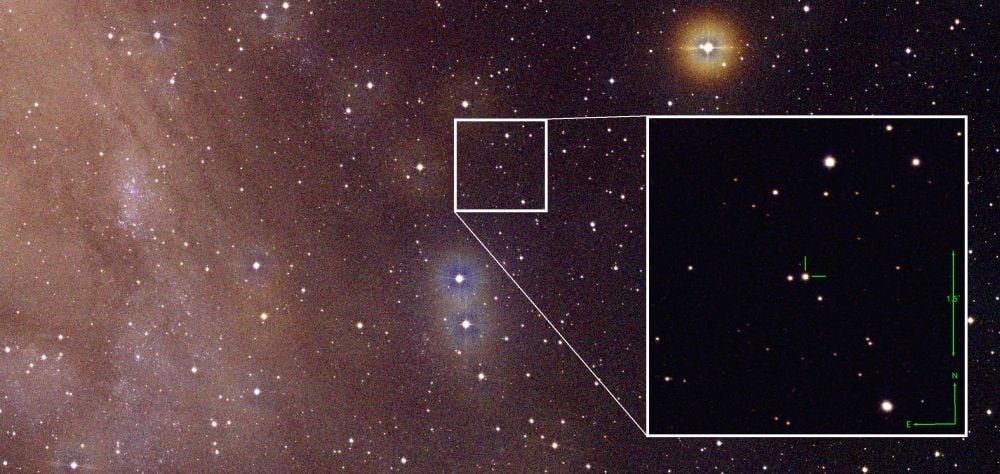 This is the finding chart for AT 2025abao. It was captured by the Asiago 67/92cm Schmidt telescope on 7 November 2025, when the light was at is maximum. M 31’s (Andromeda) spiral disk is just visible on the left of the image. The zoomed-in panel shows the transient. Image Credit: Reguitti et al. A&A, 709, A25 (2026)
Since the transient has been in the watchful eyes of astronomers for so long, they have detailed spectroscopy from it. The SPHEREx near-infrared space observatory played an important role, catching the star in its survey. “In July 2025, the source was serendipitously observed during its rapid optical fading by the first sky survey of the SPHEREx mission, providing a precise glimpse of the stellar photosphere during this phase,” the researchers state. That let them determine the masses of the stars, but only with some help from simulations.
As in a lot of astronomy research, simulations played an important role here. In this research, the authors worked with different models of CEE until the outcome of one matched the JWST’s detailed observations of the star and its surrounding dust, shed by the primary star over hundreds of years.
That work revealed that the primary was seven times more massive than the Sun, with a radius 350 times larger. It was also 18,000 times brighter than our star. “It was an absolute beast of a star, completely outshining its companion in the data,” said co-author Karel Temmink, a Ph.D. student at Radboud University in Nijmegen, Netherlands, who led the simulations.
The modelling also revealed the smaller star’s true nature. It had only about 0.7 solar masses, one-tenth as massive as the other star. Its radius was much smaller and it was also much dimmer.
The astronomers called the pair Big Bao and Little Bao, and when Little Bao was engulfed, there was a massive explosion. Only more observations will reveal what the resulting star, now simply called Bao, looks like.
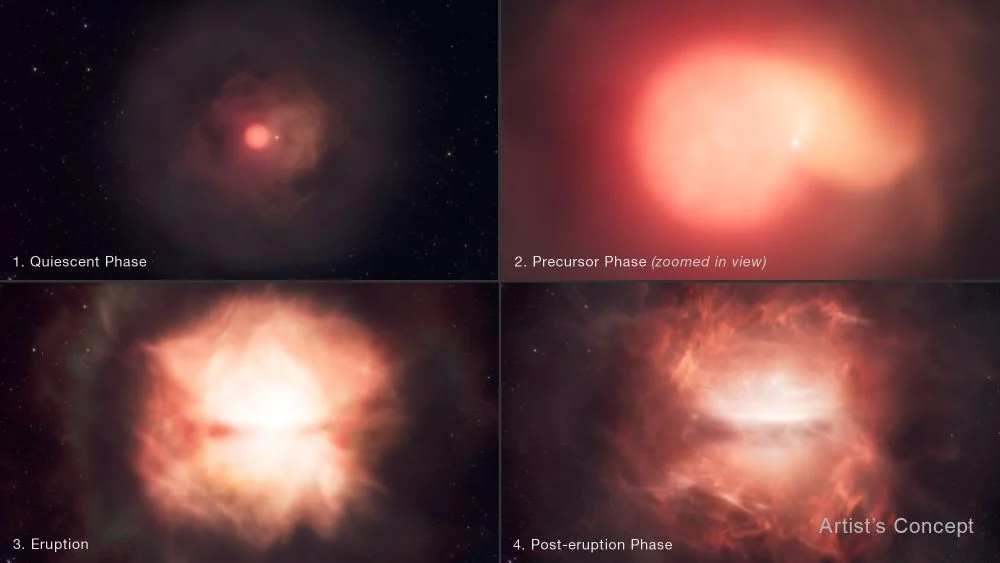 These artist’s illustrations help explain what happened with AT 2025abao and its common envelope evolution. The first panel shows the quiescent phase, when the stars are surrounded by a common envelope. The brightness was consistent during this phase. The second panel shows the stars brightening in the precursor stage. The companion star experiences drag and begins to spiral toward the primary star. In the third panel, there’s a sudden bright eruption, as the companion spiralled and the common envelope is ejected. The JWST observed this. Then, in the final panel, months after the eruption, gas from the star’s ejected envelope freely expanded at the poles, but not at the equator, where previous ejecta from the more massive star was concentrated. Image Credit: NASA, ESA, CSA, STScI, Leah Hustak (STScI); Science: Viraj Karambelkar (Columbia)
“The 2025 eruption of AT 2025abao displays the defining hallmarks of Luminous Red Novae, a class of transients established to arise from impulsive energy injection into a common envelope during the merger of a star with its companion,” the authors write. But it’s different from all other known LRN. It’s progenitor is unambiguously an evolved AGB star with an extended convective envelope.
“In contrast, all known LRN progenitors have primary stars on the main sequence,” the researchers explain. But classical CEE theory says that the primary star should be an AGB star.
“Thus, AT 2025abao provides the first view of a classical CEE progenitor system continuously monitored from its onset through its culmination,” the authors explain.
Watching a common envelope evolution in real time like this is a first in astronomy. Astronomers have had to perform a sort of forensic astrophysical study of transients like this in other cases, trying to reconstruct what happened thousands or even millions of years ago. Even with powerful telescopes and computer simulations, and with detailed theoretical frameworks to guide their work, that’s tough to do.
But this work opens a new window into CEE and how efficient it can be. And it’s just in time to help with a potential flood of upcoming transient detections. Only a few dozen luminous red novae have been detected, but the Vera Rubin Observatory’s Legacy Survey of Space and Time will detect hundreds of them, possibly thousands. The Nancy Grace Roman Space Telescope will also detect some LRN and CEE, but probably far fewer.
This work lays the foundation for understanding some of what those surveys will find. In a few years time, astronomers should have a much clearer understanding of common envelope evolution and luminous red novae.
“This end-to-end characterization using multi-survey observations demonstrates a path towards mapping the landscape of CEE outcomes with upcoming surveys,” the authors write.
About the Author

Source: Universe Today