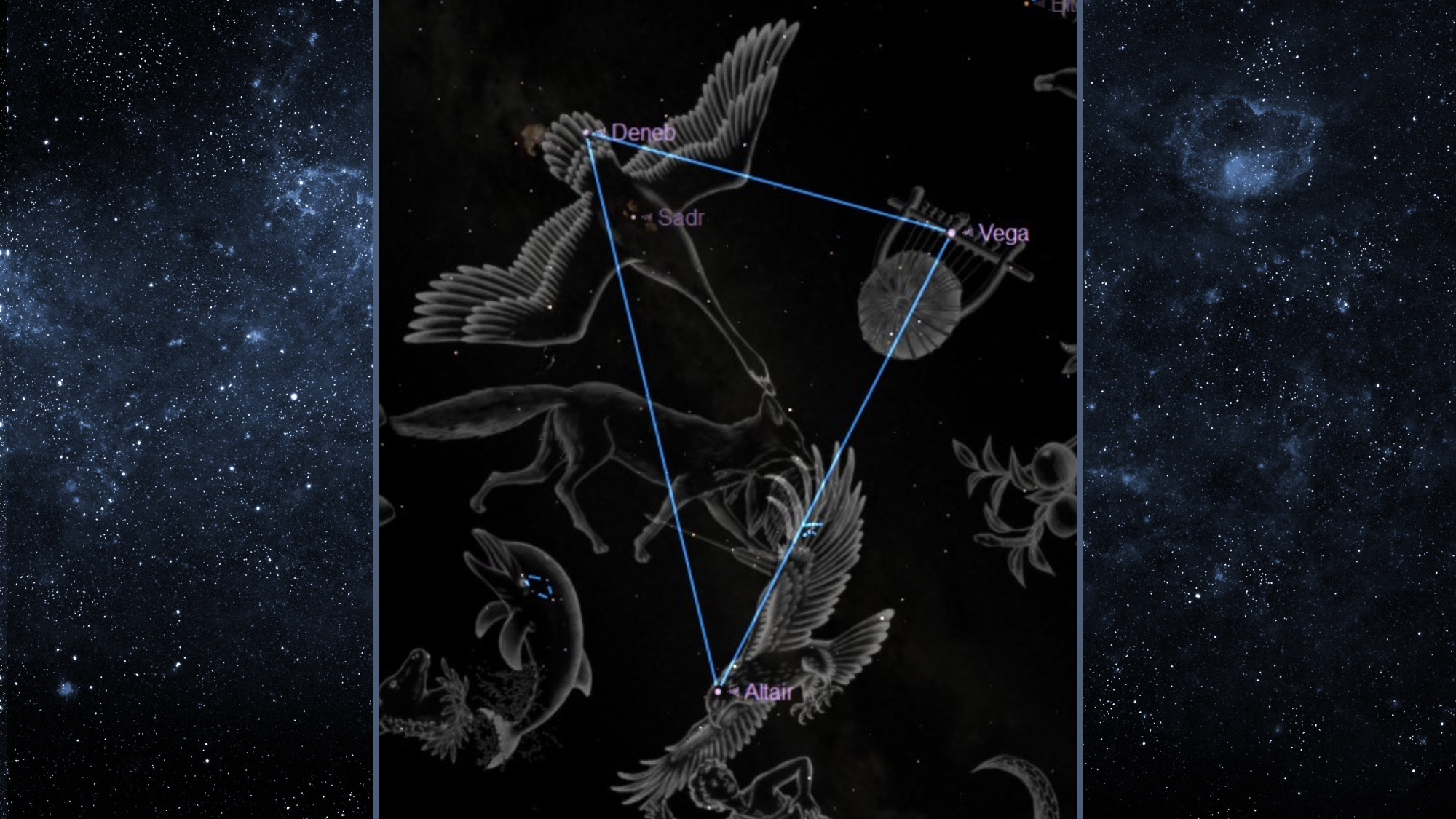
On clear September evenings, I often find myself looking up just after dusk, expecting the sky to feel a little less like summer. Yet there, still commanding the overhead darkness, are Vega, Altair, and Deneb — the three brilliant stars of the famous Summer Triangle.
Their familiar pattern can make the season feel as though it is lingering above us, even as cooler nights and earlier sunsets suggest otherwise. In fact, even as late as mid-November, the Triangle is still nearly overhead soon after sunset at dusk. That contrast raises a simple but intriguing question: if this bright celestial landmark remains so prominent well into autumn, why do we still call it the Summer Triangle?
Why not simply call it the Autumn Triangle?
Why it belongs to summer
The answer lies not in the calendar, but in how the Triangle moves across the sky over the course of a summer night. The chief reason is that, at this time of year, the Triangle does not remain visible all night. By dawn, it has begun to drop beyond the west-northwest horizon. During summer, by contrast, it remains with us from dusk until dawn: already evident in the east-northeast at nightfall, near overhead around the middle of the night, and descending in the west-northwest as daybreak approaches.
A matter of distance and brightness
The stars that compose the Triangle — Vega, Altair, and Deneb — lie at very unequal distances from us, so their apparent brightness can give a misleading impression of their true luminosity.
The closest of the three is Altair, 16.7 light-years away, followed by Vega at 25 light-years. Deneb, however, is vastly farther off, at roughly 1,600 light-years, though various sources place it between 1,400 and 2,600 light-years. Even though we see Deneb by light that may have begun its journey during the last days of the Roman Empire, it still shines at first magnitude (+1.3, to be exact) because it is a brilliant blue supergiant, at least 55,000 times brighter than the sun.
But their apparent superiority is largely a consequence of distance: Vega and Altair are only a few dozen light-years away, while Deneb lies well over a thousand light-years from Earth. Compared with the stellar lighthouse of Deneb, Vega and Altair are, comparatively speaking, penlight flashlights.
How to say “Vega”
Before continuing with this discussion about the Summer Triangle, it is worth pausing briefly on the pronunciation of Vega, a point that became especially noticeable after the 1997 science fiction drama Contact. Based on Carl Sagan’s 1985 novel, the film follows astronomer Dr. Ellie Arroway, played by actress Jodie Foster, as she discovers a radio signal from Vega containing a sequence of prime numbers.
Throughout the film, the star is pronounced “Vey-gah,” perhaps echoing Chevrolet’s Vega, the subcompact automobile sold in the 1970s. Astronomers, however, generally use a different pronunciation.
The traditional astronomical pronunciation is Vē-ga, with the stress on the first syllable. In professional astronomical usage, Dr. Arroway and her colleagues would almost certainly have said “Vee-ga,” not “Vey-gah.” George Lovi (1939—1993), who was widely respected for his knowledge of star nomenclature, often reminded audiences that “Vee-ga is a star and Vey-gah is a car.”
Who named the Summer Triangle?
There has long been debate over who first christened the bright stellar trio of Vega, Deneb, and Altair as the Summer Triangle. Some credit the legendary British astronomer Sir Patrick Moore (1923—2012), who wrote, “During a 1958 television broadcast on the BBC, I introduced the nickname of the Summer Triangle, and everyone now seems to use the term, even though it is completely unofficial.” Yet several years earlier, in his 1952 sky guide, The Stars — A New Way to See Them, H.A. Rey (1898—1977) referred to the three stars as a “right triangle,” and in his 1954 children’s book, Find the Constellations, Rey used the Summer Triangle moniker.
Still others believe the term was popularized through U.S. navigator training manuals during World War II. Interestingly, astronomer Oswald Thomas (1882—1963) described Vega, Altair, and Deneb as “Grosses Dreieck” (“Great Triangle”) in the late 1920s and as “Sommerliches Dreieck” (“Summerly Triangle”) in 1934.
Joe Rao serves as an instructor and guest lecturer at New York’s Hayden Planetarium. He writes about astronomy for Natural History magazine, Sky and Telescope, The Old Farmer’s Almanac and other publications.
About the Author