![[Aggregator] Downloaded image for imported item #78374](https://astrobitica.com/wp-content/uploads/2026/08/icon-nasa-chapea-mars-dune-alpha-extrudinglavacrete-from-vulcan-printer-highres_20260813_220654.webp)
What is a home actually for? Not the roof and the walls, but the thing itself, the space you retreat into when everything outside it is hard. I have asked myself that question more than usual this year, sitting with my own grief after losing both my parents, in rooms that were never designed for any of that. So when I came across this new piece of research out of MIT, it landed differently than most.
Engineers there have built something called the Human Environment Connection and Interaction Atlas, or HECIA, an interactive tool that maps the relationship between the physical design of a habitat and the emotional state of the person living inside it. It was built for astronauts, for the very real problem of keeping a crew not just physically alive but psychologically well on a years long journey to Mars, but the thinking behind it reaches a lot further than that.
Mars Dune Alpha, the 3D-printed habitat used for NASA’s CHAPEA missions, under construction. Its interior layout was deliberately built around a “gradient of privacy” — precisely the kind of design choice HECIA tries to map to emotional outcomes (Credit : ICON)
Led by Mich Lin at MIT, the team started from a simple observation. Submarines, Antarctic stations and spacecraft are all designed around survival, keeping people fed, breathing and safe. Almost none of them are designed around thriving. Lin’s team set out to change that for space habitats, borrowing a risk mapping method NASA already uses for physical health and applying it to emotional health instead, tracking how design choices ripple outward into feelings like anxiety, homesickness, trust and belonging.
To do it properly they turned to the Atlas of the Heart, Brené Brown’s catalogue of human emotion, and narrowed it down to fourteen feelings most relevant to people living in extreme, isolated places. Then they combed through the scientific literature connecting each one back to something physical. Lighting affects sleep. Stairs and shared entrances, oddly enough, affect friendship, because people are forced to pass each other and talk. A reconfigurable room can be rearranged to feel less foreign, which quietly reduces homesickness.
Click on any term in the atlas and it works in both directions. Start with a constraint, like distance from Earth, and it shows you what that puts at risk. Start with an outcome you want to protect, like a sense of home, and it shows you which design choices actually protect it.
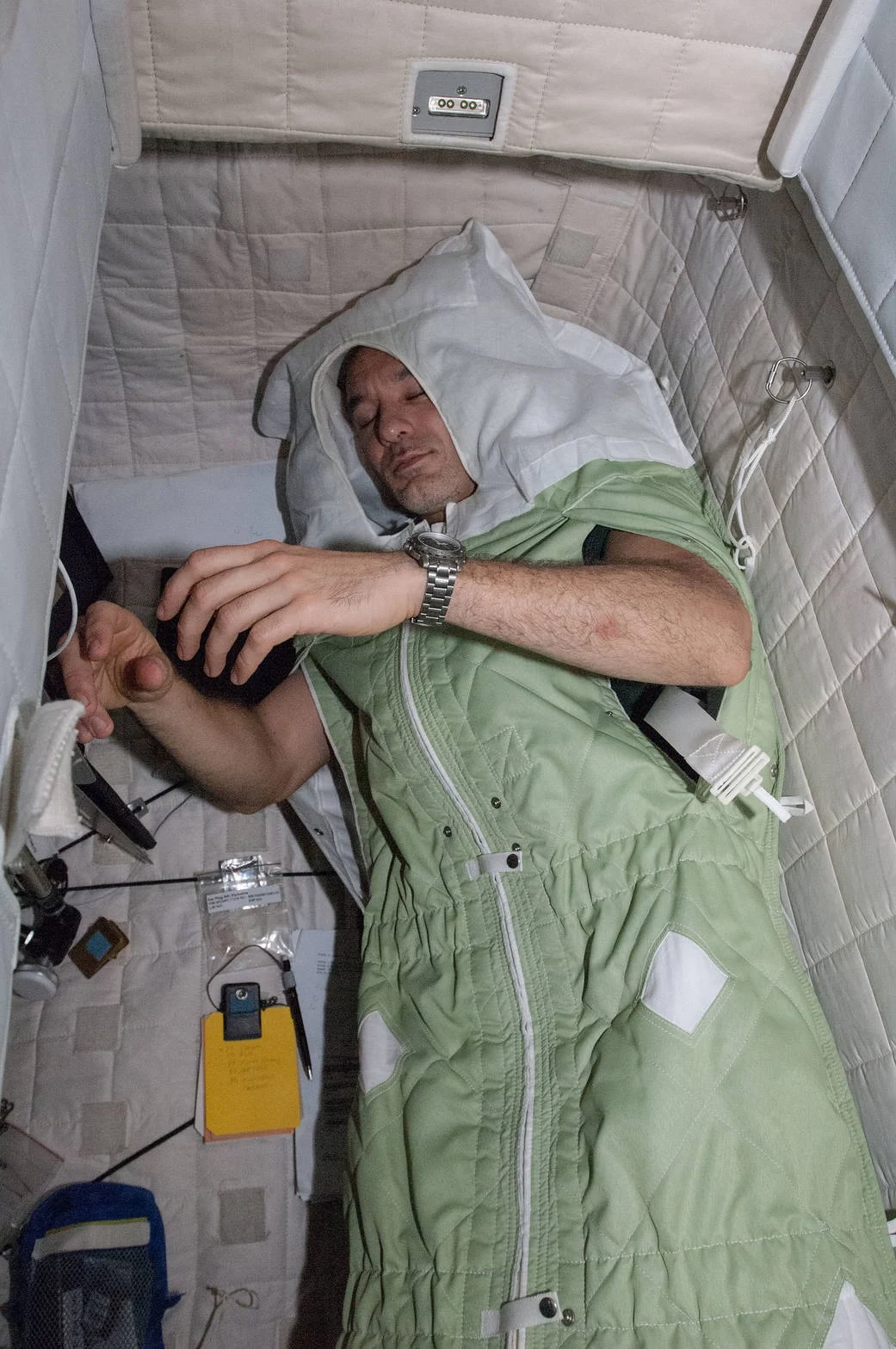
A crew member secured in a sleep restraint inside their personal crew quarters aboard the International Space Station, one of the small, private spaces designers have learned matter enormously to a crew’s sense of home (Credit : NASA)
None of it is a rulebook, and Lin is careful to say so. A habitat in lunar orbit will never behave like a habitat on the ground, and no diagram can substitute for knowing the people living inside it. But the atlas makes something visible that used to be invisible, a wall between the room you survive in and the room you can actually live in, and shows you exactly where to push to move from one to the other.
Source : How to design a space habitat that supports its residents’ mental health
About the Author

Source: Universe Today