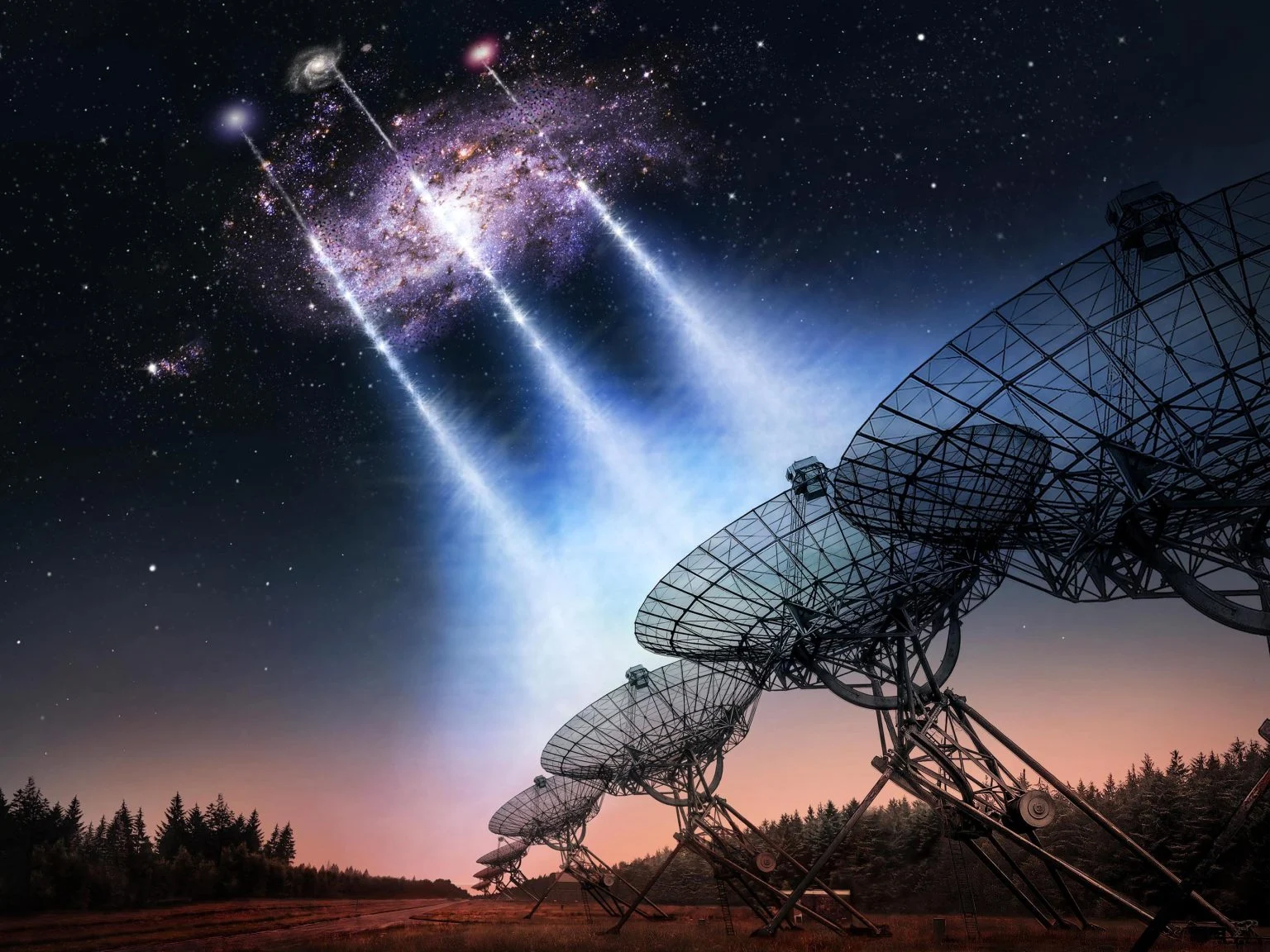
Fast Radio Bursts (FRBs) are among the most mysterious phenomena scientists face today. These transient events are basically blasts of radiation (in the radio spectrum) that last from milliseconds to a few seconds and are never heard from again. That is, of course, except for the rare exception of repeating FRBs, where the source in question releases more than one burst. Several theories have emerged as to their exact cause, including rapidly spinning magnetars, black hole and neutron star mergers, binary star interactions, and more.
Regardless, scientists have found FRBs to be a useful tool for probing the cosmos for matter that otherwise eludes detection (“missing matter”), testing fundamental physics, and searching for elusive Dark Matter and Dark Energy. According to new research led by the California Institute of Technology (Caltech), FRBs could also help map matter clustering in large cosmic structures, providing additional clues about how the Universe has evolved.
While FRBs are extremely brief events, their light travels billions of light-years to reach Earth and passes through a fog of gas, dust, and other matter along the way. The denser the fog, the more their signals disperse. This dispersion makes FRBs an effective tool for tracing the distribution of baryonic (aka. “normal” or “luminous”) matter, and how and where it clusters.
[embedded content]
Kritti Sharma, a graduate student working with Vikram Ravi, a professor of astronomy at Caltech’s Cahill Center for Astronomy and Astrophysics, led the research. The results, described in a paper that appeared in Nature Astronomy, show how FRB measurements could also help solve some of the biggest mysteries facing astronomers and cosmologists today. These include Dark Matter, Dark Energy, and neutrinos, all of which are predicted to influence how matter clumps together.
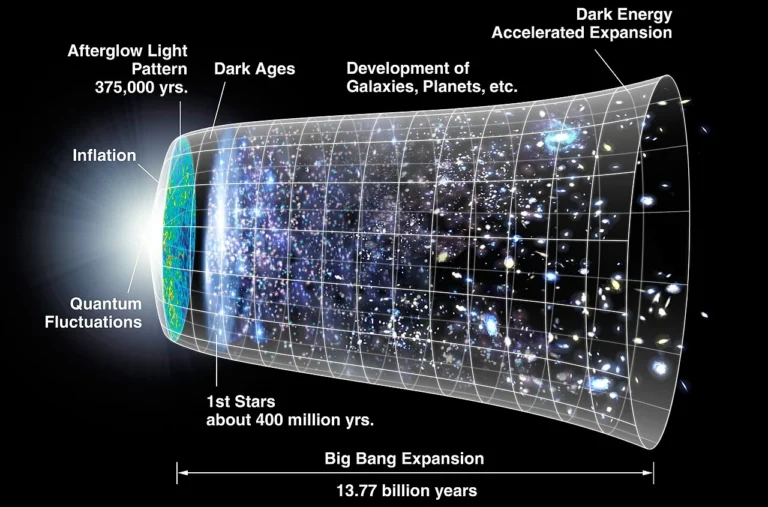
Scientists theorize that during the very early Universe, Dark Matter formed massive halos that trapped cosmic gas into dense concentrations, triggering the birth of the first stars and the seeds of supermassive black holes (SMBHs). This gave rise to the first galaxies in the Universe, which formed into large-scale structures that Dark Energy began pushing apart. To better understand these phenomena, scientists conduct massive sky surveys to measure how matter clumps together.
Feedback mechanisms also influence galaxy evolution, such as stars emitting constant flows of charged particles (solar wind) that push back on the interstellar medium. Meanwhile, supernovae disrupt their surroundings with powerful shockwaves, while SMBHs consume matter and produce powerful “winds” that suppress star formation in galactic disks. These processes can also affect how clumpy matter is, disrupting efforts to measure its distribution and cosmological effects precisely. Said Ravi:
The feedback process thins the gas around the galaxies, redistributing matter across vast distances. It smooths out clumps of matter in a way that looks astonishingly similar to what massive neutrinos do, or what dark energy or dark matter theories predict. Unless scientists can independently measure this contribution from feedback, they can’t tell these effects apart.
[embedded content]
Based on their analysis of 114 FRBs, Ravi and his colleagues conducted the first study that directly measured the impact of feedback on large-scale regions around galaxies. The results showed that gas ejected by galaxies smooths material in the intergalactic medium in a way comparable (though somewhat less than) to X-ray and microwave surveys performed by the eROSITA X-ray telescope and the Atacama Cosmology Telescope.
These results are especially encouraging since they are based on a sample of just 100 FRBs. With observatories like the Canadian Hydrogen Intensity Mapping Experiment (CHIME) detecting thousands of FRBs, there is considerable potential for using FRBs as a cosmological measuring tool. Similarly, the Caltech Deep Synoptic Array (DSA), for which Ravi is the co-principal investigator, is expected to detect tens of thousands of FRBs once it is completed (currently scheduled for 2029).
These results will complement findings made by the ESA’s Euclid mission, the Dark Energy Spectroscopic Instrument (DESI), the Vera C. Rubin Observatory, and the Nancy Grace Roman Space Telescope. The combined data will vastly improve our measurements of the Universe and may finally resolve the mysteries of Dark Matter and Dark Energy.
Further Reading: Caltech, Nature Astronomy
About the Author

Source: Universe Today