Update Nov. 21: U.S. Space Force confirmed the payload for the mission.
SpaceX launched an undisclosed number of satellites on a Falcon 9 rocket on behalf of the U.S. Space Force on Friday night. SpaceX scrubbed the launch Thursday night, but didn’t state the reason why.
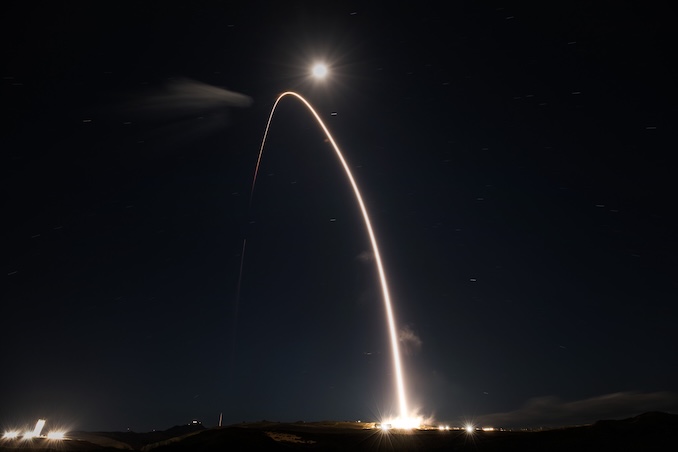
The mission, designated USSF-317, flew from Space Launch Complex 4 East at Vandenberg Space Force Base at 8:20 p.m. PST / 11:20 p.m. EST (0420 UTC on Saturday, Nov. 21). The rocket took off on a south-easterly trajectory upon leaving the pad.
Following deployment, the government issued a short statement, confirming publicly for the first time the intention of a series of missions launched this year that have received an ‘R’ designation in public filings.
“With three successful launches in two weeks, the Department of the Air Force is accelerating the development and launch of the Space Data Network Backbone constellation, advancing a government-owned and controlled communication system that will provide secure, high-speed data transport globally for the Joint Force,” said the Secretary of the Air Force Public Affairs in a press release.
“The accelerated schedule is on track to deliver regional capability this year and global support by next year.”
The Space Data Network (SDN) Backbone comes from the Portfolio Acquisition Executive (PAE) of the Space-Based Sensing and Targeting (SBST), an acquisition office within the Space Force. Back in May, the Space Force announced its award of a $2.29 billion contract to SpaceX to build a satellite constellation that “functions as an integrated network, providing robust, resilient, high-capacity, and low-latency data transport for the Joint Force.”
The Space Force said back in May that the SDN Backbone would operate alongside the Space Development Agency’s Transport Layer, a constellation of data relaying satellites manufactured by Lockheed Martin, Northrop Grumman, and York Space Systems.
Previously identified simply as ‘R’ missions assigned to SpaceX, these are the five previous such missions which include:
- Aug. 16 – USSF-366 (R-1)
- Sep. 10 – USSF-153 (R-2)
- Sep. 26 – USSF-385 (R-3)
- Nov. 06 – USSF-432 (R-4)
- Nov. 12 – USSF-627 (R-5)
Following each of these launches, 23 satellites have been catalogued. Prior to the Nov. 21 statement, the U.S. Space Force had not confirmed details about these satellites and has not made statements following these launches to confirm successful deployments.
SpaceX launched the USSF-317 mission using the Falcon 9 first stage booster with the tail number B1100. This was its 11th flight following the launches a NROL-105-, USSF-385, and eight batches of Starlink satellites.
A little more than eight minutes after liftoff, B1100 landed on the droneship, Of Course I Still Love You. This was the 235th landing on this vessel and the 679th Falcon booster landing to date.
SpaceX is scheduled to launch at least two more missions for the U.S. Space Force before the end of the month.
About the Author