
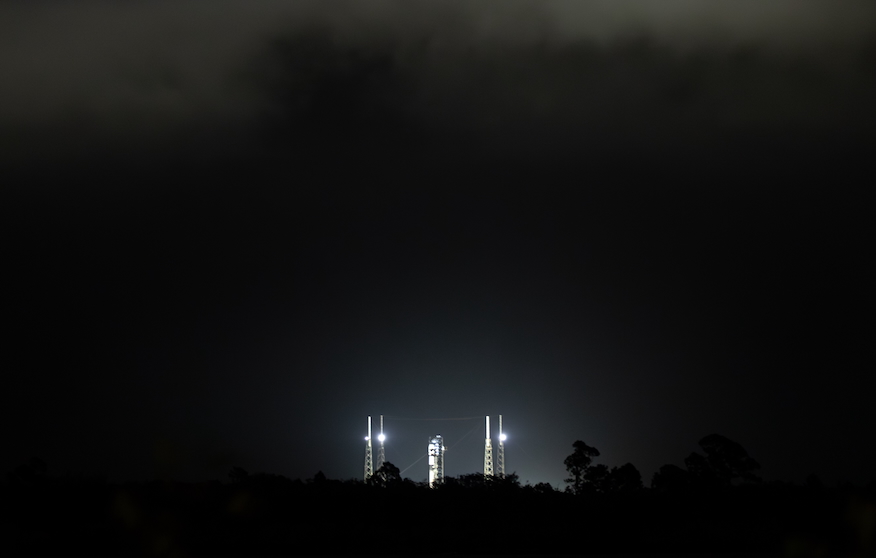
Updated at 1:57 a.m. EST, Feb 25: SpaceX scrubbed the launch attempt and is moving to one Tuesday night.
SpaceX is preparing to launch 21 Starlink V2 Mini satellites into low Earth orbit from Cape Canaveral Space Force Station on Tuesday. The company scrubbed a Monday launch attempt, likely due to weather, but didn’t publicly provide a reason for the delay.
The Falcon 9 rocket is targeting a liftoff from Space Launch Complex 40 at 10:47 p.m. EST (0347 UTC on Feb. 26).
Spaceflight Now will have live coverage beginning about an hour prior to liftoff.
On Sunday, the 45th Weather Squadron, based at Patrick Space Force Base, forecast a 60 percent chance of favorable weather conditions at the opening of the launch window, a percentage that improves to 80 percent by the end of the window. A low pressure system is expected to move through the Florida peninsula Monday bringing the possibility of showers and scattered clouds. The primary concerns for launch will be a violation of the thick cloud layers and cumulus cloud rules.
The backup window on Tuesday shows a 90 percent chance of favorable weather at liftoff.
SpaceX is using a new Falcon 9 first stage booster on this mission. The booster is believed to have the tail number B1092. That booster was spotted rolling by the Launch Complex 39A Press Site at the Kennedy Space Center on Friday morning following the launch of the Starlink 12-14 mission.
A little more than eight minutes after liftoff, the first stage booster will target a touchdown on the droneship ‘Just Read the Instructions.’ If successful, this will be the 111th booster landing on JRTI and the 413th booster landing to date.
Among the 21 Starlink satellites on board are 13 that feature Direct to Cell capabilities.
About the Author
