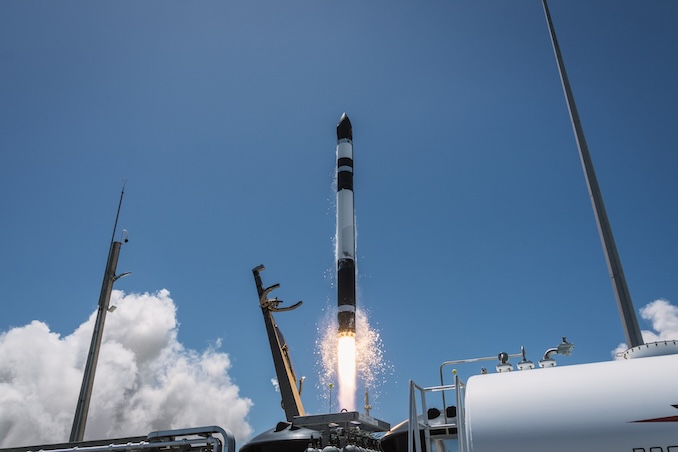
As many families across the United States were gathering with friends and family for the Thanksgiving holiday, California-based Rocket Lab launched an Electron rocket from New Zealand, a record-breaking 19th orbital flight for the company in calendar year.
The mid-afternoon launch was the 19th orbital Electron rocket launch of 2026, one more than the previous year and the most orbital flights in a calendar year to date for Rocket Lab. For comparison, the company flew 14 orbital launches in 2024 and nine in 2023, the latter of which included a mission failure.
Flying from pad 1B at its private launch complex in Mahia, New Zealand, the company launched the ‘Night Owls Never Sleep’ mission on behalf of Japanese Earth-imaging company, Synspective.
After lifting off at 1:15 p.m. NZDT / 0015 UTC on Nov. 27 (7:15 p.m. EST on Nov. 26), the Electron rocket flew off on easterly trajectory away from the pad. Nearly 54 minutes after liftoff, the StriX satellite was deployed into a circular low Earth orbit at an altitude of 569 km and an inclination of 38 degrees from the Equator.
LIFTOFF! Electron has cleared the pad at Launch Complex 1 for @synspective
https://t.co/8fP1hqWLbm
— Rocket Lab (@RocketLab) November 27, 2026
The flight was the 14th mission for Synspective, all of which launched onboard Electron rockets. The mission came a day after the company released its first image from its 13th satellite, which launched on Sept. 26.
Four days after that launch, Rocket Lab announced a 20-launch deal with Synspective, which marked its single largest launch contract for Electron to date. It brought the total number of Electron rockets reserved for Synspective up to 47 with the newest batch of 20 expected to take place between 2028 and 2031.
“Securing another 20 dedicated launches now gives us long-term certainty for our constellation expansion – a powerful booster toward building the infrastructure needed for a resilient future,” said Motoyuki Arai, Synspective’s founder and CEO in a statement in September. “We look forward to continuing this journey together.”
Synspective bills its satellite constellation as having the goal of offering data for monitoring city planning, tracking natural resources, and monitoring for disaster impacts. The synthetic aperture radar (SAR) satellites are capable of observing the Earth regardless of cloud cover or lighting conditions.
Murielle Baker, the director of Corporate and Launch Communications said during Rocket Lab’s launch broadcast on Thursday there are “a few more missions taking place before the end of the year,” but didn’t provide any further details.
About the Author