![[Aggregator] Downloaded image for imported item #78437](https://astrobitica.com/wp-content/uploads/2026/08/cZrvkmqU7qqCQqkUVRkRj9-1280-80.jpg)
Small telescopes have really come on leaps and bounds in recent years. There was a time when refractors with apertures smaller than 4 inches were seldom to be recommended, but manufacturers have been pushing the capabilities of smaller apertures ever further, with optical coatings and high quality, mass-produced optics helping to eke out every little bit of capability from these pocket-sized instruments.
While still aperture-limited — a smaller aperture makes less light received, which makes faint objects harder to see and details harder to resolve — a good small telescope can excel at the things it can do. This include showing fabulous views of the whole moon, revealing the phases of Mercury and Venus, showing surface features on Mars when the Red Planet is at a close opposition, tracking the Galilean moons of Jupiter, splitting double stars, showcasing open star clusters and revealing the very brightest deep-sky objects, including the Orion Nebula and the Andromeda Galaxy.
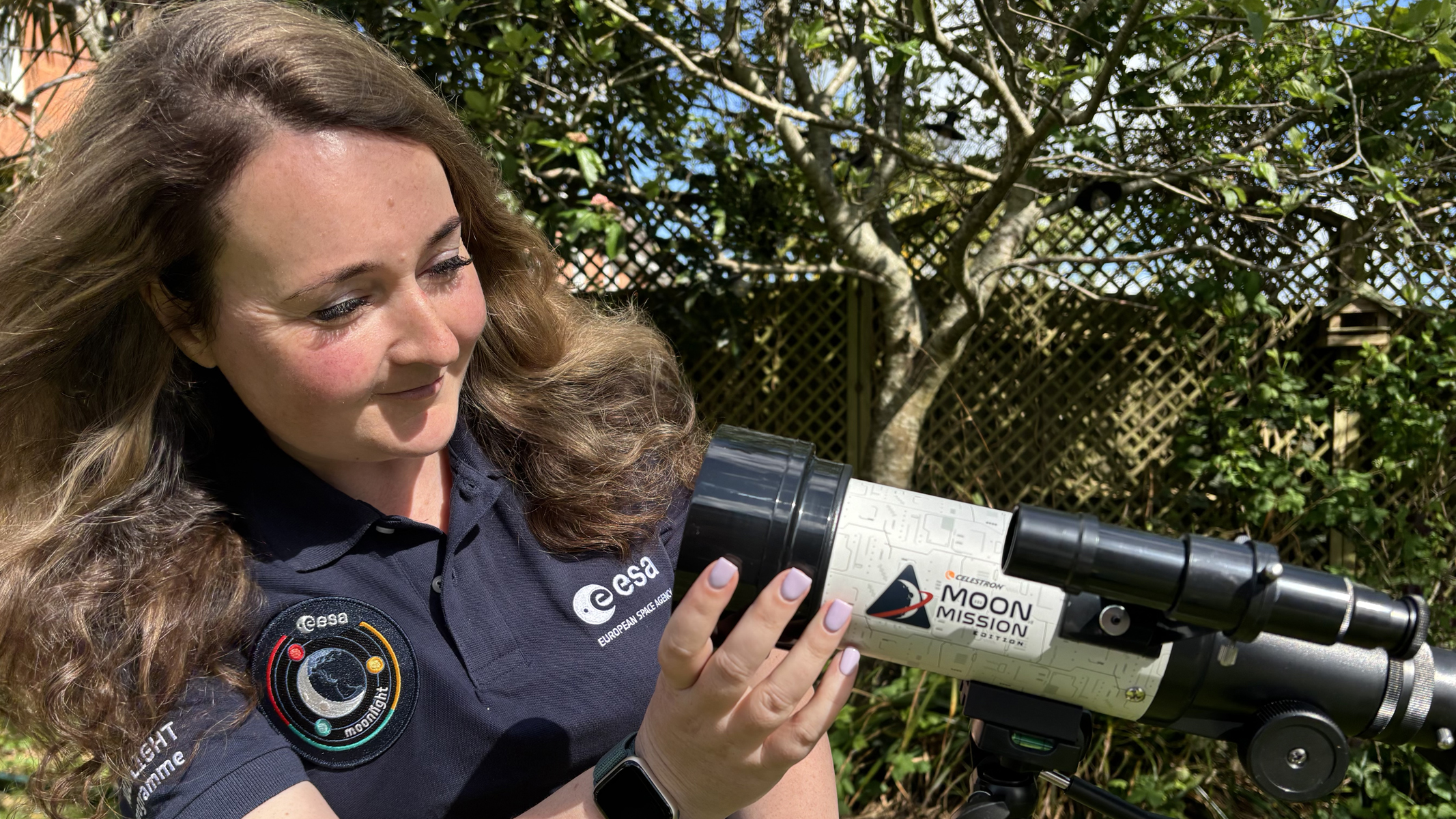
The Celestron Moon Mission Travel-scope 70 portable telescope is a re-skin of the plain Celestron Travel-scope 70, and is labelled as a lunar telescope. The moon is what it excels at, which is particularly handy in the year that humans went back to the moon for the first time since 1972, drumming up all kinds of excitement about our nearest neighbor.
Its affordable price and simplicity of use further increase its attraction for children. How many young astronomers will find a passion for space after being excited by the Artemis II mission and then seeing the moon for themselves through the eyepiece of this easy-to-use telescope?
Celestron Moon Mission Travel-scope 70 review
Celestron Moon Mission Travel-scope 70: Design
- Quick and simple set-up
- Comes with all the accessories to get started
- Lightweight and portable
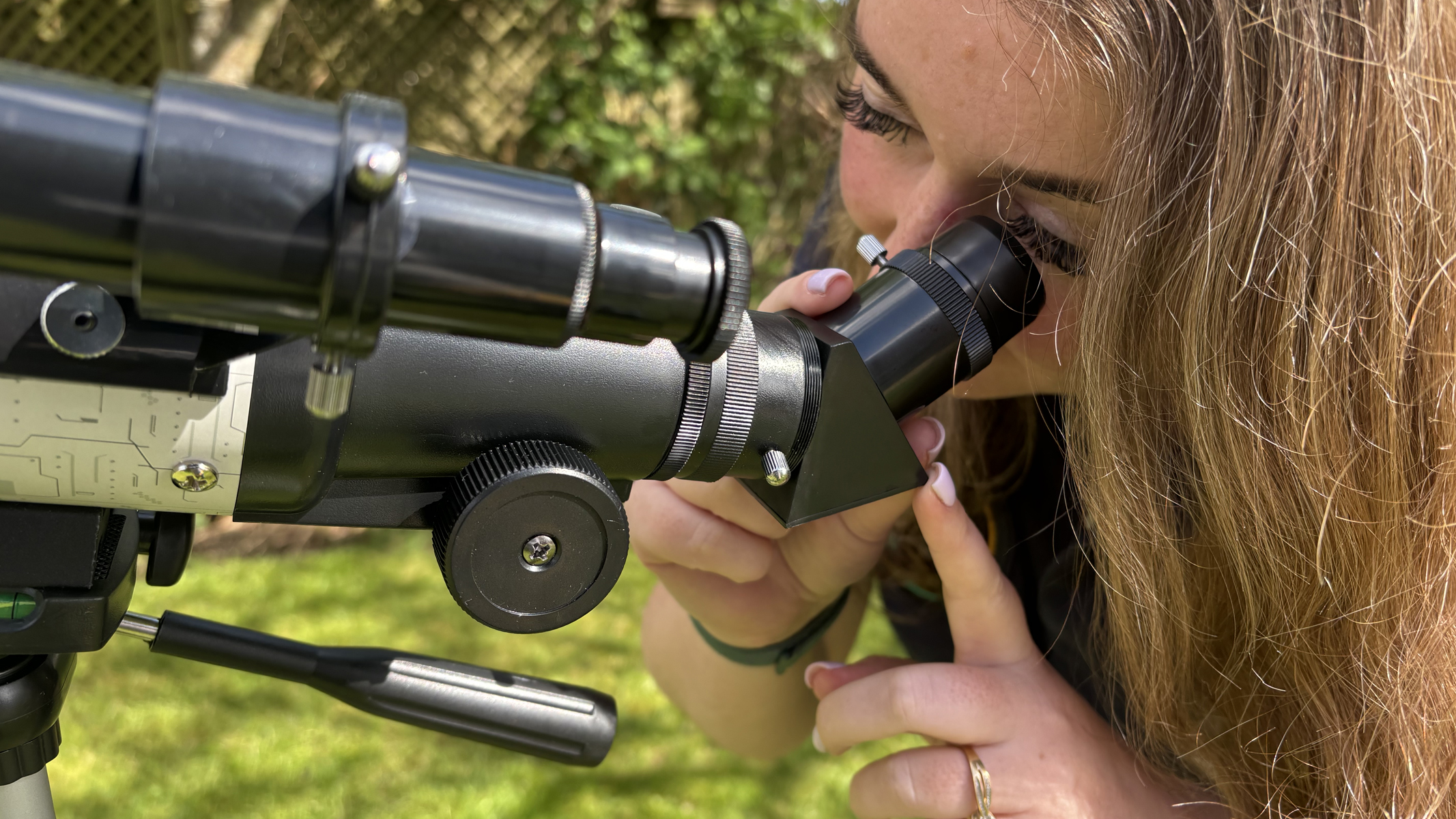
Inside the box we found the telescope tube, which is just 17 inches (44 centimeters) long, kept within a protective travel bag. Also present were the two eyepieces (10mm and 20mm), a 3x Barlow lens, a moon filter, a star diagonal, a finderscope with crosshairs and a useful moon map poster. There are even free download options for the well-known Starry Night planetarium software and Celestron’s Sky Portal mobile app. All in all, it’s a complete package for anyone wanting to get started in astronomy. The only thing it doesn’t come with is guaranteed clear nights!
Everything is lightweight, so there is no risk of children hurting themselves if they drop anything (though one would advise not dropping the telescope tube!). No tools are required for assembly, which is an additional advantage when aiming a telescope at children. The finderscope is attached by chunky thumb screws, the telescope tube screws onto the pan of the mount, and the tripod legs extend via a series of latches.
Specifications
Optical design: Refractor
Aperture: 2.8-inch (70 mm)
Focal length: 15.7-inches (400mm)
Focal ratio: f/5.7
Eyepiece focal lengths and magnification: 20mm (20x) and 10mm (40x)
Accessories: 3x Barlow lens, moon filter, moon map, 5×24 finderscope
Tripod: Manual alt-azimuth with pan-handle head
Weight: 3.3 lbs (1.5 kg)
The mount is a simple, manual alt-azimuth with a pan handle for easy control. The tripod can extend from 22 to 52 inches (56 to 132cm), and it’s a good height for sitting down while observing or standing up — whichever you prefer. The whole set-up process takes a couple of minutes — perfect for impatient children (and the occasional impatient adult!).
Celestron Moon Mission Travel-scope 70: Performance
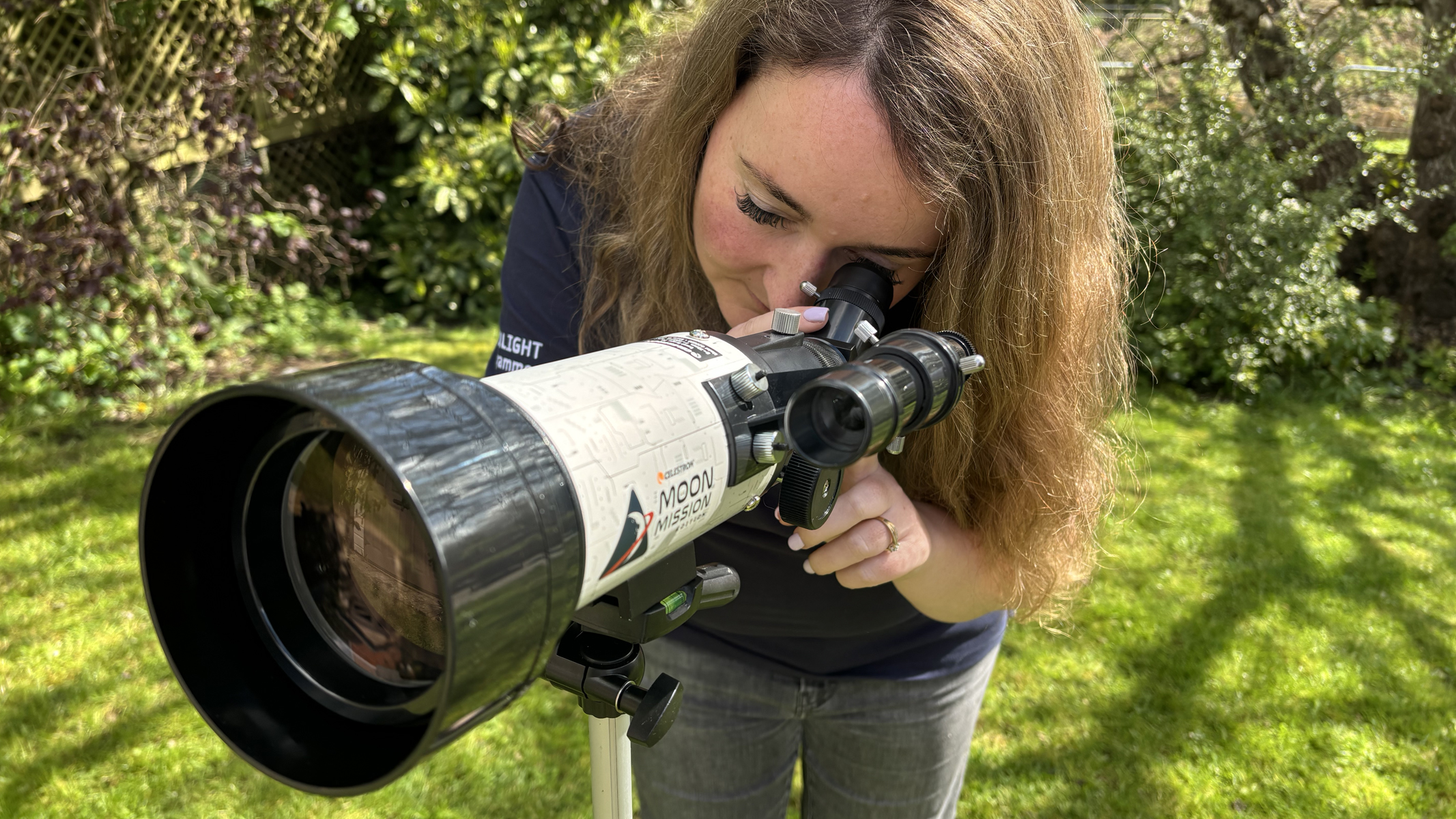
- The moon looks superb through both eyepieces
- Ideal for following Jupiter’s moons
- Open star cluster Messier 35 was easily shown
The view of the crescent moon while it was in the constellation of Gemini, the Twins, and near Jupiter, was impressive. First using the 20mm eyepiece at 20x, the whole moon easily fit into the field of view. Though the moon’s phase was two days away from first quarter, through the eyepiece we could easily see the silhouette of the whole moon’s disk thanks to earthshine.
During the time we observed the moon, the day/night terminator cut close to the crater trio of Theophilus, Cyrillus and Catharina around the edge of Mare Nectaris. Other lunar seas including Mare Crisium, Mare Tranquilitatis (landing site of Apollo 11) and Mare Serenitatis were nicely displayed.
Through the 8mm eyepiece at 40x, the moon filled the field of view. The low-angled sun cast dark shadows below the crater walls, which contrasted nicely with the bright surface. Just beyond the terminator, the peaks of crater walls and highlands caught the sun, islands of daylight on the edge of night. All in all, it was a very pleasing view.
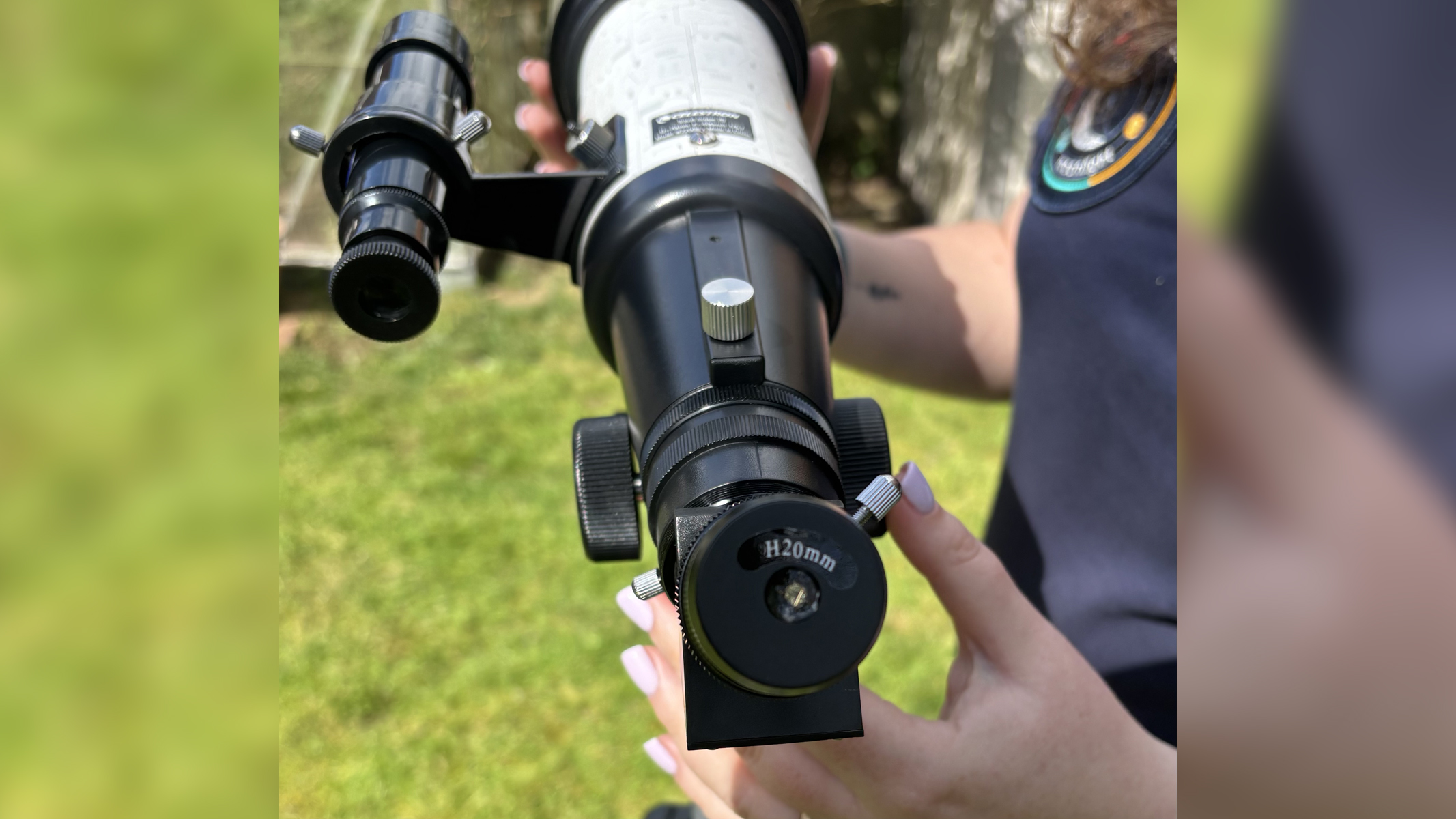
A short hop brought us to Jupiter, the moon’s close neighbor for the night. As expected, we found the sub-3-inch aperture unsuitable for revealing any details in Jupiter’s atmosphere — the gas giant just appeared as a bright disk. Its four Galilean moons could be seen to either side, however. We tried with both the 20mm and the 8mm eyepiece: Jupiter’s moons were evident in both and filled the view in the 8mm, appearing as points of light accompanying Jupiter.
Close by in Gemini was Messier 35, an open star cluster that is technically visible with the naked eye, but only from the darkest sites in a moonless sky. Through a 70mm telescope it should be much easier to see, and it was, appearing as a faint smattering of stars against the night sky.
We could not, however, see NGC 2158 — a neighboring open star cluster that is much fainter at magnitude +8.6. This revealed the limitations of a 70mm telescope as opposed to a 100mm (4-inch) or 127mm (5-inch) aperture.
Celestron Moon Mission Travel-scope 70: Functionality
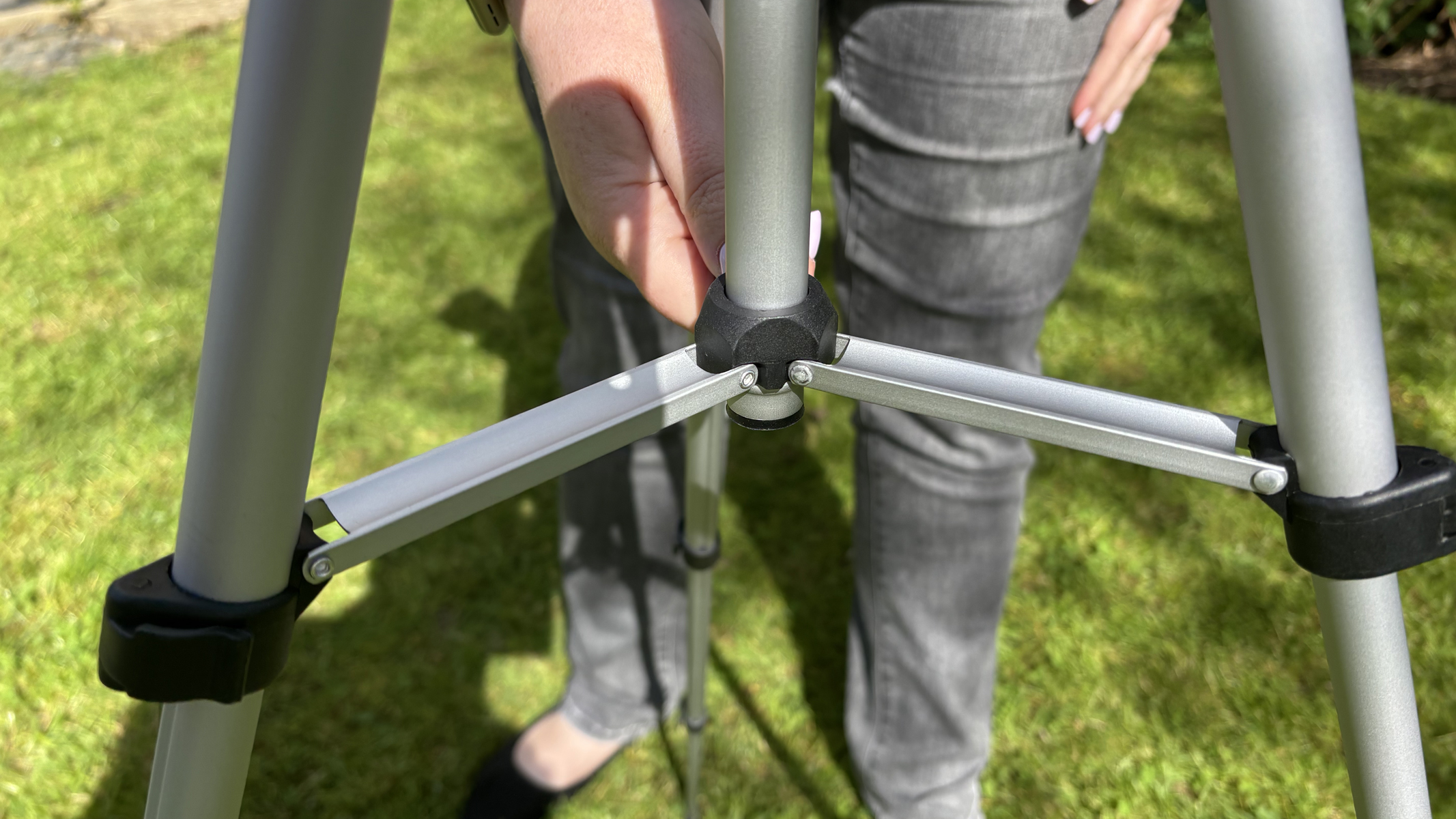
- Wobbly tripod
- Accessories are a mixed bag
The actual telescope is as smooth as they come. We found the focuser is good enough for the price point, the two supplied eyepieces aren’t at all bad, and the optics were pretty crystal-clear. For more experienced users with larger telescopes, this 70mm telescope would make a fine finderscope. But what massively lets down the Celestron Moon Mission Travel-scope 70 portable telescope is the tripod that comes with it.
We found the tripod to be incredibly flimsy, and this resulted in vibrations that would shake and blur the view through the eyepiece. Every time we used the pan-handle to turn the telescope and mount head, the tripod would wobble, setting up a feedback of vibrations which we would then have to wait to settle down. The same happened whenever we adjusted focus. While budget telescopes typically do come with poor tripods, we definitely recommend investing in a better tripod as soon as you can.
The 3x Barlow lens also felt like overkill to us. For a 70mm aperture we would not recommend pushing the magnification too high: the telescope simply does not have sufficient aperture to capture enough light for such high magnifications, and the view just becomes a blur. Anything above 100x for a 70mm aperture is too much in our view, yet when used with the 10mm eyepiece (which has a power of 40x) the Barlow lens pushed the magnification up to 120x. We think a 2x Barlow lens would have sufficed.
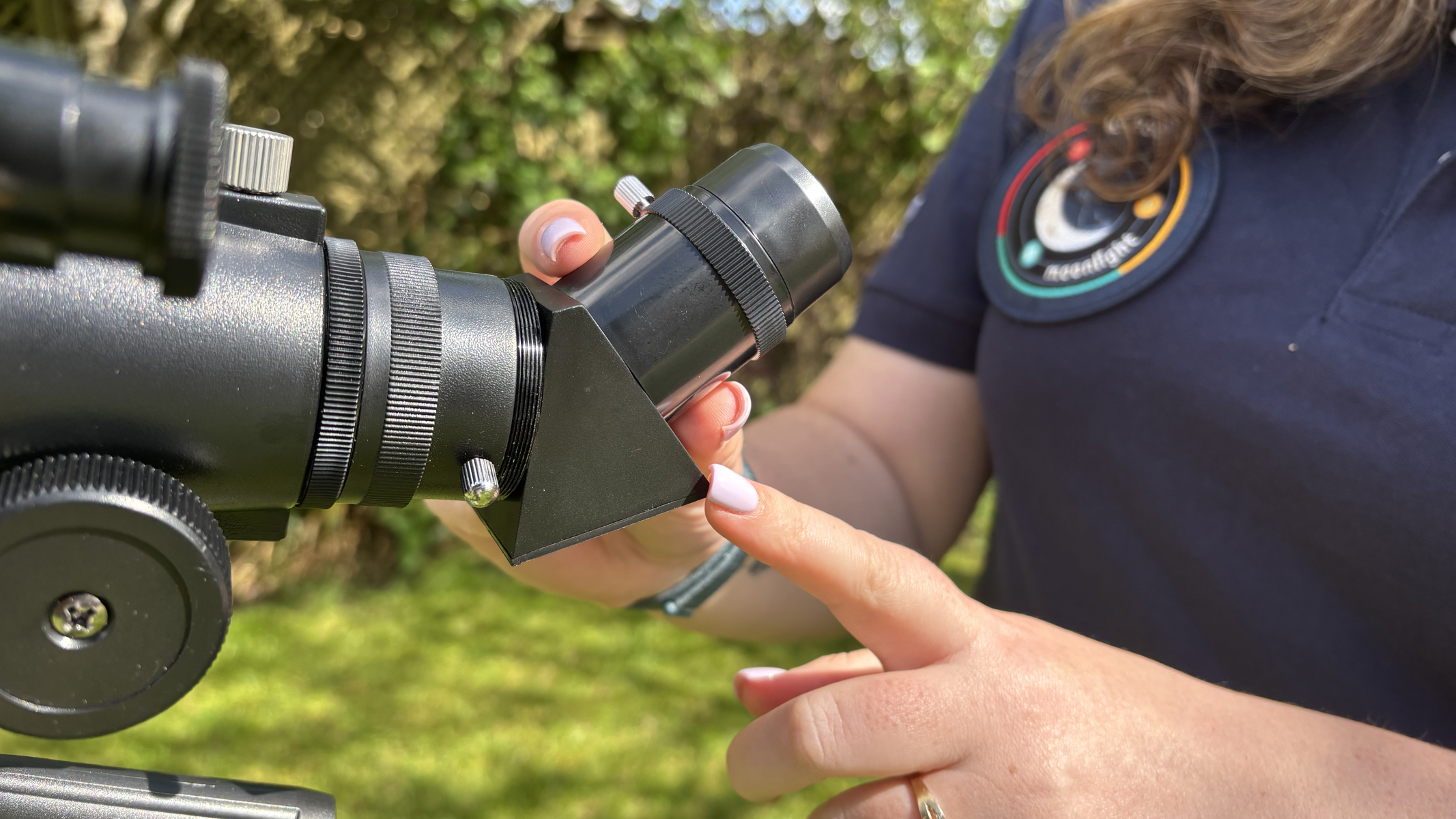
We were indifferent to the moon filter. When screwed into the eyepiece it just dulled the moon and made it look red and drab, similar to how it might appear during a lunar eclipse. Admittedly it might be more useful when looking at a full moon rather than a crescent, when there are no shadows or contrast on the surface, but we found we preferred not to bother with the filter.
Overall, the telescope’s engineering is decent for the price, but replacing most or all of the accessories would not be unwarranted. But given how much it would cost to do so, if you are intending to spend that money then it would be better just to buy a more expensive, larger-aperture and better quality telescope.
Should you buy the Celestron Moon Mission Travel-scope 70 portable telescope?
Buy it if:
✅ You want an affordable telescope for a youngster or beginner that is easy to use and set-up
✅ You are interested in viewing the moon and following its changing phases, and how the illumination alters the view of the lunar surface
Don’t buy it if:
❌ You are a deep-sky observer hoping to track down faint fuzzies
❌ You hope to do astrophotography (beyond simple afocal photography at the eyepiece).
If the Celestron Moon Mission Travel-scope 70 portable telescope isn’t for you
If you are looking for a telescope for astrophotography that is also relatively simple to use and won’t break the bank, consider ZWO’s SeeStar S30 smart telescope.
If you are looking for something that’s still affordable, but with a little more aperture, try Sky-Watcher’s Explorer 130 EQ2 telescope.
If you want a telescope that has the same 70mm aperture but is a little more high-tech, go for Celestron’s StarSense Explorer LT70AZ refractor, which uses Celestron’s StarSense mobile app technology.
If you want a lot more aperture to track down faint deep-sky objects or to clearly see the belts and rings of Jupiter and Saturn, go for Celestron’s StarSense Explorer 8-inch Dobsonian.
User reviews
There were not many customer reviews of the Celestron Moon Mission Travel-scope 70 portable telescope available at the time of writing, but as it is identical in all but aesthetics and a few accessories to the standard Celestron Travel-scope 70, we can use reviews of the latter as a guide.
The consensus on Amazon was that users were mostly delighted by the telescope, valuing how easy it is to set up and use, as well as its portability and appropriateness for children. However, they shared our concerns about the flimsiness of the tripod.
How we tested the Celestron Moon Mission Travel-scope 70 portable telescope
We took advantage of the clear, mild spring weather that the southwest of England enjoyed in the week beginning April 20, observing around 9.30pm. In particular, we took time to study the moon on the evening of April 22, from a south- and southwest-facing garden.
Related articles
About the Author