If we ever intend to send crewed missions to Mars, as NASA and China plan for the coming decades, several criteria must be met. Some of the most pressing are the need for more advanced propulsion, technologies that will ensure astronaut health and safety, and propellant for the return trip. Depending on the mission architecture, one option is to have refueling depots on Mars that leverage In-Situ Resource Utilization (ISRU) to manufacture propellant.
At the Massachusetts Institute of Technology (MIT), PhD candidate Lanie McKinney and researchers with the Aerospace Plasma Group are working to build technology that will convert Mars’ atmosphere into propellant. The technology will use cold plasma to convert Mars’ abundant carbon dioxide into oxygen and carbon monoxide, which could support for life support systems and propellant stations on Mars.
Through MIT’s Space Resources Workshop, McKinney has participated in NASA competitions that sought innovative solutions to living sustainably in space. This student-founded and led group develops proof-of-concept systems to support ISRU on the Moon and Mars. For her first competition, she and her teammates were tasked with designing a self-sustaining Mars mission that would last for 10 years.
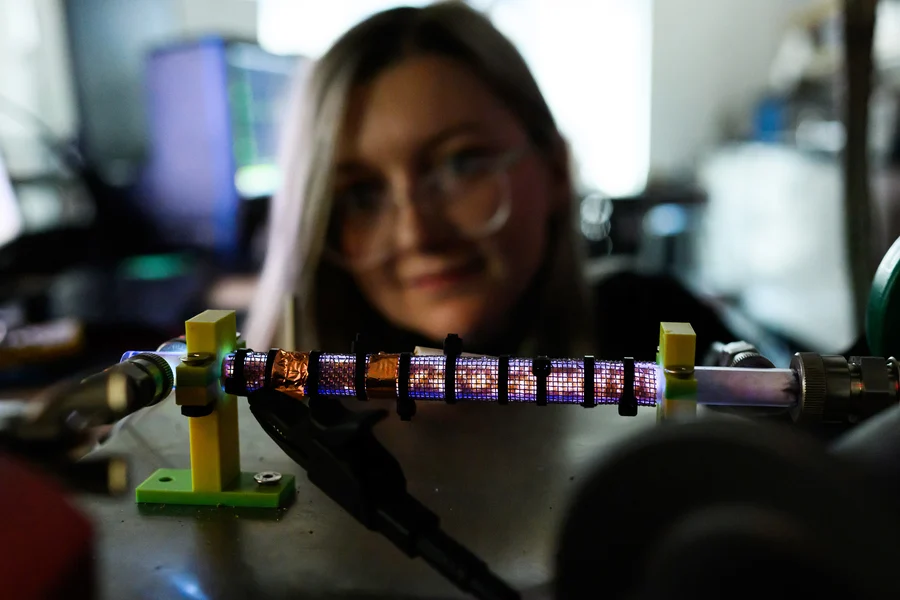 McKinney and her Nanosecond Repetitively Pulsed Dielectric Barrier Discharge (NRP-DBD) device. Credit: Gretchen Ertl/MIT News
She also participated in NASA’s LunaRecycle Challenge back in March, where she co-led MIT’s Composites for Extraterrestrial Recycling By Engineering the Reuse and Upcycling of Zotek (CERBERUZ) team. The team recently won first prize in Phase 2 for a system that grinds mixed trash into powder that can be reused via injection molding to make spare parts and 3D-printing filament, for which they were awarded $775,000.
Under the mentorship of Carmen Guerra-Garcia, the Esther and Harold E. Edgerton Associate Professor at MIT, McKinney has developed a small plasma reactor that handles the conversion process. It’s known as a Nanosecond Repetitively Pulsed Dielectric Barrier Discharge (NRP-DBD), a type of plasma reactor that extracts oxygen from carbon dioxide. Her current work combines the reactor with an oxygen-selective membrane that extracts oxygen rapidly to prevent it from recombining with CO after initial separation. This is a challenge because the conversion process is not yet well understood, and it is unclear how the membrane will respond to the reactive plasma environment.
“We can actually perform the conversion step really well,” McKinnley said in an MIT News story. “But what happens in a plasma is we convert it, and then we get a mixture that needs to be separated. We are not entirely sure what we will see.”
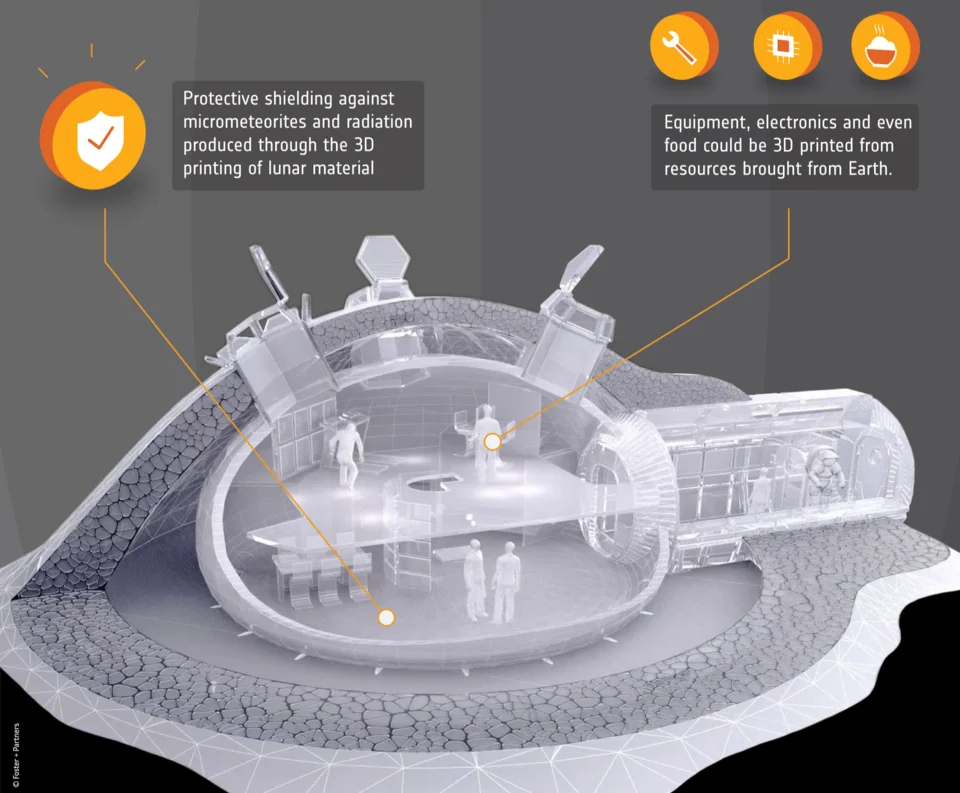
Another project McKinney participated in brought engineers and architects together through MIT’s Space Architecture course, the goal of which was to develop ideas for protecting lunar habitats from radiation using only lunar resources. McKinney and her team’s solution was to produce bricks from lunar regolith that could be stacked without mortar or binders.
One possible technology for building habitats on the Moon and Mars involves 3D printing from local resources (Credit: ESA)
Said McKinney, these and other efforts taught McKinney that solving the problems of human space exploration requires collaboration across disciplines:
The kinds of innovative solutions that can be discovered when you work on a team that brings together different expertise and experiences was one of the project’s major takeaways. I feel like I have learned so much from being a part of these different teams. I love to explore and go on adventures. And space is the ultimate thing you could explore.
This same spirit of collaboration is essential to achieving the next steps that follow reaching the Moon and Mars. Developing the technology and solutions needed to get astronauts there is only the first step. If humans intend to work (and eventually live) for extended periods on the lunar and Martian surface, solutions are needed that can only come from multi-disciplinary cooperation, as well as public-private and international partnerships.
“If we don’t build gas stations on Mars, it will be very difficult to get humans back to Earth. We’re going to need some way to produce the propellant on site. What comes next is building up a permanent presence so that we can do amazing science and be really effective at exploration.”
Further Reading: MIT
About the Author

Source: Universe Today