Something deep inside Mars has scientists looking for clues to its internal evolution. A team at the University of Arizona and Brown University, led by Alexander Byrne, used a technique called “tidal tomography” to probe a heat anomaly in the southern hemisphere mantle. It turns out this subsurface region measures about 200 to 400 degrees Celsius warmer than the rest of the mantle. That warm spot may contain information about heating inside the planet and how Mars has changed over its lifetime.
The hot spot shows up in tracking data from the Mars Global Surveyor, Mars Odyssey, and Mars Reconnaissance Orbiter taken over a period of 16 years. What the data show are the effects of seasonal tidal forcing as Mars orbits the Sun. According to Brown University postdoctoral researcher Nick Wagner, who is part of Byrne’s team, slight changes in the Martian orbit force slight changes in Mars’s shape.
“As Mars travels around the Sun, the Sun’s gravity gently stretches and squeezes the planet,” said Wagner. “Because Mars’ orbit is not a perfect circle, the strength of this pull changes over the course of a Martian year, so the amount that Mars deforms changes as well. This deformation is called a tidal bulge. This tidal bulge causes mass inside the planet to shift slightly, producing tiny changes in its gravitational pull. An orbiter passing over a region with slightly stronger gravity speeds up a little, while one passing over slightly weaker gravity slows down. So, we can use the measured speed changes of orbiters to estimate the amount Mars is squishing.”
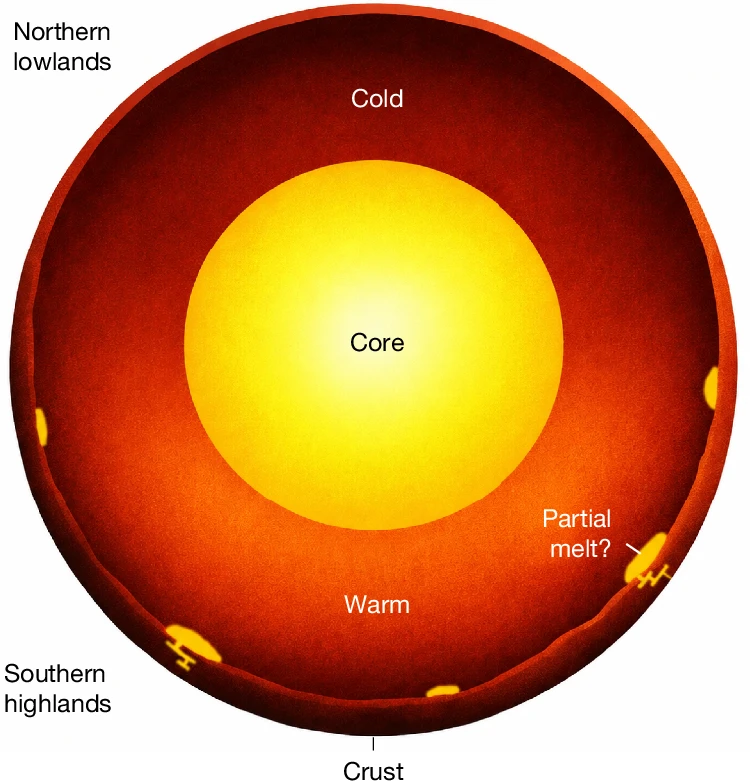
Temporal variations in gravitational changes indicate some kind of thermal anomaly within Mars’s mantle under the southern highlands of the planet. It may be inducing partial melting beneath the surface, but it gets stalled by the crust before reaching the surface. That upwelling could result in thickening and enhanced magnetization across Mars’s southern highlands. The mantle under the northern highlands is thinner and comparatively cool. Credit: Byrne et al.
Tidal Forcing Shapes a World
Mars isn’t the only world to undergo this kind of tidally induced shapeshifting. Jupiter’s moon Io is the poster child for such activity. As it orbits Jupiter, Io is tugged by both Jupiter and the moon Europa. The pulling activity stretches Io, and that results in a heavy amount of volcanic activity.
It also happens on Earth, according to Wagner, who pointed out that similar measurements have been made using GPS stations. “My postdoctoral supervisor at Brown University, Harriet Lau, helped constrain the buoyancy of two large “blobs” underneath the Pacific Ocean and Africa called the Large Low Shear Velocity Provinces,” he explained. “What’s interesting is that there is also a compositional component, meaning it’s not just a temperature difference. I think this Martian anomaly may also have a compositional component, but a follow-up study will need to be done.”
The big question is how the warm spot in Mars’s southern mantle came into existence. It could have been there since the formation of the planet, some 4.5 billion years ago. If that happened, then it definitely influenced Mars’s geodynamic evolution. It’s also possible that the anomaly was created due to an ancient impact. Interestingly, the southern hemisphere crust is a lot thicker than the north on Mars, and that could have protected the mantle and kept it warmer throughout Mars’s evolutionary history. If any of these happened, then a lot of work needs to be done to help researchers understand how they influenced the creation of the warm spot.
Understanding Tidal Tomography
The scientific technique of tidal tomography uses signals to measure shifts in the shape of a planet or moon. It allows scientists to “look inside” a planet without actually digging into the surface. It can provide information about the composition of the crust and mantle of Earth and Mars, as well as nuances in their orbits. The ongoing measurements made by spacecraft orbiting Mars will continue to chart changes as Mars makes its way around the Sun. In the future, scientists using the Jupiter Icy Moons Explorer (JUICE) will use a specialized radio science experiment onboard the spacecraft to map the gravitational field of Jupiter’s moon Ganymede and give them new insights into the interior of that world. In addition, measurements of its deformation due to tidal influences should help scientists determine the existence and depth of the moon’s interior ocean and the depth and strength of its outer icy shell. Other worlds that could benefit from such studies include Mercury and Enceladus (at Saturn).
For Mars, continued measurements should give new insights into the differences in crust thickness on Mars (its “crustal dichotomy”), as well as any tectonic activity within the Red Planet. The southern hemisphere anomaly isn’t the only region worth studying. In their paper, the Byrnes team noted that future studies could also help researchers understand the thermal models of the planet and the influence of deep-seated volcanic activity (magma production) at Mars.
For More Information
Researchers Reveal Warm Heart of Mars with Help from Gravity and Orbiting Spacecraft
Tidal Tomography Reveals a Thermal Anomaly Beneath Mars’s Crustal Dichotomy
Prospects of Using Tidal Tomography to Constrain Ganymede’s Interior
About the Author

Source: Universe Today