
PARIS — Icarus Robotics, the New York startup developing dexterous mobile robots for space missions, conducted tests of its free-flying platform ahead of a 2027 demonstration on the International Space Station.
“We had to work with [Canadian astronaut] Chris Hadfield to get a capability to do testing,” Ethan Barajas, Icarus CEO and co-founder, told SpaceNews in a recent interview, citing a lack of U.S. facilities.
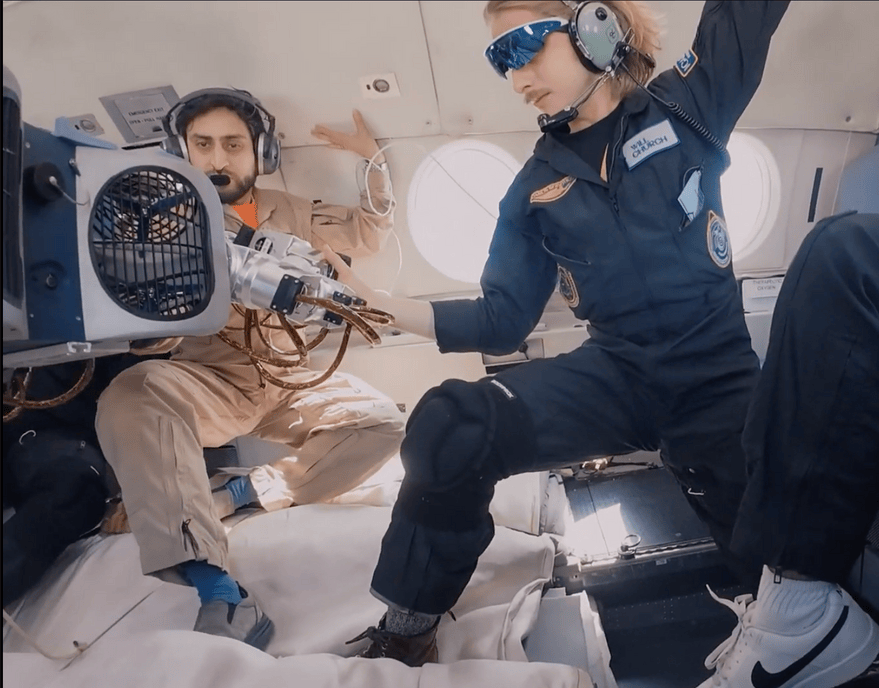
Ahead of Joy’s 2027 ISS demonstration, Icarus tested Joy, a robot with manipulators for dexterity, in four parabolic flights, acquiring a total of 22 minutes of microgravity operations. The testing demonstrated the performance of Joy’s flight controller, sensor suite and manipulation capabilities. Through the flights, Icarus personnel also rehearsed scheduling, crew coordination and safety procedures, Icarus announced Sept. 17.
“This test marks a turning point — not just for Icarus, but for what’s possible in space robotics,” Barajas said in the news release. “The commercial space era is arriving faster than anyone expected, and the infrastructure to support it has to keep pace.”
Joy is one step toward the “robotic workforce that maintains orbital data centers, assembles lunar infrastructure, and makes sustained human presence in space viable,” Barajas added.
Microgravity flights
Icarus conducted its testing campaign in Canada because no U.S.-based operator is currently offering parabolic flights. Similarly, Starlab Space plans to conduct microgravity testing at the Center for Space and Aviation Switzerland and Liechtenstein.
“Washington and private capital are moving heavily into commercial space, including the stations meant to succeed the ISS when it retires around 2030,” according to the Icarus Robotics news release. “The domestic capacity to develop and validate the hardware that goes inside them has not kept pace with the capacity to launch it.”
Historically, U.S. firms have turned to Florida-based Zero-G. But the company’s flights are “temporarily paused,” according to its website.
Startup Mu-g Technologies is preparing to conduct parabolic flights in a Dassault Falcon 50 business jet. In addition, NASA awarded a contract in June to Denmar Technical Services to modify a 737-700 for microgravity tests.
About the Author