The more scientists learn about Earth, the more habitability appears to involve an almost kaleidoscopic array of variables and interactions. Though our current search for potentially habitable worlds is mostly restricted to finding rocky planets with liquid water and atmospheres, it will have to advance well beyond that to bear fruit. Things like exoplanet plate tectonics to keep climates moderate, and stars with long, stable lifetimes that let life fluorish and evolve are factors in habitability.
New research suggests that another factor may come into play: mountains. The research is titled “Raising mountains for a habitable Earth,” and it’s published in Science Advances. The lead author is Dr. Matthijs Smit of the University of British Columbia’s Department of Earth, Ocean and Atmospheric Sciences.
Their main claim is that mountains are critical because they increase the surface area exposed to weathering, and that makes important chemicals and nutrients available, as well as changing the chemistry of the oceans and the atmosphere. That, in turn, led to the eventual appearance of complex life.
“The formation of mountain belts (orogens) elevates rocks above sea level, making them available for chemical weathering and altering the composition of the atmosphere and oceans, which in turn control habitability,” the authors write.
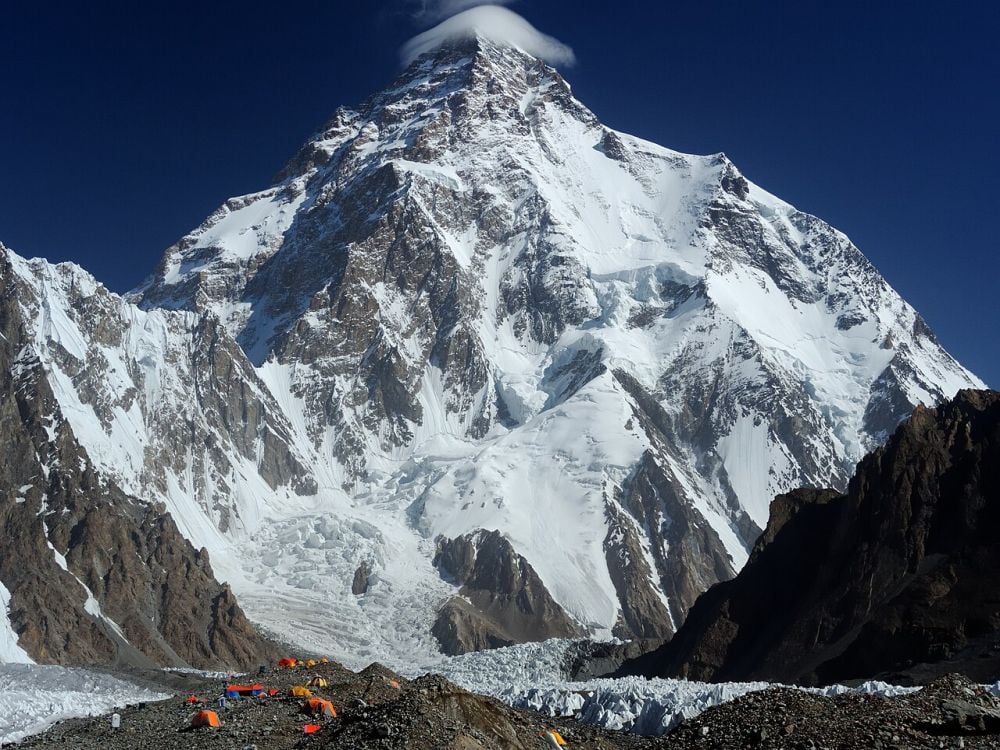
K2 is the second tallest mountain in the world. The crust underneath it is some of the thickest in the world. Research shows that in Earth’s past, the crust thickened in some places, leading to the growth of very tall mountains. Increased weathering from those mountains preceded the planet’s episodes of oxygenation, and researchers hypothesize that episodic spurts of mountain growth enabled Earth’s habitability, and the eventual appearance of complex life. Image Credit: By Zacharie Grossen – Own work, CC BY-SA 4.0, https://commons.wikimedia.org/wiki/Special:Redirect/page/42469860
“Continental silicate weathering controls the oceanward flux of carbon and bioactive nutrients that limit marine primary productivity, thus exerting control on atmospheric chemistry, climate, and marine biomass and biodiversity,” they explain. “The majority of the global terrigenous runoff derives from mountainous regions.”
The researchers focused on the last three billion years of Earth’s history. They examined metamorphic rocks that were pushed deep underground by overlying tectonic plates. When mountains formed where plates collided, the mountains were able to reach much greater heights. That raised nutrient levels in the oceans, which helped photosynthesizing lifeforms oxygenate Earth’s atmosphere.
‟Changes that occurred deep in the Earth ultimately gave rise to much taller mountains over time, which may have made our planet habitable by providing the nutrients needed for life to form and flourish,” lead author Smit said. “Nutrients such as phosphorous are essential ingredients for life on our planet, but prior to three billion years ago, these elements were locked in the Earth’s crust and the oceans were quite nutrient-starved. All this changed when tall mountains started to develop.”
The research shows that two periods of peak metamorphic pressure inside the planet, between 2.7 to 2.2 and 0.8 to 0.7 billion years ago, led to thicker crusts in mountain-forming regions, and that let taller mountains form. The growth of Earth’s mountains spiked, and those orogenic growth spurts were synchronous with other important changes on the planet.
‟The first growth spurt may have led to the emergence of land on a large scale for the first time, while the second growth spurt thrust mountain ranges to enormous heights,” said co-author Dr. Douwe van Hinsbergen of Utrecht University, The Netherlands. ‟Given such profound effects, mountains may well have played a far greater role in the creation of a habitable planet than previously assumed.”
Earth’s atmospheric oxygen rose in distinct periods, and the most well-known and consequential one was the Great Oxygenation Event (GOE) from about 2.4 to 2.0 billion years ago. The researchers say that by the time the GOE occurred, Earth’s mountains had grown substantially. They rose from near sea-level to about half the height of the modern-day Himalayas. Another distinct period of rising atmospheric oxygen was the Neoproterozoic Oxygen Event (NOE) from around 700 million to 500 million years ago. Mountain growth spiked at that time, too, according to the researchers. Various other atmospheric factors and oceanic factors related to habitability and complex life increased, too.
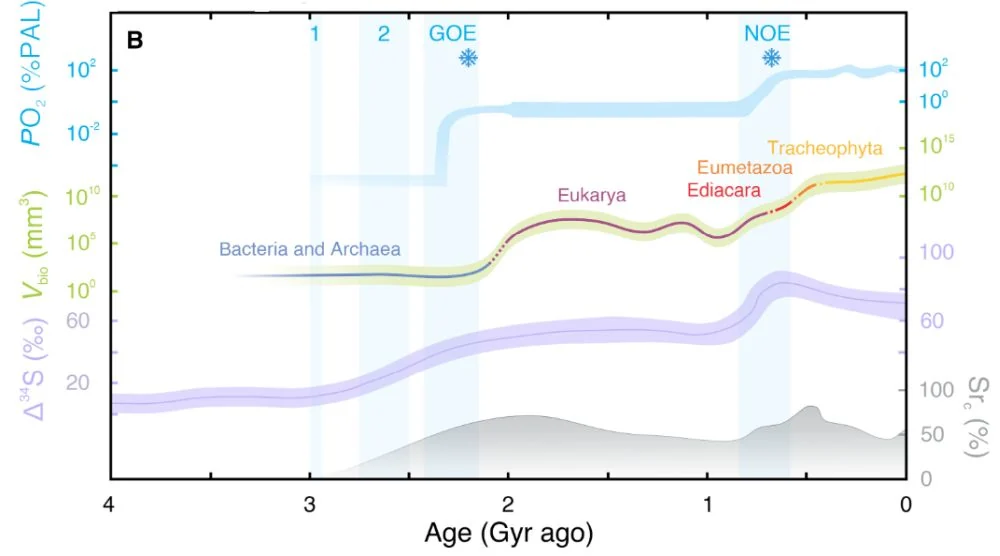
This figure shows time on the x-axis and more other information throughout. Blue shows how atmospheric O2 pressure rose compared to modern levels, especially during the GOE and the NOE. Purple shows the rise of sulfur isotope diversity, a measure of biological sulfur metabolism over time, and grey shows the percentage of oceanic strontium that comes from continental mountain erosion. Green shows the rise of organisms capable of oxygenic photosynthesis. The snowflake symbols show Earth’s main icehouse stages. Image Credit: Smit et al. Science Advances 13 Nov 2026 Vol 12, Issue 46
The timing of these spurts of mountain growth coincided with the growth of crustal thickness in mountain belts. In these belts, the thickness of the upper accreted crust grows as plates collide. The first episode increased thickness from 30km to 60 km, and the second episode saw an increase to almost 90 km. ‟We suspect that these increases are ultimately linked to the cooling of our planet,” Dr. Smit said. ‟As a result, the process that makes mountains changed, allowing mountains to grow taller.”
“Causes for environmental upheaval culminating in the GOE and NOE have been sought in various external forcing mechanisms, such as increased runoff resulting from supercontinent breakup, enhanced weathering of basaltic rocks at low latitude, and a dwindling CO2 (carbon dioxide) flux from arc volcanism,” the authors write. While the researchers agree that these are valid hypotheses, they also point out that they’re transient. That doesn’t match the “irreversible nature of global oxygenation,” and other changes. They’re also not restricted to periods preceding the GOE and NOE.
The two episodes of crustal thickening and resulting spikes in mountain elevation and erosion are a better fit. “In contrast to all of these processes, the orogenic growth associated with tectonic revolutions R1 and R2 broadly coincide with the major periods of environmental upheaval in terms of their approximate timing, paucity, and irreversibility,” the authors write.
The researchers couldn’t measure the height of long-gone mountains, but they were able to determine the density and thickness of ancient crust. Since crustal thickness and density correlate with mountain height, they could calculate the height of ancient mountains.
Earth’s tallest mountains today, Mount Everest, K2 and Kangchenjunga, are almost certainly some of the tallest ever produced. They approach nine km above sea level, and the crust under them is about 80 km thick. That’s twice as thick as other continents. They illustrate how crustal thickness generates tall mountains, and emphasize the hypothesis that mountain growth helped enable Earth’s habitability.
‟It’s likely not a coincidence that life on Earth developed and diversified approximately during the same period that the two growth spurts occurred,” said co-author Dr. Ellen Kooijman of the Swedish Museum of Natural History, Stockholm. ‟It’s exciting to think that mountain belts were once non-existent and that their development over the past three billion years may have driven the environmental and biological change that shaped our planet.”
About the Author

Source: Universe Today