
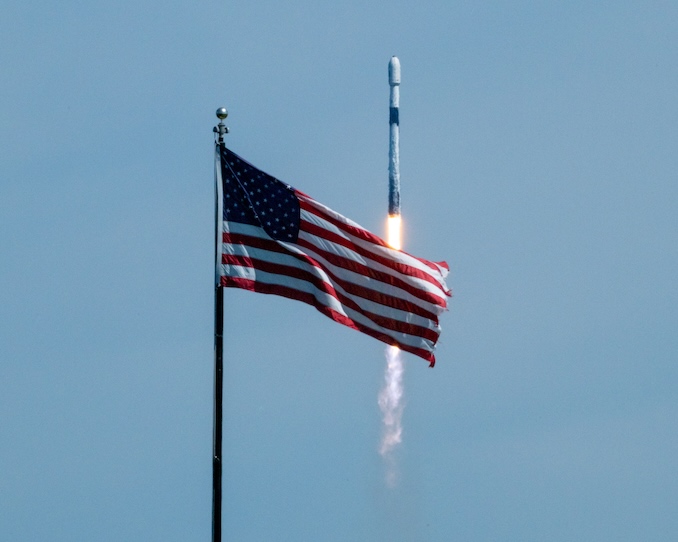
SpaceX launched a trio of satellites for its oldest commercial customer, SES, on a Falcon 9 rocket flying Sunday afternoon from Florida. This was SpaceX’s 700th Falcon rocket launch to date, split between 687 Falcon 9 rockets and 13 Falcon Heavy rockets.
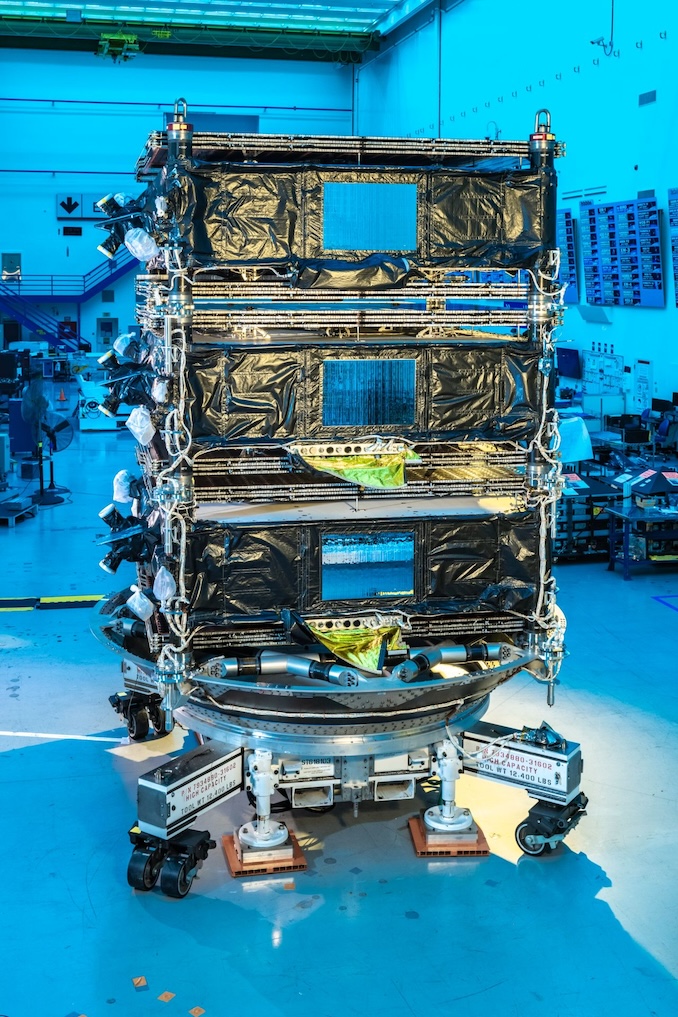
The O3b mPOWER-F mission sent satellites number F11, F12, and F13 on a trek to medium Earth orbit. The Boeing-built satellites were the final three to be added to the O3b mPOWER constellation.
Liftoff from Space Launch Complex 40 (SLC-40) at Cape Canaveral Space Force Station happened at 2:49 p.m. EDT (1849 UTC).
The 45th Weather Squadron forecast a 60 percent chance for favorable weather at the opening of Sunday’s launch window. Meteorologists stated in their outlook that conditions deteriorate to 40 percent favorability by the end of the window.
“Models this morning show that while steering flow remains light leading into the primary launch window Sunday afternoon, it will have a more defined offshore component,” launch weather officers wrote. “Hi-res models suggest this will be enough to slow the development of the east coast sea breeze until just before or near the start of the window.
“With the sea breeze over the Spaceport, the risk early in the window will be for showers and storms to quickly develop in the immediate vicinity. The threat transitions just inland later in the window as numerous collisions between ongoing activity likely drift back towards the Spaceport along with any lingering storms.”
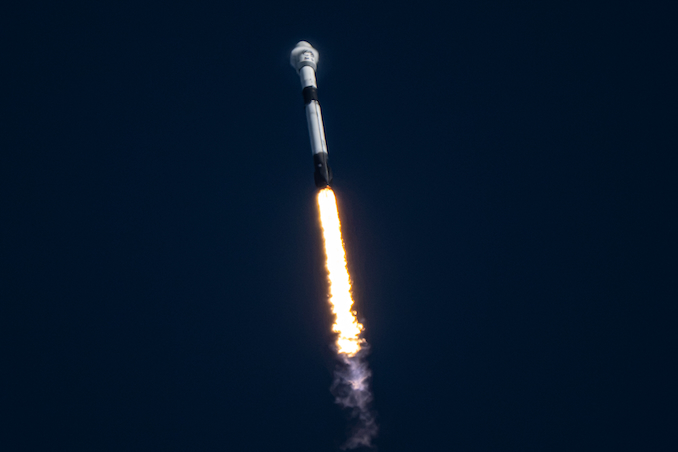
SpaceX launched the mPOWER-F mission using the Falcon 9 first stage booster with the tail number B1080. This was its 29th flight after launching four missions to the International Space Station, the European Space Agency’s Euclid observatory, SES’ Astra 1P, and 22 batches of Starlink satellites.
This was the 400th orbital launch to take flight from SLC-40, of which SpaceX was responsible for launching 345. The pad was outfitted with a crew and cargo access tower in 2023, allowing it to begin flying Dragon missions starting in March 2024 — fittingly, by using B1080 to launch the CRS-30 mission.
More than 8.5 minutes after liftoff, B1080 landed on the droneship, A Shortfall of Gravitas, stationed in the Atlantic Ocean. This was the 166th landing on this particular vessel and the 661st Falcon booster landing to date.
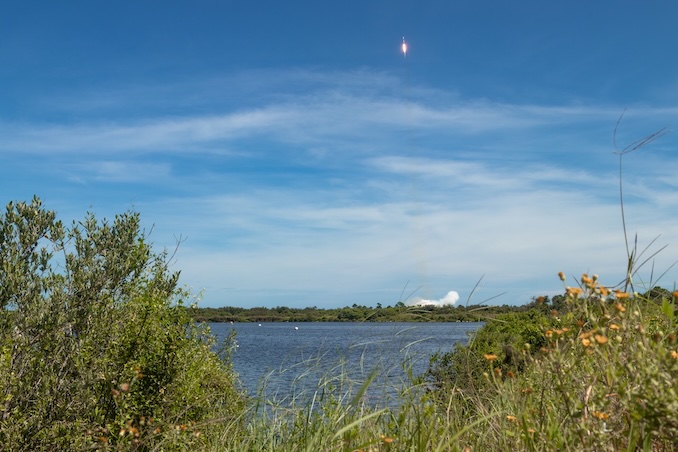
O3b mPOWER finale
The planned mission on Sunday afternoon will bring the O3b mPOWER satellite constellation up to 13 spacecraft in medium Earth orbit. They each have a dry mass of 1,900 kg, according to SES.
The first two satellites were launched on a SpaceX Falcon 9 rocket back on Dec. 16, 2022, with subsequent launches in pairs in April 2023, November 2023, December 2024, and July 2025.
Prior to the launches of the fifth and sixth satellites, an electrical issue was discovered that was found to impact both the broadband capacity and the estimated operational life of those satellites.
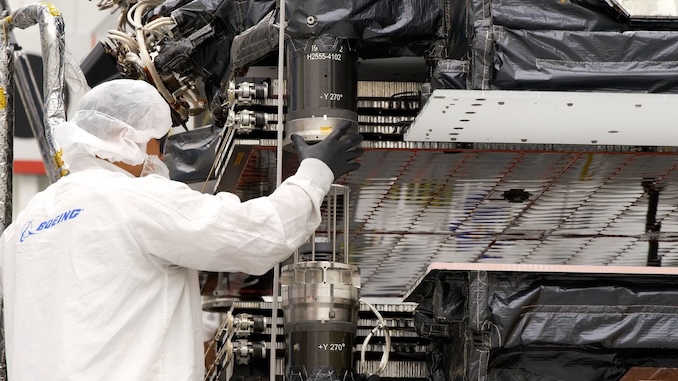
To compensate for this, changes were made to satellites 7-11 and two additional spacecraft were added to the constellation. Satellite manufacturer, Boeing, announced the delivery of the final trio of satellites to SES in early September 2026.
“The delivery of these final three satellites allows us to ramp up our constellation’s capabilities to meet growing commercial and government demand,” said Xavier Bertran, chief product and innovation officer of SES, in a statement. “The performance we are seeing from the 10 satellites already on orbit validates this architecture. The completion of the O3b mPOWER system reinforces our proven leadership in MEO while advancing our innovation roadmap.”
These newest satellites are scheduled to be released from the Falcon 9 rocket’s second stage beginning nearly 34 minutes after liftoff. Their deployment is staggered by seven minutes.
Boeing said that these satellites are expected to enter service by the middle of 2027 after completing their orbit-raising maneuvers and necessary checkouts and commissioning.
“The fully operational O3b mPOWER constellation proves the effectiveness of our software-defined payload technologies, shown by our ability to secure the most demanding missions of our commercial, joint-force and allied military customers,” said Ryan Reid, president of Boeing Satellite Systems International.
About the Author


![[Aggregator] Downloaded image for imported item #83192](https://astrobitica.com/wp-content/uploads/2026/09/20260902-Starlink-15-23-Feature-Image.jpg)