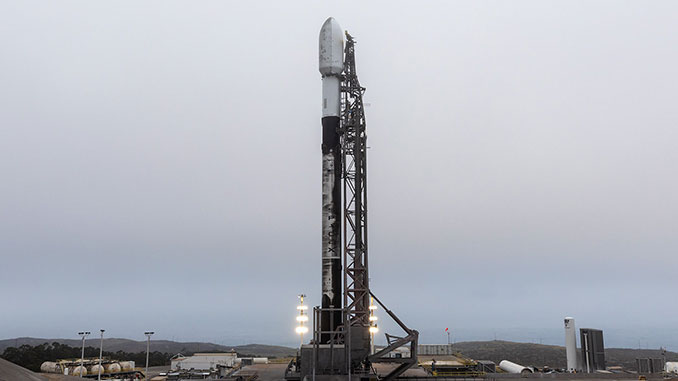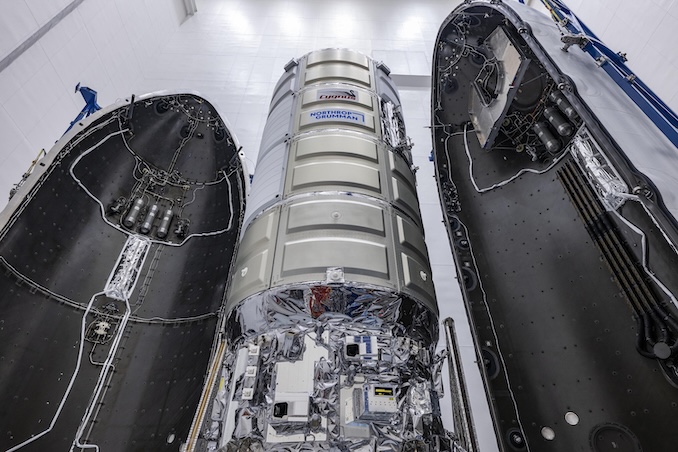
SpaceX is preparing to launch a Falcon 9 rocket carrying a Northrop Grumman Cygnus cargo ship Sunday on a two-day flight to the International Space Station.
The NG-25 mission is the 25th flight of a Cygnus cargo spacecraft to the ISS as part of NASA’s Commercial Resupply Services (CRS) contract. The vehicle is named the S.S. James ‘Jim’ A. Lovell, in honor of the legendary astronaut who flew four missions, including Apollo 8 and 13.
Liftoff from Space Launch Complex 40 is scheduled for Sunday, Nov. 29, at 10:47 a.m. EST (1547 UTC), weather permitting. NASA said on Friday that there is a 60 percent chance for favorable conditions with concerns stemming from thick clouds expected to be in the area at launch time.
Spaceflight Now will have live coverage beginning about an hour and a half prior to liftoff.
<iframe title=”YouTube video player” src=”https://www.youtube.com/embed/qroRtpNHVFU” width=”678″ height=”381″ frameborder=”0″ allowfullscreen=”allowfullscreen”>
SpaceX will launch the mission using the Falcon 9 first stage booster B1096. This will be its ninth flight following the launches of Kuiper Falcon 1, NASA’s IMAP, NROL-77, GPS III-9, NASA’s SpaceX CRS-34, CRS-35, NROL-95, and Starlink 6-87.
Nearly eight minutes after liftoff, B1096 will target a landing back at Landing Zone 40, adjacent to the launch pad. If successful, this will be the ninth landing at this site, with three of those being performed by B1096.
“This will be the fifth overall launch by Falcon 9 on behalf of Northrop Grumman,” said Jared Metter, Director of Flight Reliability, at SpaceX during a prelaunch news teleconference. “We continue to be honored to have these missions on our manifest. These are critical mission that help provide the necessary science, food, supplies, and equipment to help maintain the orbiting laboratory of the ISS.”
Roughly 14.5 minutes after liftoff, the Cygnus XL spacecraft will separate from the Falcon 9 upper stage to begin the two-day journey. An on-time liftoff would see the vehicle arrive at 2:35 a.m. EST (0735 UTC) on Tuesday, Dec. 1.
The Cygnus XL spacecraft carries about 5,000 kg (11,000 lbs) of science and supplies onboard. NASA astronauts Jessica Watkins and Luke Delaney will monitor the vehicle’s arrival and use the Canadarm2 to capture and berth the vehicle to the Earth-facing port of the Unity module of space station.
Gaurang Patel, Operations Integration Manager for NASA’s ISS program, said the spacecraft will remain at the space station until May.
“Overall, we will be delivering 42 standard menu BOBs (Bulk Overwrap Bags) and 65 crew-specific menu and coffee/tea preference BOBs and four fluid loading kits,” Patel said. “In addition to the food and supplies and equipment for the crew, Cygnus is also delivering new experiments with goals of improving drug delivery for cancer and osteoarthritis, predicting cancer spread, advancing treatments for muscle loss, improving radiation sensing, and advancing food production on future, long-duration missions.”
Payloads onboard highlighted by NASA include Lockheed Martin’s JOining demonstration IN-Space (JOINS), which will test two welding techniques in microgravity; Utah State University’s Ohalo 3 module, which will study plant water delivery and crop production; and the University of Connecticut’s DNA Nano B, which manufacture particles for medicine delivery.
The ISS National Laboratory is also sponsoring more than 35 payloads onboard Cygnus. Some of those include an autonomous assembly demonstration from Rendezvous Robotics, a study of radiation impacts on rubber compounds from Dunlop Tires, and a technology demonstration of radiation shielding from Malagen Labs.
While on orbit, Dave Schiller, Vice President of Civil Space and Sciences at Northrop Grumman, said this Cygnus may be used to help reboost the ISS to help maintain its position in orbit. When and how many reboosts will be up to NASA and its international partners.
About the Author