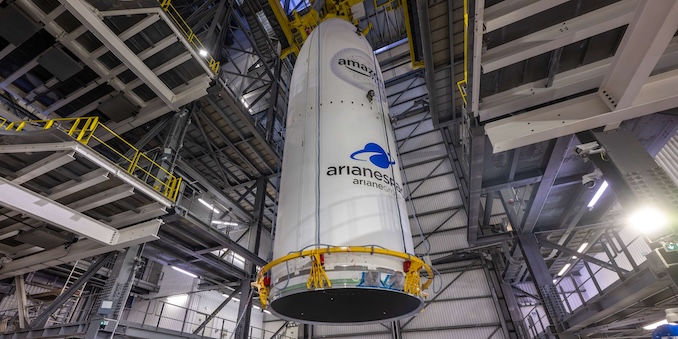
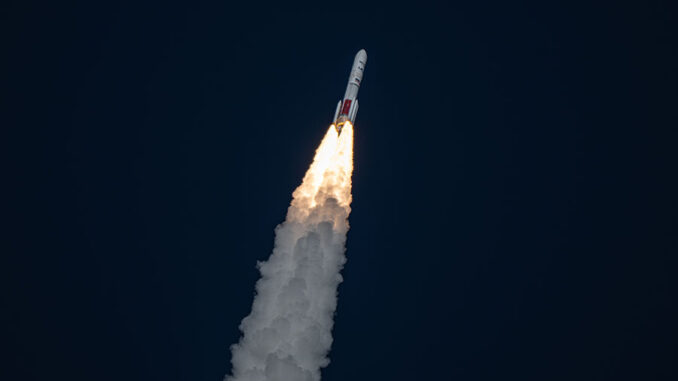
Amazon Leo is planning to launch a batch of satellites onboard an Ariane 6 rocket Tuesday, nine days after it lost 40 satellites when United Launch Alliance’s Vulcan rocket failed to reach orbit.
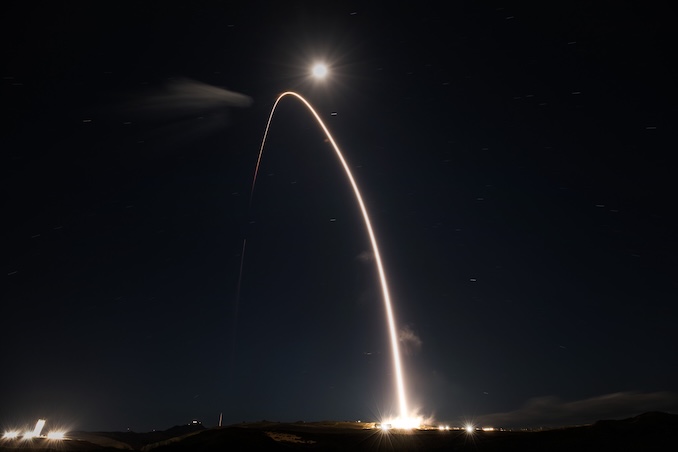
Liftoff of the Leo Europe 4 (LE-04) mission from Europe’s Spaceport in French Guiana is scheduled during a window that opens at 7:45 a.m. Kourou Time (5:45 a.m. EST / 1045 UTC). It will be Amazon’s fourth flight on an Arianespace rocket and the tenth flight of the rocket overall.
Spaceflight Now will have live coverage beginning about an hour prior to liftoff.
In April 2022, Amazon selected Arianespace to fly 18 missions for its constellation. That announcement also came with the choice of 38 Vulcan rocket launches and 12 onboard Blue Origin’s New Glenn rockets. The board of Amazon eventually pushed to add a trio of launches onboard SpaceX Falcon 9 rockets, all of which were flown in 2025.
In late 2025, Amazon Leo also converted an option from Blue Origin to fly a total of 24 batches of satellites on New Glenn rockets. At the same time, the retail giant also purchased an additional 10 Falcon 9 rockets.
However, both Blue Origin and ULA faced years of delays with the debuts of their heavy-lift launcher vehicles and suffered issues this year that significantly set back their launch capabilities. During ULA’s February launch of USSF-87, an anomaly with one of the Northrop Grumman-built GEM63 XL solid rocket motors caused Vulcan to be grounded for the majority of 2026.
During its return-to-flight mission on Nov. 15, Vulcan suffered a different issue, this time with the rocket’s main booster. That caused the first full mission failure for ULA since its founding in 2006 and the loss of the 40 Amazon Leo satellites onboard.
“There is risk with any launch, and that’s especially true for inaugural missions like LV-01,” Amazon said in a statement following the anomaly. “ULA has been a trusted partner for Amazon, and we believe they’ll learn from this mission and deliver on their long-term plans for Vulcan.”
Meanwhile, Blue Origin’s fourth New Glenn rocket, intended for a launch of 48 Amazon Leo satellites, was destroyed along with some launch infrastructure during an explosion on the pad during a static fire test of the BE-4 engines. Amazon Leo’s satellites were not onboard the rocket when it blew up.
Blue Origin had been working towards returning to flight by the end of the year, but is now expecting its first flight in early 2027.
While Arianespace hasn’t suffered the major setbacks of Blue Origin and ULA, it has also faced challenges this year. Reported turbopump issues on the Ariane 6 main Vulcan 2.1 engine caused a schedule delay for the launcher program.
The LE-04 vehicle, designated VA271, will be the fourth flight of Ariane 6 in the 64 configuration, and features four P160C solid rocket motors.
A successful mission Wednesday will bring the total number of Amazon Leo satellites launched by Arianespace up to 136 and all told there will be 432 Amazon Leo satellites in orbit, including those launched by United Launch Alliance and SpaceX.
The completed first-generation satellite constellation for Amazon Leo will consist of 3,232 spacecraft in orbit. Amazon announced back in October that it built its 1,000th satellite at its facilities in Kirkland, Washington.
Amazon Leo was originally required by the Federal Communications Commission to deploy half of its constellation to orbit by July 30, 2026. Amazon Leo filed for a modification of that requirement in January, asking for an extension of the deadline by 24 months.
“At the time of filing, Amazon Leo reported that it had launched 180 satellites and estimated that it will have deployed approximately 700 satellites by July 30, 2026,” wrote Jay Schwarz, the FCC’s Space Bureau Chief, in an order partially granting Amazon Leo’s waiver request in June.
In the order, Schwarz wrote that while Amazon Leo is exempt from the 50 percent requirement, the company is still on the hook to deploy the full first-generation constellation by July 30, 2029. There’s also a reference to Amazon Leo providing “detailed schedules of future launches along with information on its financial and operational investments in the Gen1 constellation and its mitigation efforts thus far.”
With the loss in 2026 of both of its largest rocket launchers, Amazon Leo has significant ground to make up in 2027.
About the Author