United Launch Alliance said Wednesday that a preliminary review of flight data points to an inadequate supply of fuel to the Blue Origin-manufactured engines of its Vulcan rocket, rather than a problem with the engines themselves, as the reason Sunday’s launch fell short of orbit with 40 Amazon Leo internet satellites aboard.
ULA posted the update at 11 a.m. EST (1600 UTC). The company uses “booster” to refer to Vulcan’s first stage, which is powered by two methane-fueled BE-4 engines, the same engines that power Blue Origin’s New Glenn rocket.
“While work remains to determine cause, preliminary indications are that the low booster thrust was the result of inadequate fuel supply from the vehicle to the BE-4 engines, not from the performance of the engines,” the company said.
The finding is not a final cause, but if it holds, it has implications beyond ULA.
It points away from the BE-4 as a culprit for the failure, which carries importance for Blue Origin as the Jeff Bezos-founded space company works to return New Glenn to flight after the rocket exploded on its Cape Canaveral launch pad during a test in May. It also points away from the Vulcan’s Centaur 5 upper stage, which NASA is weighing for its Space Launch System moon rocket. And ULA said the six solid rocket boosters, whose nozzle problems on two earlier flights led to a nine-month gap between Vulcan launches, performed normally.
Still, Vulcan is grounded again with no return-to-flight date, leaving the U.S. Space Force, which had sought to use Vulcan to launch national security payloads, and Amazon, which purchased 38 Vulcan launches to boost its Leo satellite internet service to orbit, waiting.
ULA did not say which part of the vehicle failed to deliver enough fuel or why. In an update Tuesday, the company said the Federal Aviation Administration will oversee the ULA-led investigation, be involved in every step and approve ULA’s final report, including any corrective actions.
“It is very early in the process, and we want to focus on the data and avoid speculation until the investigation is complete,” the ULA statement reads.
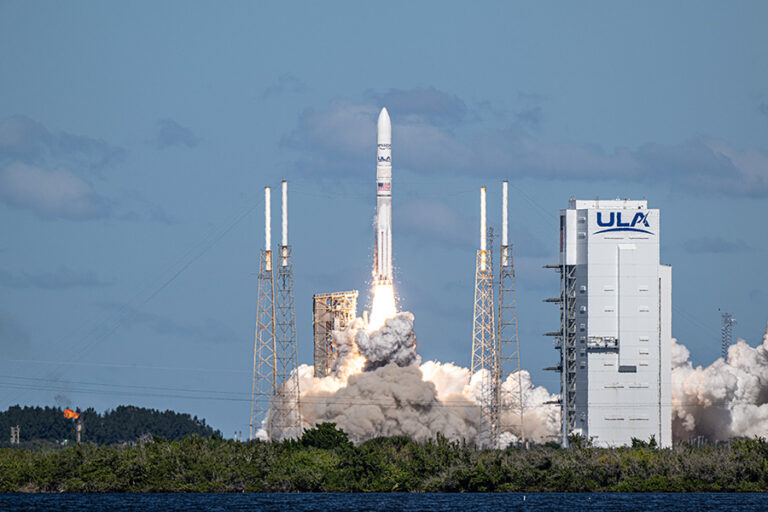
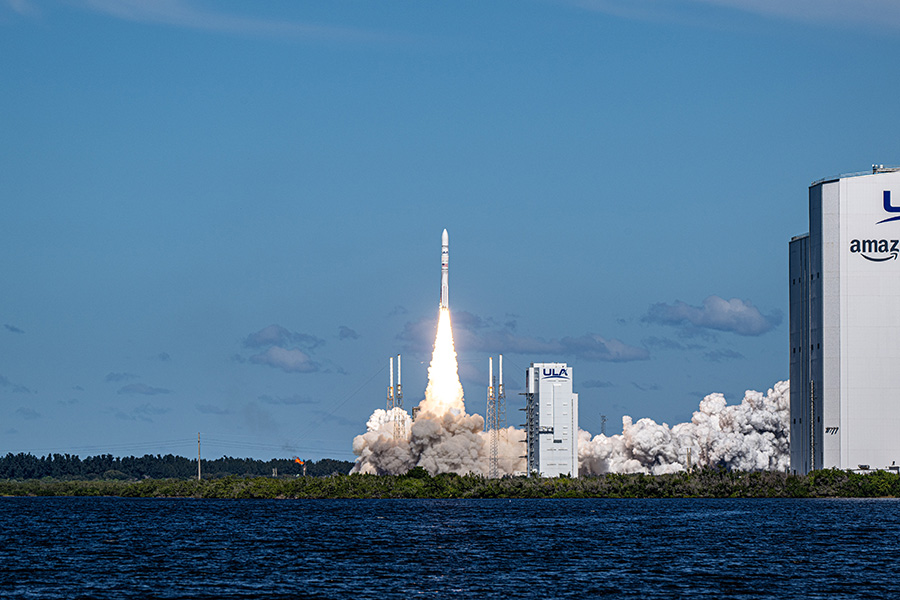
Vulcan lifted off at 12:40 p.m. EST (1740 UTC) Sunday from Space Launch Complex 41 at Cape Canaveral Space Force Station. It was the rocket’s fifth flight and its first since February.
ULA said Tuesday that early indications showed “just after liftoff the launch vehicle experienced low [first stage] performance, resulting in stage separation occurring when the vehicle was low in altitude and below minimal velocity to reach orbit.” The company lost telemetry — and any chance of completing the mission — about 10 minutes into flight.
That account fits what was visible during ULA’s webcast. As Spaceflight Now reported Sunday, the BE-4s appeared to fire longer than ULA’s prelaunch timeline called for, and the first stage separated from the Centaur later than expected.
Speaking Tuesday at a Washington Times event in Arlington, Virginia, ULA President and CEO Mark Peller said “we had a significant shortfall in booster first stage performance.” The Centaur separated and ignited its RL10 engines, he said, but the first stage left it “in such a low-energy state” that it “couldn’t make up for that performance deficit.”
The solid rocket boosters were the main question going into the flight. A nozzle malfunctioned on one of Vulcan’s Northrop Grumman-built GEM 63XL side-mounted solid rocket boosters during the rocket’s second flight, in October 2024; on the USSF-87 mission Feb. 12, another solid rocket booster appeared to suffer a nozzle burn-through. Vulcan reached its planned orbit on both occasions, but after the February anomaly the Space Force suspended national security launches on the rocket.
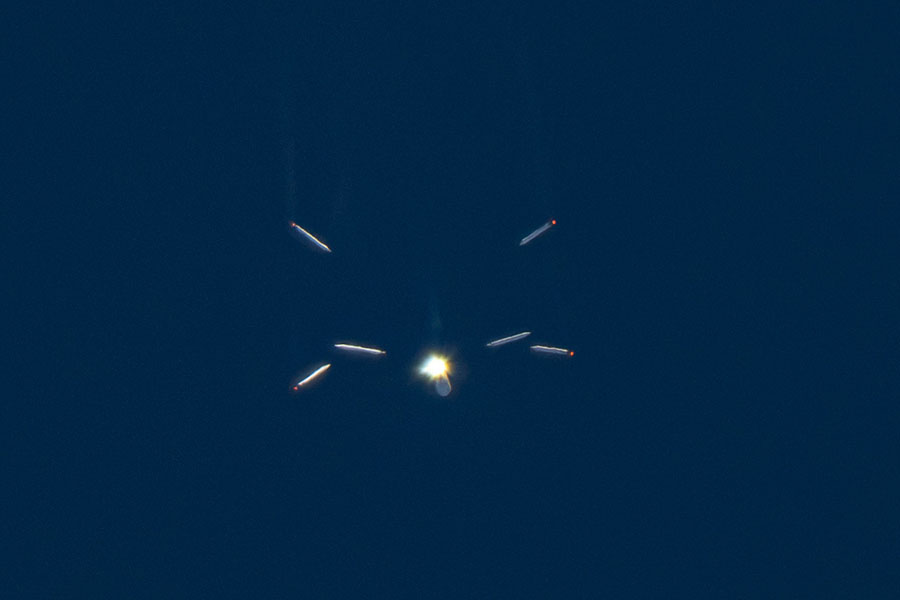
On Sunday, all six boosters burned out and fell away about 1 minute and 35 seconds after liftoff.
“All indications are that the solid rocket booster performance was nominal, following nozzle improvements implemented for this launch,” ULA said.
Peller called the GEM 63XL’s affixed to Vulcan during Sunday’s launch “six clean SRBs.”
The flight was also the first for BE-4 engines since a New Glenn rocket exploded in spectacular fashion May 28 during a test, heavily damaging Blue Origin’s facilities at Launch Complex 36. The company’s CEO, Dave Limp, later said that failure originated at the main oxygen valve on one of the heavy-lift rocket’s seven BE-4s.
The two BE-4s powering Vulcan, rated together at more than 1 million pounds of thrust, carried a Blue Origin retrofit designed and tested in the aftermath of the May explosion.
Blue Origin is now targeting January for New Glenn’s return to flight, Bloomberg reported this month, citing a memo from Limp. A Blue Origin filing with the Federal Communications Commission lists a window of Jan. 15 through April 15 to cover the “launch of a New Glenn” along with preflight and postflight work.
For NASA, ULA’s statements post-launch leaves intact the record of the Centaur 5, which has flown only on Vulcan. NASA said last month it is pursuing two upper-stage options for the SLS moon rocket on Artemis 4: its current interim cryogenic propulsion stage and a stretched version of the Centaur 5.
“Artemis, Moon Base, and the nation need ULA,” NASA Administrator Jared Isaacman wrote Sunday on X.
Amazon lost its largest batch of Leo satellites to date. Had the launch proved a success, it would have brought the number of Leo satellites Amazon has launched to 436. That figure would have pushed the company closer to a first-generation constellation of more than 3,200 satellites. Amazon and Blue Origin’s rival, SpaceX, has put more than 11,200 Starlink internet satellites in orbit since the Elon Musk-founded company began building out its constellation in 2019.
With both Vulcan and New Glenn grounded, Amazon’s other booked rides are on Arianespace’s Ariane 6 and SpaceX’s Falcon 9.
The loss is ULA’s first outright mission failure since Boeing and Lockheed Martin formed the company in 2006. Three of Vulcan’s five flights have now had problems, though Sunday’s is the only one in which the payload did not reach orbit.
“We truly understand the impact this has on our customers and are committed to returning to flight as safely and quickly as we can,” ULA said Tuesday.
The company said it will provide more updates as the investigation continues.
About the Author