There’s ample evidence that large galaxies host supermassive black holes (SMBH) in their centers. And there’s growing evidence from gravitational wave detectors that these SMBH merge when their galaxies merge. But astronomers think that sometimes they don’t merge, and these are called recoiling SMBH.
A merger takes a long time, and in its final moments, powerful gravitational waves are released. Theoretical predictions state that if the waves aren’t emitted equally in all directions—or aren’t isometric—the imbalance can drive the merger remnant SMBH away from the galactic center with a powerful kick. This SMBH doesn’t leave the galaxy entirely. Instead, it acquires a pendulum-like motion, swinging back and forth, oscillating across the galactic center.
Critically, an SMBH merger remnant like this doesn’t have a constant speed. Instead, it moves fastest near the galactic center, and slows at the other end of its swing. This fact is important in new research.
The research is “Statistical evidence for massive black hole recoils in active galactic nuclei,” and it’s published in Monthly Notices of the Royal Astronomical Society. The lead author is Bence Bécsy, an Assistant Professor in the School of Physics and Astronomy at the University of Birmingham.
“Many SMBH binaries are expected to merge after inspiralling due to gravitational-wave emission, and will be observable in the mHz gravitational-wave band by LISA,” the authors explain. Uneven gravitational waves can give the merger remnant SMBH a recoil velocity between 360,000 km/h to 3.6 million km/h. The recoil drives its pendulum-like oscillation.
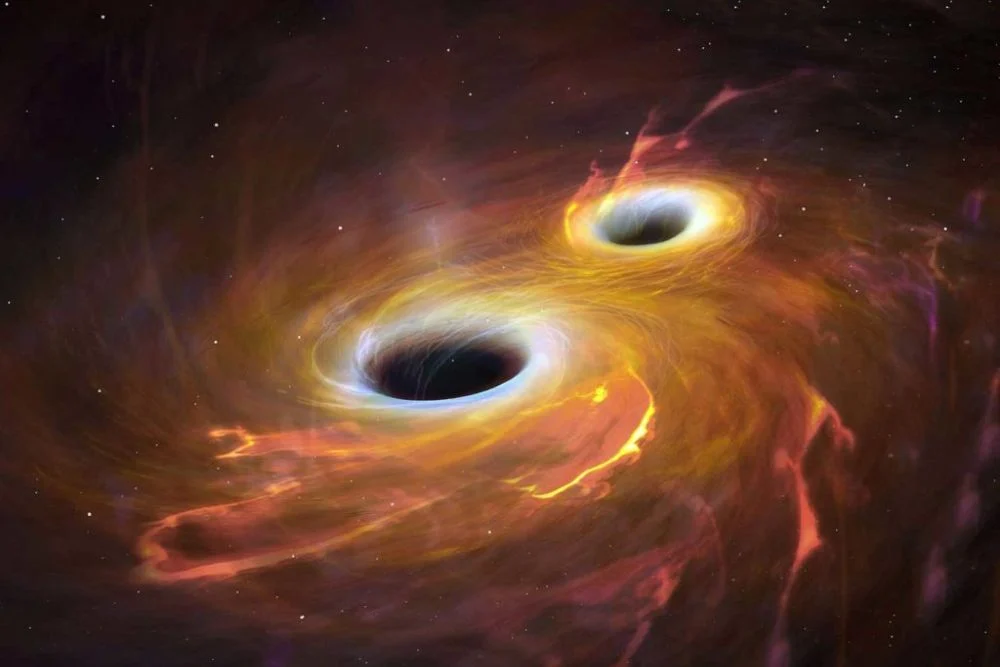
This artist’s illustration shows two black holes merging. If the gravitational waves generated by the merger are uneven, it can create a recoiled black hole. Image Credit: NASA
“It is expected that such a SMBH can retain the inner region of its accretion disc and remain active for between 10 million and 100 million years after the merger, allowing it to be observable as a quasar (QSO) with detectable kinematic and spatial signatures of the merger,” the authors add.
Evidence for these recoiling SMBH has been difficult to obtain. Researchers have identified some candidates, but in each case, there was an alternate explanation for their observations. This work is different because it doesn’t focus on individual candidates. Instead, it takes what astrophysicists think is true about recoiling black holes and looks for it statistically in a population.
“We search for a population-level signature of gravitational-wave recoiling supermassive black holes: a positive correlation between dust obscuration and the magnitude of the line-of-sight velocity offset of broad emission lines relative to the host,” the authors write. Their work is based on the 16th data release from the Sloan Digital Sky Survey and its quasar catalogue.
Quasars are the brightest active galactic nuclei, which are SMBH that are actively accreting material. Their high luminosity makes them easier to find and observe. The researchers analyzed about 100,000 quasars in their work. What were they looking for?
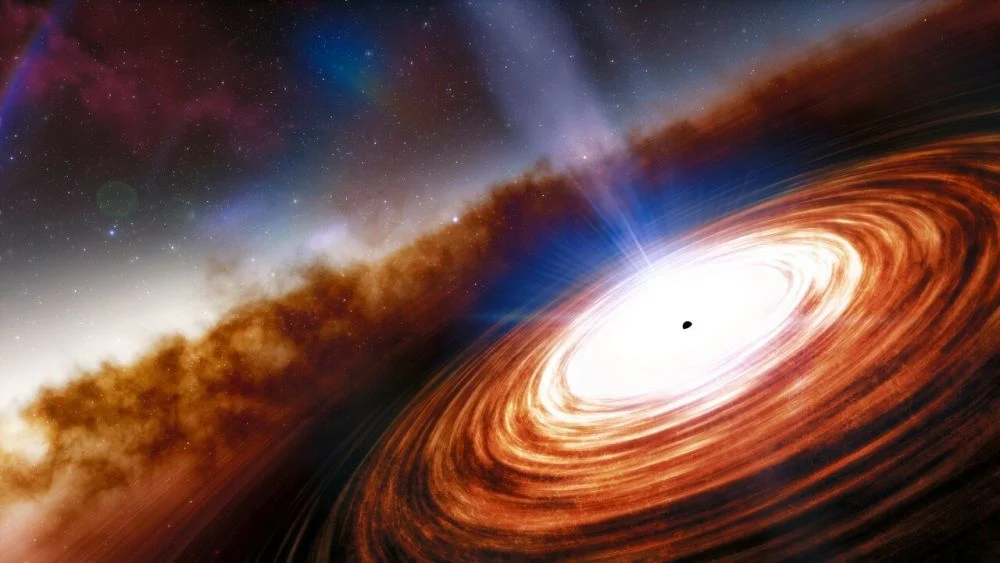 Quasars are extremely luminous, and many of their properties are still poorly understood. Fortunately, their high luminosity aids their study. Image Credit: NOIRLab/NSF/AURA/J. da Silva (Spaceengine)
There are two pieces of critical information encoded in the light from quasars. The first is their velocity. Since quasars are SMBH, they are massive and have a powerful gravitational grip on gas in their vicinity. As a recoiling SMBH oscillates, its velocity alters depending on its position relative to the galactic center. Gas close to the SMBH moves along with it, and is called its Broad Line Region (BGR). The gas further away does not move with it, and is called the Narrow Line Region (NLR). Light from both bodies of gas is shifted by a small amount, relative to one another.
“In what follows, we assume that a recoiling SMBH will move together with its BLR, while the NLR will be left behind and exhibit a redshift consistent with that of the host galaxy and the dust torus at the galactic centre,” the authors explain.
So the light signal from each body of gas, the BLR and the NLR, is different. It’s called a doppler shift, and astronomers use spectrographs to detect it. By comparing the two signals, researchers can determine the SMBH’s speed.
The second piece of evidence encoded in the light concerns dust.
Dust near the quasar reddens its light, in a phenomenon called extinction. If the quasar is redder than similar light sources, then it’s suffering more dust extinction. Extinction can be measured with spectroscopy and photometry.
Dust is thickest near the galactic center, and that’s also where the remnant SMBH moves the fastest. So a faster moving quasar should also be more reddened by dust extinction. This is the relationship at the heart of this work.
The results showed an astonishing difference among the most reddened quasars. Dust obscuration tracks black hole speed: the faster the black hole moves, the more likely its quasar is to be buried in dust, with the fastest group showing three times the obscured fraction of the slowest. Recoiling black holes would produce this result, but that doesn’t mean these are all recoiling black holes.
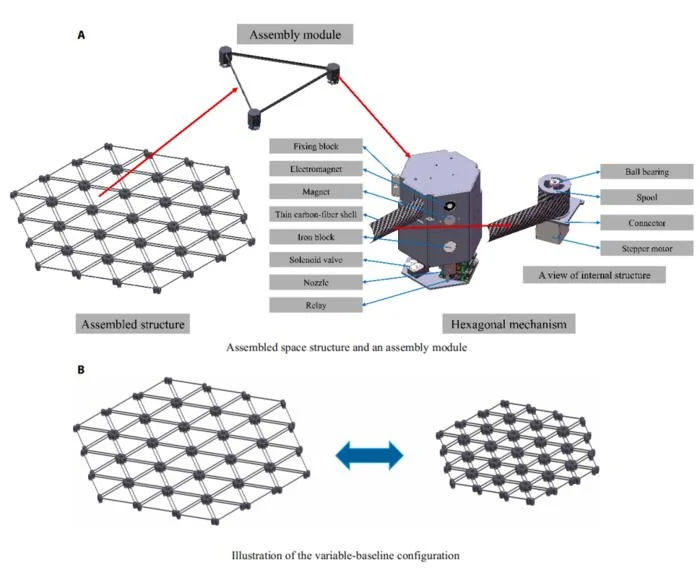
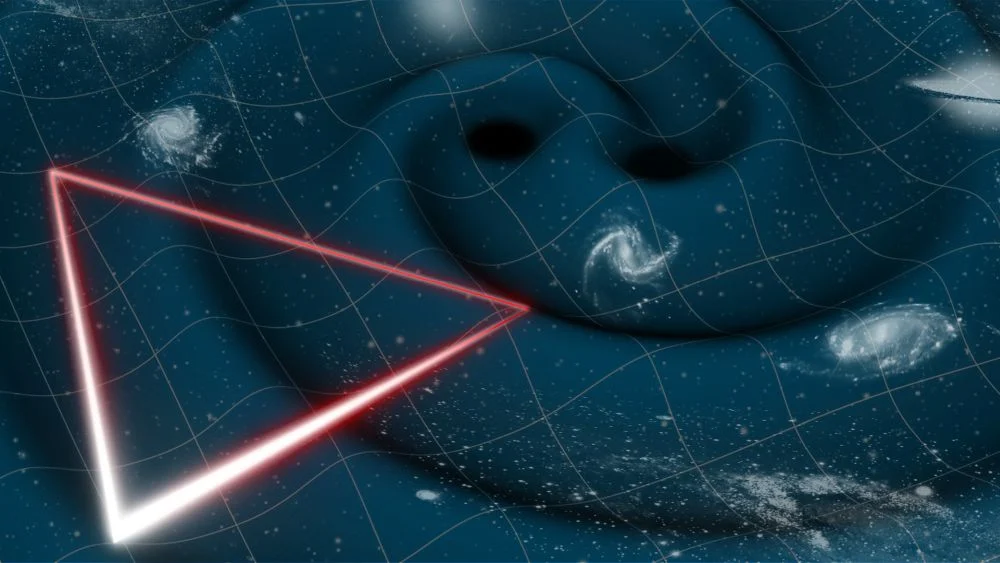 LISA will be the first space observatory dedicated to detecting gravitational waves. It will have a group of three spacecraft that orbit the Sun while maintaining an equilateral triangle. The laser beams between all three will detect gravitational waves. If this research is correct, LISA should detect recoiled SMBH. Image Credit: ESA. Licence: CC BY-SA 3.0 IGO or ESA Standard Licence
“It is very difficult to prove that the black hole in a single quasar has been ejected, because other phenomena can produce similar signatures. What is new about our research is that, rather than looking for individual candidates, we searched statistically for traces of an entire population,” lead author Bécsy said in a press release. “This enabled us to identify a relationship consistent with theoretical predictions.”
“While the correlation we find might be evidence for a population of recoiling SMBHs, alternative explanations are possible,” the authors write. Winds, viewing angle, or other effects could also explain it. Still, finding the trend across a large statistical sample is intriguing.
More definitive proof for recoiling SMBHs might arrive with LISA, the Laser Interferometer Space Antenna, after its planned launch in 2035.
“If the signal is indeed caused by ejected black holes, then two supermassive black holes merged relatively recently in a significant proportion of quasars, meaning that these events are common,” said Professor Zsolt Frei, study co-author and head of the HUN-REN–ELTE Extragalactic Astrophysics Research Group.
“This directly determines how many such events LISA may be able to detect.”
About the Author

Source: Universe Today