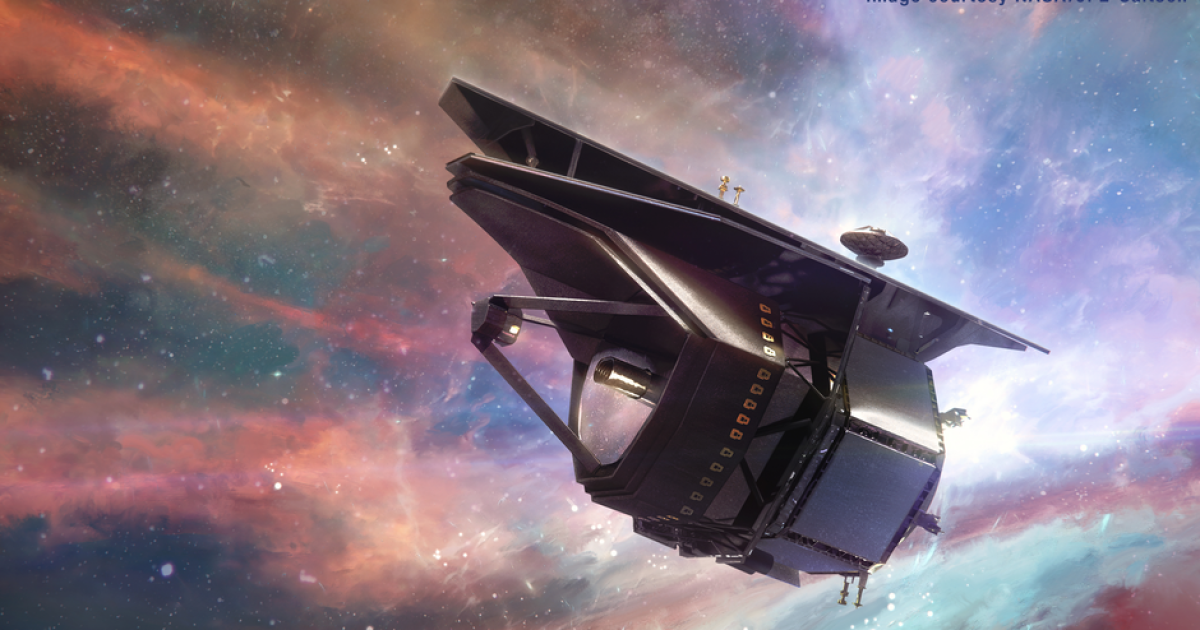
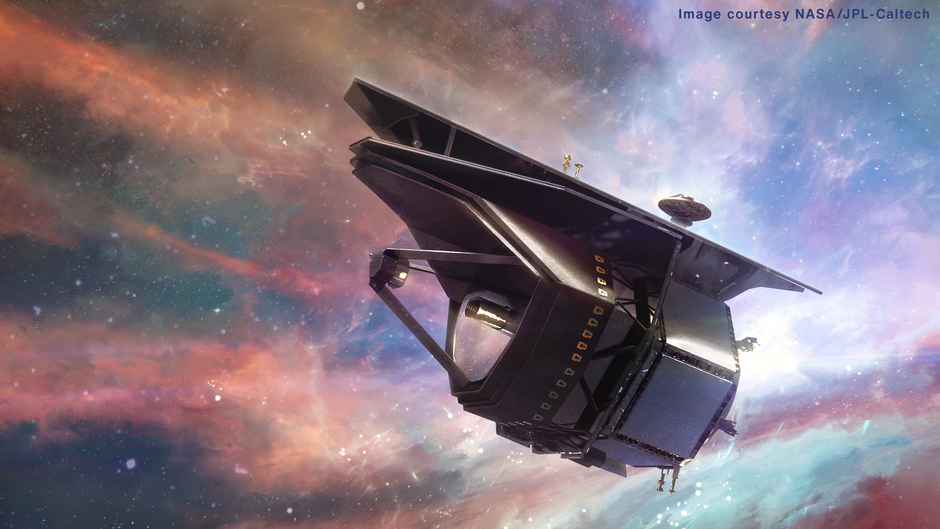
NASA has selected the far-infrared space telescope mission PRIMA (PRobe far-Infrared Mission for Astrophysics) to move to the next stage in its development. PRIMA will be the first in a new mission class and help scientists learn more about the evolution of the universe.
PRIMA will carry a 5.9-foot (1.8-meter) mirror, and NASA hopes to launch it in 2033 for a five-year mission. It will fill a longstanding gap between the James Webb Space Telescope (JWST) and ground-based radio telescopes by observing in far-infrared wavelengths. Since the European Space Agency’s Herschel Space Observatory ran out of coolant in 2013 — four years after NASA’s Spitzer Space Telescope lost its own far-infrared vision — no space telescope has covered this stretch of the spectrum.
“The PRIMA mission is humanity’s next window into the deep universe. It will unveil the obscure across cosmic time to better understand the formation of planets, stars, black holes, and even how water on Earth came to be,” Nicky Fox, associate administrator of NASA’s Science Mission Directorate, said in a statement.
A new mission class
PRIMA belongs to a new category of mission, called Probe Explorers, which lives inside NASA’s Explorers Program, the agency’s oldest continuously running program for space science. Explorers are relatively low-cost missions, each led by a principal investigator and built for efficient science. The program began with Explorer 1, which discovered Earth’s radiation belts in 1958, and has continued with over 100 missions — including the 2025 launches of PUNCH, which watches the Sun’s corona turn into the solar wind, and SPHEREx, an all-sky infrared mapper.
At the other end of the spectrum sit the flagship missions — the Hubble Space Telescope, JWST, and now the Nancy Grace Roman Space Telescope. The new class that PRIMA kicks off, Probe Explorers, was designed to split the difference. PRIMA’s project cost is capped at $1.2 billion, not counting launch. For comparison, SPHEREx cost around $488 million for the mission’s entire lifecycle and Roman’s development cost alone was over $3 billion.
NASA created the class on the recommendation of the National Academies of Sciences, Engineering, and Medicine in their 2020 astronomy decadal survey — an influential once-a-decade priority list compiled with feedback from the scientific community. The National Academies also proposed that the class’ first mission tackle either X-ray or far-infrared astronomy. In October 2024, NASA’s Science Mission Directorate named two finalists for consideration, PRIMA and the Advanced X-ray Imaging Satellite (AXIS), giving each team $5 million for a yearlong concept study — Phase A.
Now officially selected to move to Phase B, PRIMA’s team will refine the design and mature the technology needed for the mission. A confirmation review of its cost, schedule, and technical readiness comes next. Finally, the mission will move into Phase C, where construction begins. NASA’s Jet Propulsion Laboratory in Southern California will manage the project, joined by Goddard and Marshall space flight centers and international partners in France, Italy, Germany, Canada, South Korea, Japan, and the United Kingdom.
Seeing in far-infrared
PRIMA will observe at wavelengths from 24 to 235 micrometers — squarely in the far infrared, a portion of the electromagnetic spectrum that is currently unobserved by any major observatory. Observatories like JWST and SPHEREx can observe in the near-infrared, which sits just past what our eyes can detect. JWST can also extend its reach into the mid-infrared. But far-infrared waves run much longer — yet still too short for ground-based radio telescopes.
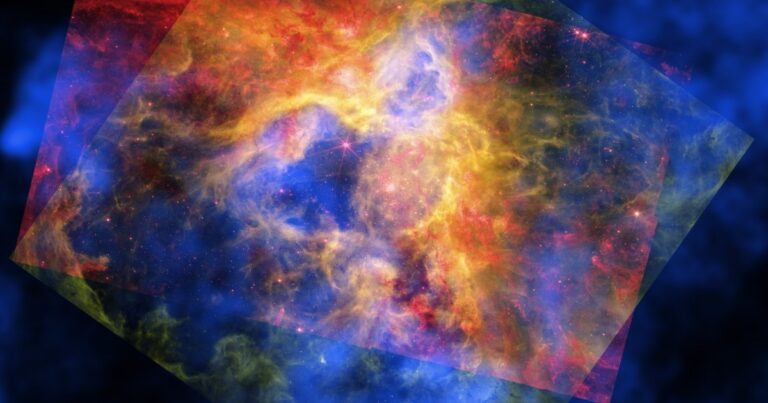
In the far infrared, PRIMA can observe the faint glow from stellar nurseries and growing black holes that visible light can’t reach. On Earth, that glow never makes it to the ground: Water vapor in Earth’s atmosphere absorbs nearly all of it. Only above the atmosphere can a telescope see this light clearly. Like JWST and the Roman space telescope, PRIMA will be positioned at the Sun-Earth L2 point — a location about 930,000 miles (1.5 million kilometers) from Earth and opposite the Sun.
PRIMA will carry two instruments. First, a sensitive spectrometer called FIRESS (Far-Infrared Enhanced Survey Spectrometer) will split incoming far-infrared light into its component parts. Among other things, FIRESS will allow scientists to learn more about the evolution of other planetary systems by determining elemental abundances and masses of their planet forming disks. Second, PRIMAger (PRIMA Imager), a hypersectral camera, will map wide patches of sky in the far-infrared range from 25 to 84 micrometers to learn more about how black holes grow in distant galaxies. Together, the instruments will help PRIMA answer questions about the origin of our universe and achieve science across its three science themes: the origin of planets and their atmospheres, how galaxies and their supermassive black holes grow together, and how the universe built up its reservoirs of dust and metals — the molecules that are the building blocks for life.
One finalist left standing
Although NASA’s recent announcement allows PRIMA to officially move ahead, the mission’s path forward opened up in March when NASA disqualified AXIS. In a statement at the time to Space News, NASA said the Probe concept “was not compliant with the 2023 Astrophysics Probe Explorer Announcement of Opportunity.” The agency based that decision on AXIS’ own cost estimate from September 2025 that put the mission about 10 percent over budget.
In an email posted to social media, Christopher Reynolds, the mission’s principal investigator and a University of Maryland astronomer, blamed the overage on “the programmatic chaos of 2025” at Goddard Space Flight Center, which managed AXIS. According to Reynolds, NASA’s employee buyout program cost the project more than 20 key people, the center scaled back work in response to President Trump’s budget proposal that would have killed the Probe program, and last fall’s 43-day government shutdown cost the team still more time.
Towards the end of the email, Reynolds gave a nod to PRIMA: “There is still one excellent mission under consideration for the Probe program, PRIMA, and we wish them a smooth and speedy path to selection and flight.” Now that NASA has granted the first half of that wish, PRIMA is one step closer to the second, and to giving astronomers their first far-infrared view from space since 2013. of that wish, PRIMA is one step closer to the second, and to giving astronomers their first far-infrared view from space since 2013.
Brooks Mendenhall is a staff writer at Astronomy, based in Chattanooga, Tennessee, fueled by an unending curiosity about the universe. A former classroom teacher, he has a knack for breaking down complex concepts for a wide audience.
About the Author