Looking for a sky event this week? Check out our full Sky This Week column.
October 7: Titan passes north of Saturn
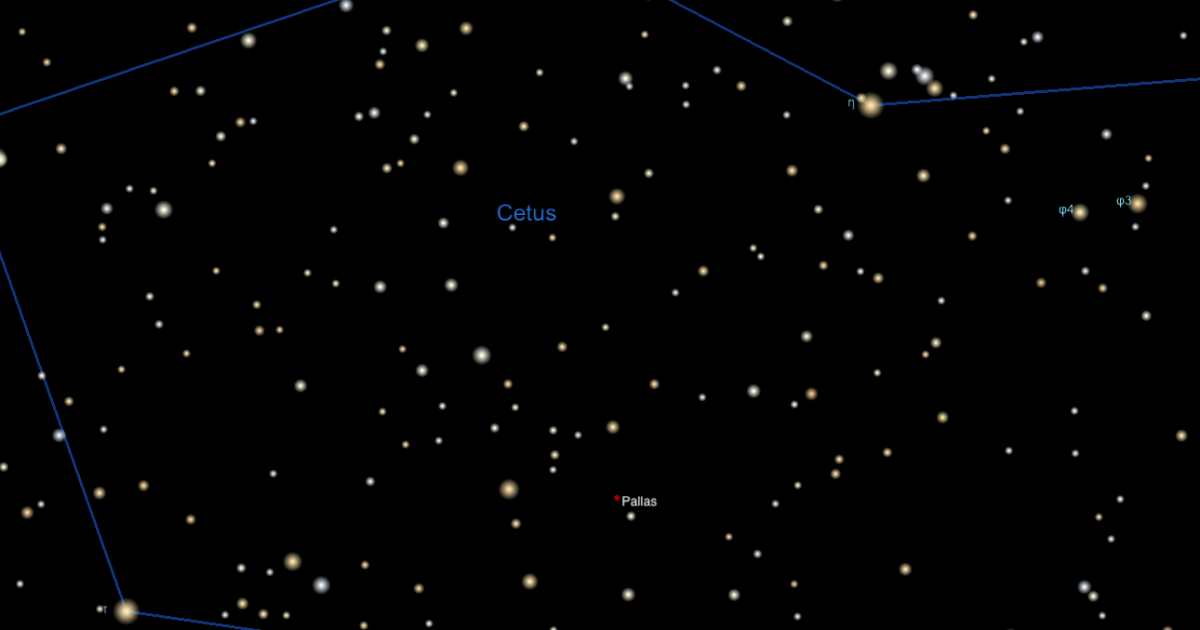
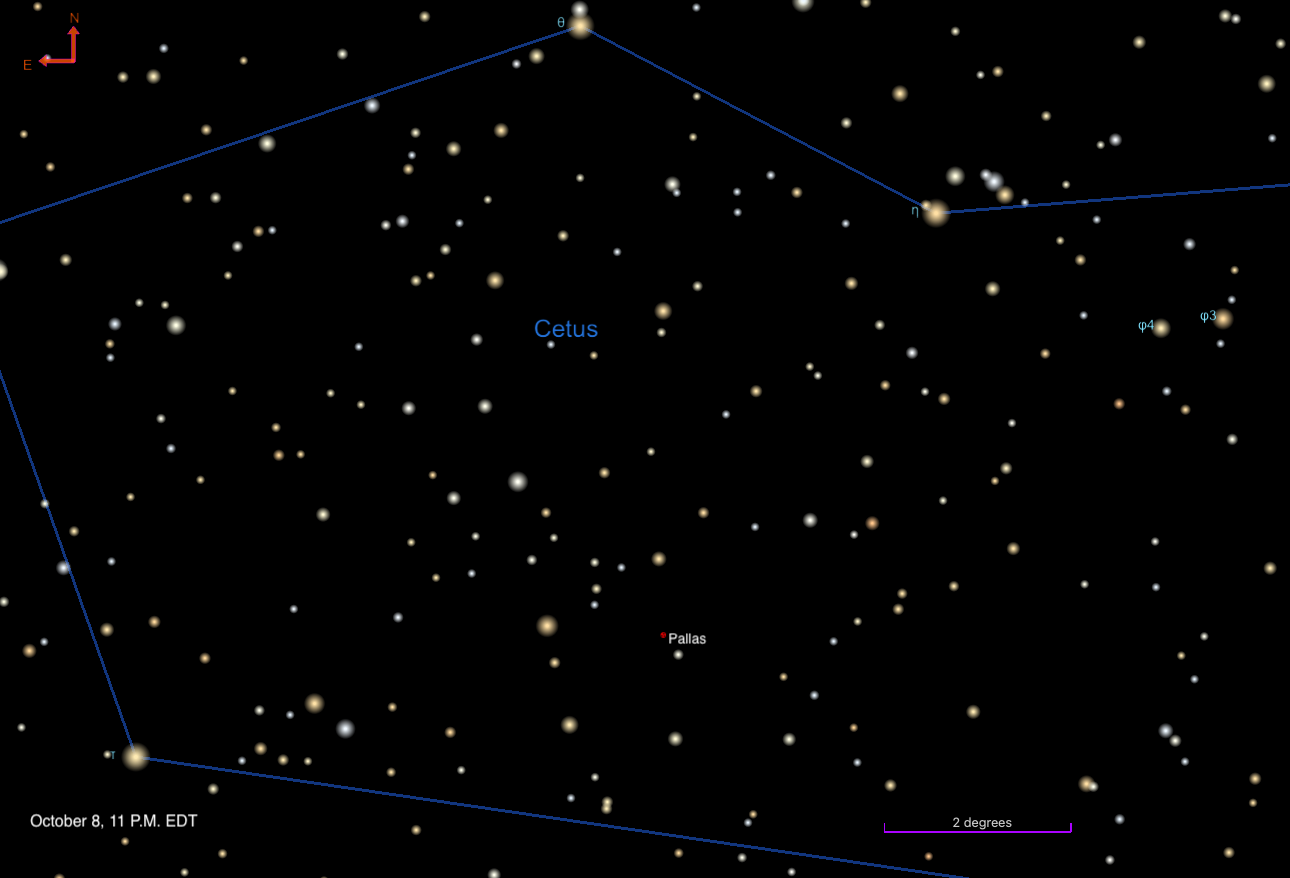
Asteroid 2 Pallas recently reached opposition in Cetus the Whale. Let’s track it tonight using binoculars or any size telescope.
Although it’s highest around 1 A.M., Pallas is visible all night and has already reached an altitude of 20° by 10 P.M. local daylight time, standing above the southwestern horizon. While Saturn is in northern Cetus, Pallas is near the center of the constellation, about 5.4° southeast of magnitude 3.5 Eta (η) Ceti. Around 10 P.M., you can also use Saturn to find Pallas by simply dropping just a little less than 19° down from the naked-eye planet toward the horizon.
Pallas glows at magnitude 8.3 and sits roughly ¼° northeast of a field star of roughly the same magnitude (8.2). It’s moving slowly, inching closer to the star over time and closing the gap by a few arcminutes over the course of the night. Using that star as a signpost, you may be able to notice its motion if you take a photo every few hours. If you come back tomorrow night, you’ll definitely notice a change: Pallas and the star have swapped positions, so that Pallas is now southwest of the field star and pulling away over time.
Sunrise: 7:03 A.M.
Sunset: 6:31 P.M.
Moonrise: 4:53 A.M.
Moonset: 5:26 P.M.
Moon Phase: Waning crescent (3%)
*Times for sunrise, sunset, moonrise, and moonset are given in local time from 40° N 90° W. The Moon’s illumination is given at 10 P.M. local time from the same location.
Alison Klesman is senior editor of Astronomy magazine. She holds a Ph.D. in astronomy and has studied a variety of topics, from minor planets to supermassive black holes.
About the Author