This post was originally published on this site.
07/10/2026
6 views
0 likes
Scientists using the European Space Agency’s Mars Express, in combination with a state-of-the-art meteorological model of the Red Planet, have found that there may be some very exotic physics behind Mars’s most curious cloud.
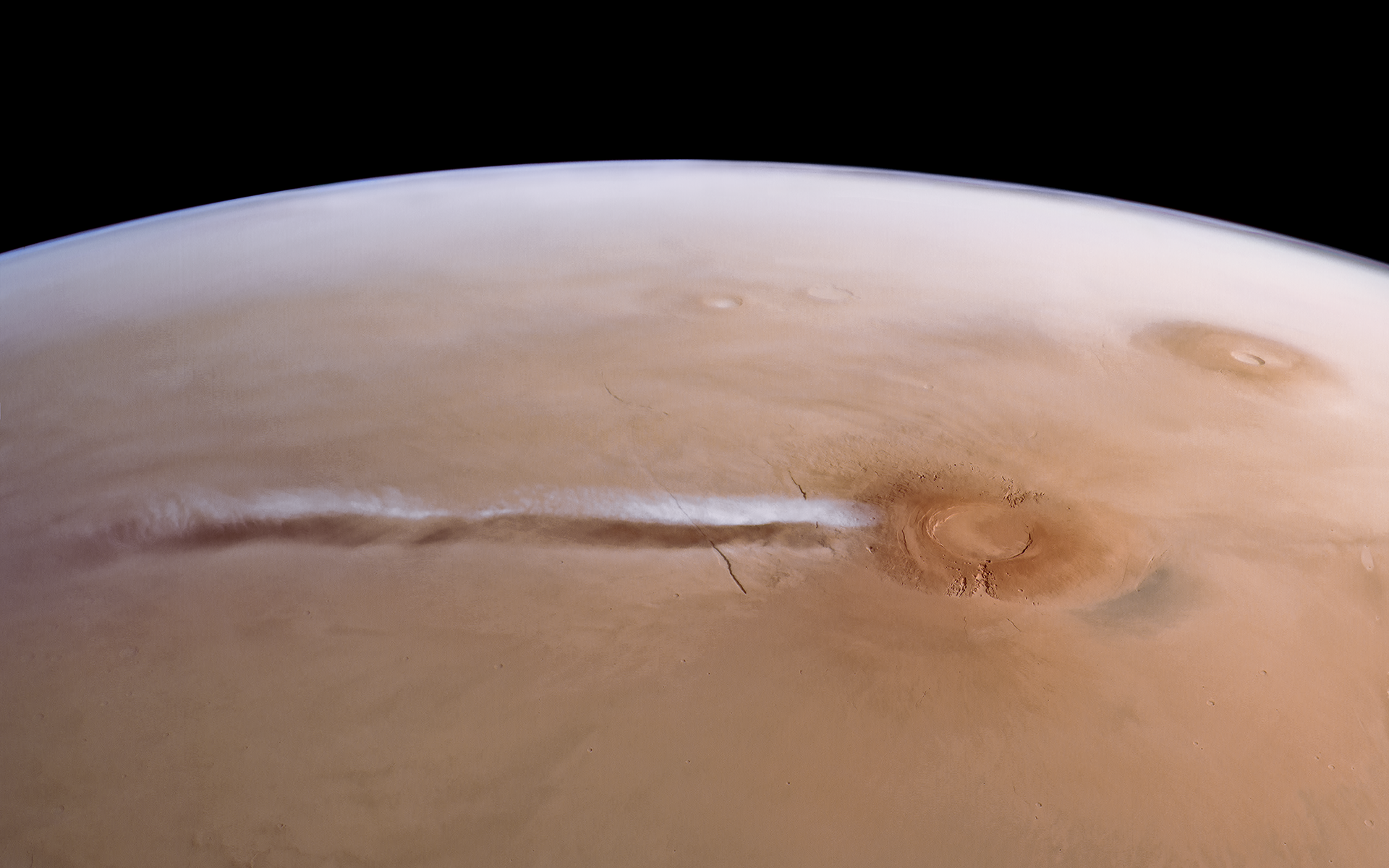
Every spring and summer in Mars’s southern hemisphere, during the martian dusty season, we see a spectacular cloud emerge: the Arsia Mons Elongated Cloud (AMEC), the most visually striking cloud on the Red Planet.
This white wisp of water ice emerges downwind of the 20-km-tall Arsia Mons volcano. It forms, grows, and fades on a daily basis, stretching out for up to 1800 km – nearly twice the length of the UK – before quickly evaporating. This cycle repeats every morning for several months.
Mars Express first revealed the AMEC in 2018, and has viewed the recurrent cloud repeatedly since. Researchers have explored its evolution, vivid dynamics and intriguing behaviour, determining it to be an orographic cloud: a type of cloud also seen on Earth that forms as wind flows past the craggy topography of a volcano or mountain.
However, when trying to model exactly how the cloud springs to life, our simulations simply didn’t reproduce what we see in the images – until now.
“To create the AMEC in our modelling, we found that we needed to include some exotic physics… physics that, while included in textbooks, is treated as theoretical and usually thought not to happen in nature. It certainly hasn’t been seen in action before,” says Jorge Hernández-Bernal of LMD/CNRS/Sorbonne Université in Paris, France, lead author of the new study. “Once we included this physics in our simulations, the AMEC emerged just as we hoped.”
“Wholly unexpected”: a rare process in action
On Earth and elsewhere, clouds typically form when moist air cools and water vapour condenses into liquid droplets or icy crystals. This usually happens via a process known as heterogeneous nucleation, which requires specks of other ‘stuff’ to be present in the atmosphere for vapour to cling and condense onto – salt, pollen, soot, or dust, for instance. On Mars, it’s thought to be dust.
“For the AMEC, it seems that cloud formation takes place without needing any of this ‘stuff’,” adds Jorge. “Water vapour turns directly into icy cloud particles without any middle step. It’s akin to droplets of condensation appearing in the middle of a room, rather than on a window. We call this homogeneous nucleation, and we’ve never seen it before in a planetary atmosphere. It’s wholly unexpected.”
Scientists had suggested that this process might take place in the upper atmospheres of Earth and Venus, but it hasn’t been spotted. Its rarity is due to it requiring exceptional circumstances, with extreme relative humidity levels of over 100 000 times those usually experienced in our daily life on Earth. “We’ve not seen these conditions on Mars before, but our finding now strongly suggests that the planet’s humidity can indeed reach these extreme levels,” says Jorge.
Jorge and colleagues found that the AMEC sits in a unique position where Mars’s thin atmosphere and the towering height of the nearby Arsia Mons volcano come together to create the conditions needed to see this rare process in action.
As winds flow past Arsia Mons, the volcano’s bulk triggers a powerful wave that lifts moist parcels of air several kilometres up into the air in just a few minutes. This cools the atmosphere rapidly, causing temperatures to drop by 30 degrees in just 10 minutes and relative humidity levels to spike. Water vapour then spontaneously freezes directly into cloud particles, forming the AMEC.
A win for Mars Express
While some aspects of the modelled cloud don’t exactly match the observations, “the result is remarkable,” says Jorge. “We don’t have nearly as much information about Mars’s atmosphere as we do about Earth’s, so reproducing the AMEC to this degree is a big success for the model.”
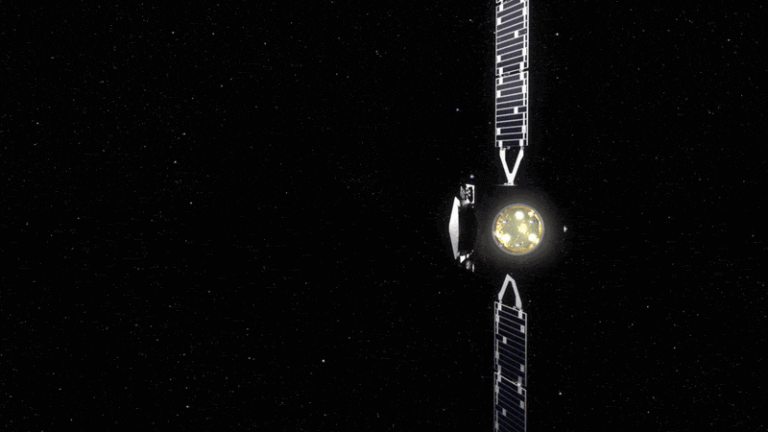
The researchers based their modelling on data from the three cameras aboard Mars Express: the Visual Monitoring Camera, High Resolution Stereo Camera, and OMEGA. Mars Express can image large swathes of the martian surface at high resolution, and it is one of the few Mars-orbiting spacecraft – alongside ESA’s ExoMars Trace Gas Orbiter – able to observe during morning hours, when the AMEC is present.
“Mars Express can also track how the cloud is changing on timescales of mere hours, which gives us an unrivalled view of short-lived phenomena on the planet,” says ESA Mars Express Project Scientist Colin Wilson. “Overall, this finding is a true accomplishment for the mission and its scientists: Mars Express discovered the AMEC, has followed up and monitored it for years, and is now helping reveal the secrets of its formation.”
Beyond furthering our understanding of atmospheric processes on Mars and elsewhere, the result highlights that we should not discount unlikely processes when exploring the planets of the Universe (including exoplanets). Colin adds: “While clouds on Earth and Mars seem to be governed by the same ‘rules’, understanding this exotic martian cloud required exotic physics – and this may be true elsewhere in the cosmos.”
Notes for editors
Mars Express has imaged the AMEC using both the lower-resolution VMC camera and – as in this release – with the high-resolution HRSC. This marks the first ESA release featuring HRSC imagery of the AMEC, and shows the cloud in striking detail.
‘Homogeneous ice Nucleation from Water Vapour Suggested by Elongated Clouds on Mars’ by J. Hernández-Bernal et al. is published today in Nature Geoscience. https://doi.org/10.1038/s41561-026-02089-9. A free version of the paper is available here.
For more information please contact
ESA Media Relations
media@esa.int
About the Author