Looking for a sky event this week? Check out our full Sky This Week column.
October 6: The Moon occults Jupiter
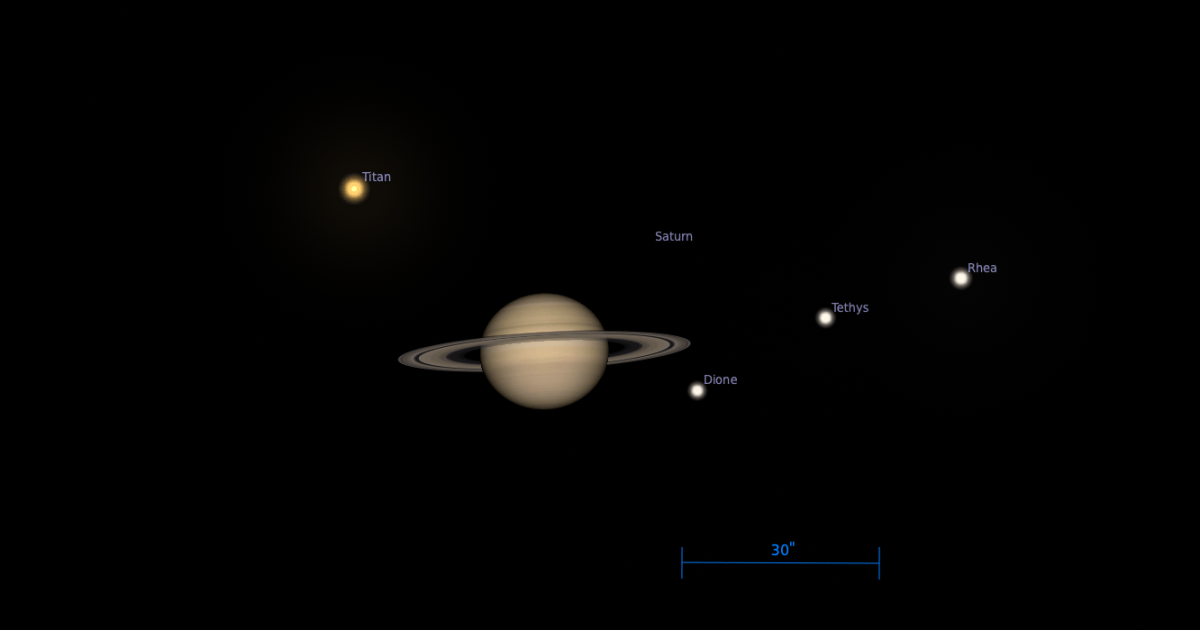
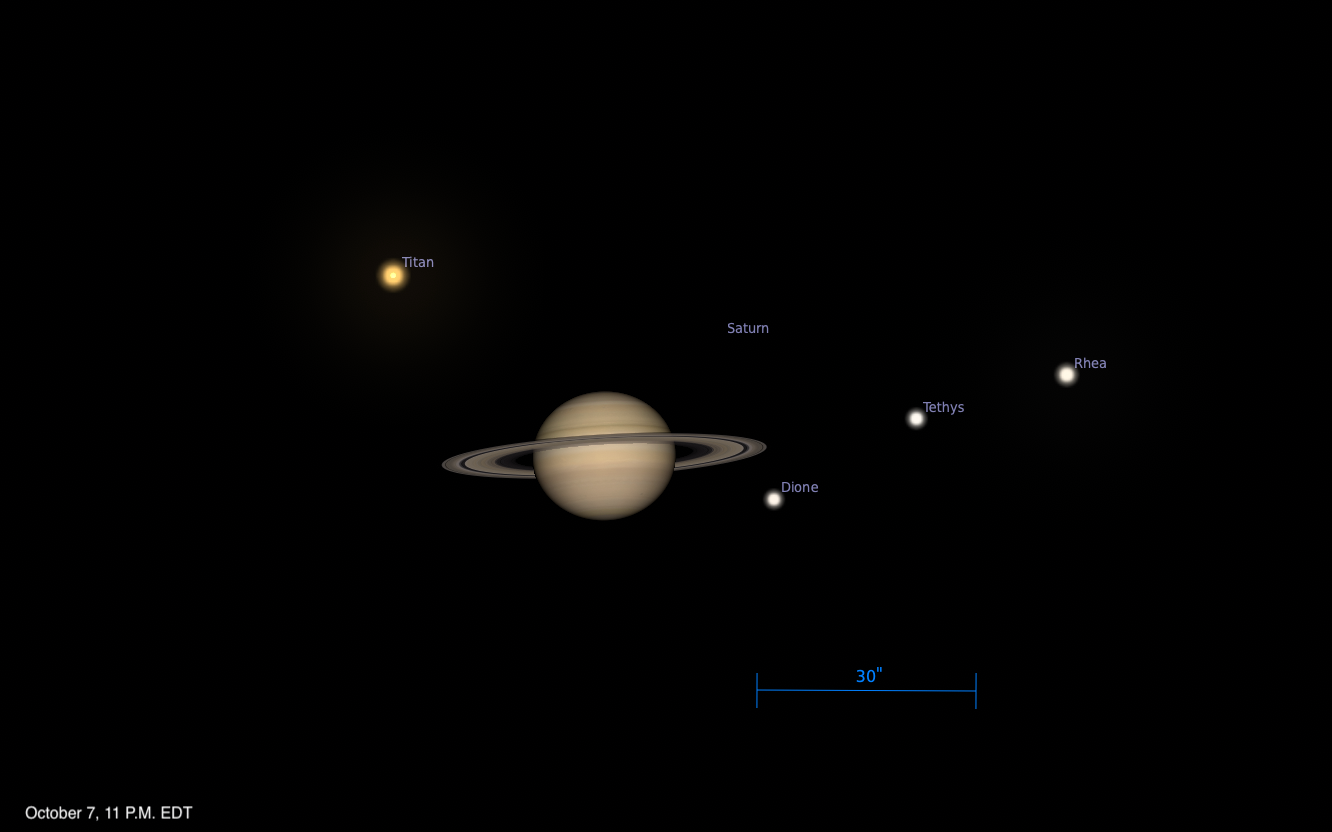
Saturn’s brightest moon, Titan, has closed the gap between itself and its parent planet to sit less than 1’ northeast of the ringed world tonight.
With Saturn already above the horizon as the sky is darkening, you can take your time observing it. Titan shines at mid-8th magnitude, which makes it stand out among the fainter moons that cluster closer to the planet. Dione, Tethys, and Rhea all shine around 10th magnitude and begin the evening west of the planet, but their positions change quickly thanks to their relatively tight orbits.
Rhea and Tethys are moving west, but Dione is tracking eastward. It is occulted by the southwestern limb of the planet just before 2:15 A.M. EDT on the 8th (now early in the morning for all but those in the Pacific time zone) and reappears just under two hours later, now at the southeastern limb. During this time, Titan has been moving westward as well, and stands due north of Saturn around 6 A.M. MDT (note the time zone change, as it is dawn or nearly dawn farther east) on the 8th. The evening of the 8th will find Titan northwest of the planet, moving farther away again.
Sunrise: 7:02 A.M.
Sunset: 6:32 P.M.
Moonrise: 3:43 A.M.
Moonset: 5:03 P.M.
Moon Phase: Waning crescent (7%)
*Times for sunrise, sunset, moonrise, and moonset are given in local time from 40° N 90° W. The Moon’s illumination is given at 10 P.M. local time from the same location.
Alison Klesman is senior editor of Astronomy magazine. She holds a Ph.D. in astronomy and has studied a variety of topics, from minor planets to supermassive black holes.
About the Author