In recent decades, astronomers have found evidence that supermassive black holes can really mess with their galaxies’ evolution. They gobble up material intended for star formation, quenching the birth of stars. Conversely, jets streaming away from those hungry monsters can energize gas-rich regions and enhance the chances of a galaxy birthing batches of stars in those areas.
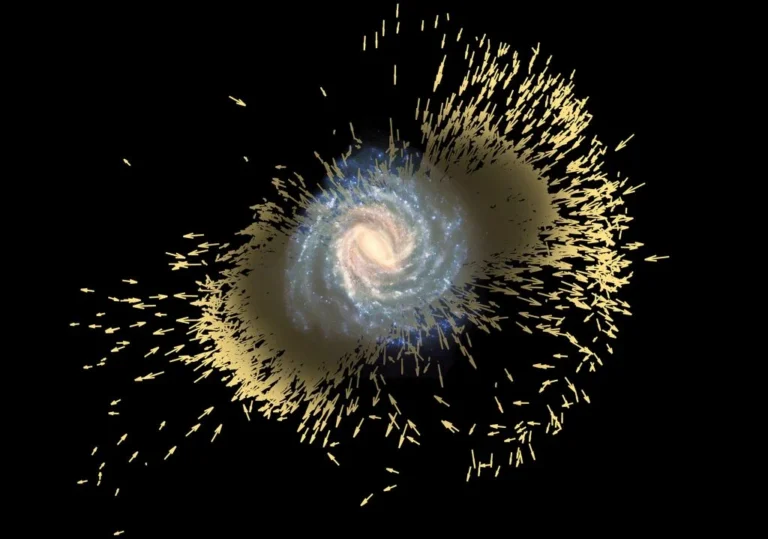
A recent study by a team of astronomers at Arizona State University and Raman Research Institute in India focused on large envelopes of gas that seem to surround many galaxies, including the Milky Way. This reservoir, called the circumgalactic medium (or CGM for short), can be quite huge — sometimes stretching out 10 to 20 times the size of the visible part of a galaxy. The CGM is a so-called “baryon reservoir” (meaning visible material) that contributes to and regulates the long-term evolution of a galaxy. The gases in these regions are a valuable supply of material for star birth as they move into the nearby galaxy and clump together under the force of gravity.
Team members Sanchateeta Borthakur (ASU) and Namrata Roy (RRI) combined observations of hundreds of galaxies with active jets. Those studies were made using the Dark Energy Spectroscopic Instrument (DESI) survey (mounted on the 4-meter Mayall Telescope on Kitt Peak in Arizona) and radio jet measurements from the LOFAR Two-meter Sky Survey (LoTSS) (a low-frequency radio array located in Europe). They took the combined measurements coming specifically from the jets and looked for the telltale signals of ionized hydrogen (H-alpha).
The result showed a very clear and strong set of signals from the axes of the radio jets. This means that the jets are “heating up” the gases along their paths. Their strongest influence is where the jets come in contact with the CGM and then farther out as the jets travel through space and release their superhigh energies. In both places, the shock fronts and energy releases can light up the gases or disrupt them. The end result is a wave of star formation along the shocked areas, or a “quenching” of star birth where the jet disrupts the gas supply. According to Roy, the action of the jets illustrates something amazing about the power of the supermassive black holes. “The surprising question is: How can something so small energetically impact something so enormous?” said Roy.
Black Holes and Their Jets
Galaxies with active black holes and jets usually get referred to as active galactic nuclei (AGN). Those jets don’t happen in a vacuum, which is why astronomers looked for evidence of their activity in the surrounding CGM. “What excites me most is the scale of the connection,” Roy said. “A black hole is incredibly small compared to a galaxy, but its impact can reach hundreds of thousands of light-years, far into the galaxy’s outer reaches. The jet carries the energy outward, and the gas lights up along its path.”
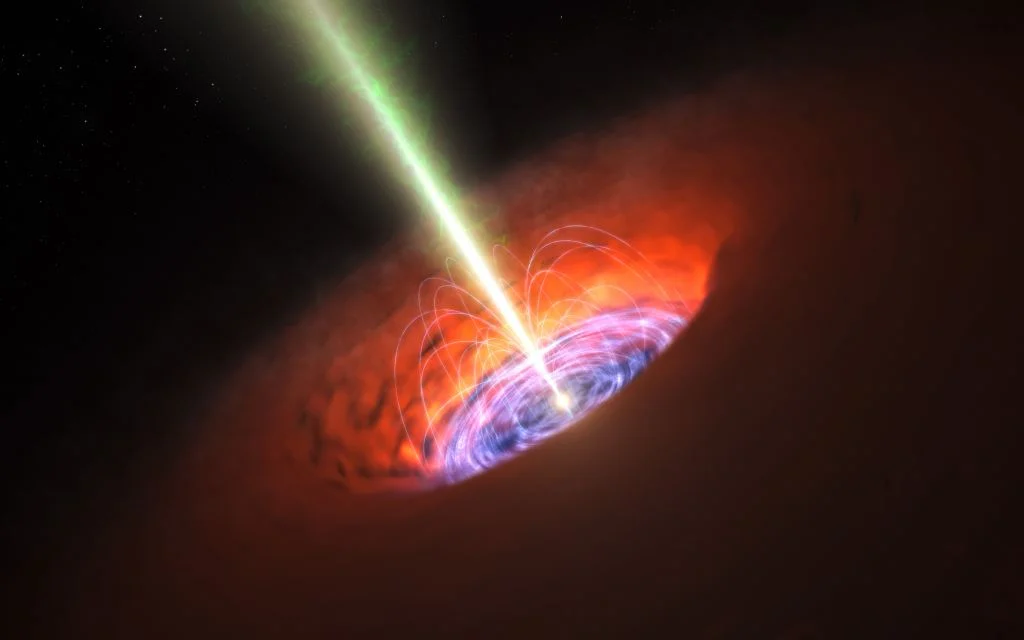
Artist view of an active supermassive black hole and its powerful jets. Image Credit: ESO/L. Calçada
The jets themselves (also known as relativistic jets) form in pairs as highly collimated, high-energy, high-speed outflows away from the black hole. They’re produced as material swirls close to the black hole and gets superheated. The heat has to go somewhere, and a jet is what forms. The jets produce emissions in all wavebands, including radio frequencies, which allows them to be studied in detail. The energy they carry is what we detect from Earth using X-ray, radio, and other instruments. The jet actions — heating, stirring, shocking, and disturbing clouds of gas — are what can provide braking action or acceleration of a galaxy’s growth. If the black hole is eating up the available supplies of gas in the near neighborhood, or its jet is destroying those supplies farther out in the galaxy, that has a profound influence on how quickly the galaxy can grow. In the worst-case scenario, the activities of the black hole and its jets can render the galaxy into a quiescent state. That means it won’t form many (if any) stars. We would see the deaths of stars in such a galaxy, which would bring new material and influences for star birth, but it would be a different “look”.
What are the Effects?
If the jets are disturbing and energizing clouds of gas in the CGM far from the black hole, the chances for bursts of star formation along the regions where the jets flow are much higher. This is why it’s important to look along the axes of the jets to find areas where the gases are being affected in some way. In the future, astronomers can create more simulations of this type of action, combined with further observations like those done with DESI and LOFAR already. The result should be a stronger case for understanding the already-observed interactions between radio jets in AGN and the CGM that forms haloes around their galaxies.
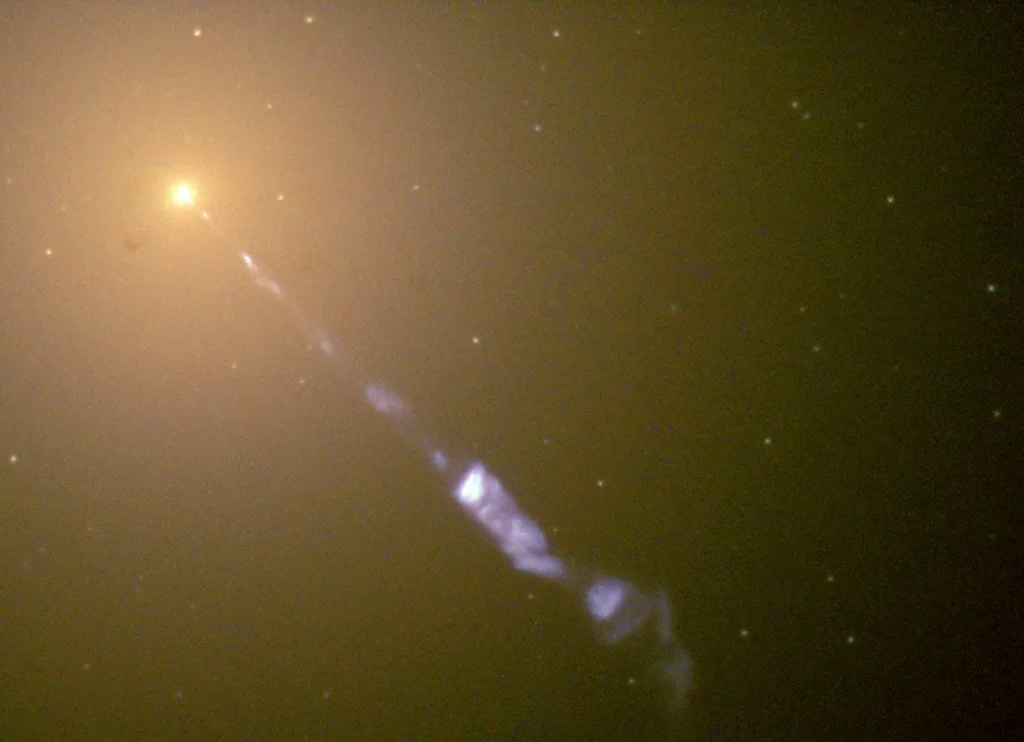
Image taken by the Hubble Space Telescope of a 5000-light-year-long jet ejected from the active galaxy M87. The blue synchrotron radiation contrasts with the yellow starlight from the host galaxy. The dots spread around the image are not individual stars, but globular star clusters. Credit: NASA/The Hubble Heritage Team (STScI/AURA)
For More Information
Black Hole Jets May Shape the Fate of Entire Galaxies
Lighting Up the Circumgalactic Medium: Strong, Jet-aligned H-alpha Emission around Radio Galaxies
About the Author

Source: Universe Today