To measure the expansion rate of the cosmos, astronomers rely on the relationship between distance and recessional velocity (redshift). This has been historically difficult when it comes to quasar pairs, galaxies with bright cores that are on the verge of colliding. Fortunately, researchers at the University of Alberta have devised a more precise method for measuring the distance between double quasars, helping reduce uncertainty when measuring cosmic expansion.
Quasi-stellar objects (aka quasars), which are powered by supermassive black holes (SMBHs) at the center of galaxies, are the most powerful and persistent in the cosmos. The powerful accretion disks and jets these black holes have cause the cores of these galaxies to temporarily outshine all of the stars in their disks. When galaxies merge, these central regions do as well, creating even larger supermassive black holes at their centers.
The research was led by Dr. Huanqing Chen, an assistant professor of astrophysics at the Augustana Campus at the University of Alberta. He was joined by Camille Avestruz, a researcher at the Leinweber Institute for Theoretical Physics and an assistant professor at the University of Michigan, and Jakob Wiest, a graduate student of UM’s Astronomy and Astrophysics program. The paper describing their findings appeared in The Astrophysical Journal Letters.
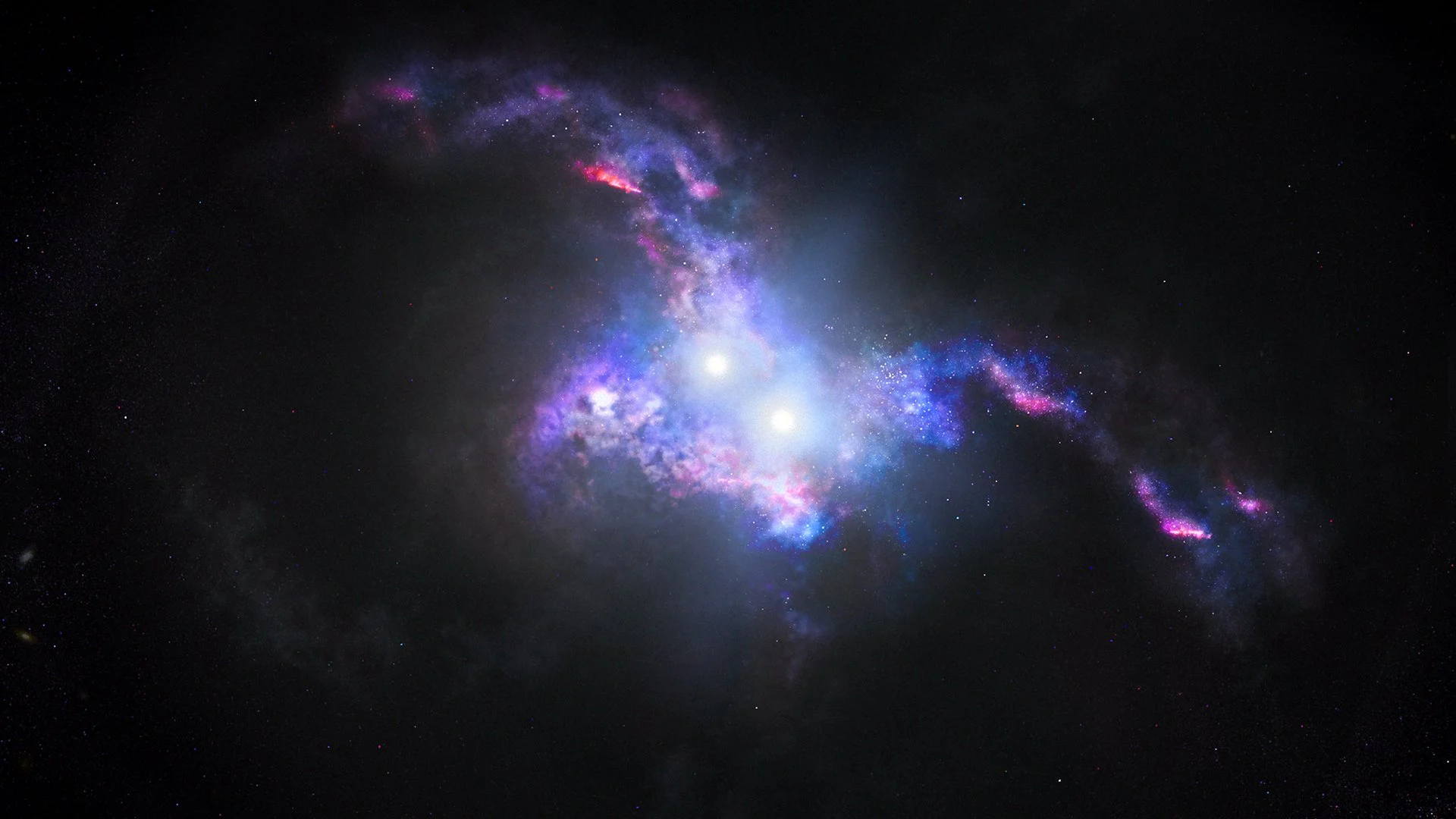
Illustration showing quasars coming together in merging galaxies. Credit: NASA
To determine a galaxy’s recessional velocity, scientists measure light emitted by gas clouds within them. This has been difficult with quasar pairs since active SMBHs often push that gas outward so fast that the measured velocity deviates significantly from the galaxy’s actual velocity. This leads to depth-perception problems for line-of-sight separation measurements, causing errors of up to 10 million light-years. As Chen said in a UAlberta press release:
When we spot two quasars close together in an image, we’re looking at a projection of a three-dimensional universe, so we know their separation across the sky very precisely, but their separation along our line of sight carries a large uncertainty. Being able to measure the true physical separation is an important factor in deciding how long it takes two quasar-hosting galaxies to merge.
In contrast, the study tested the Quasar Proximity Effect (QPE). This alternative approach examines hydrogen absorption lines in the regions of gas around a quasar that are lit up and heated by its light. Astronomers can see this region in a quasar’s spectrum because the heated gas becomes transparent. Using simulations and algorithms, the team applied this same method to measuring distances between quasar pairs. As Chen illustrated:
If you picture two light bulbs that sit at exactly the same spot, you see a single bright region. If one is placed in front of the other, you see a second bright patch out ahead — and how far ahead it sits tells you how far apart the bulbs are. With quasars, we use those transparent regions the same way, to work out the separation between the two.
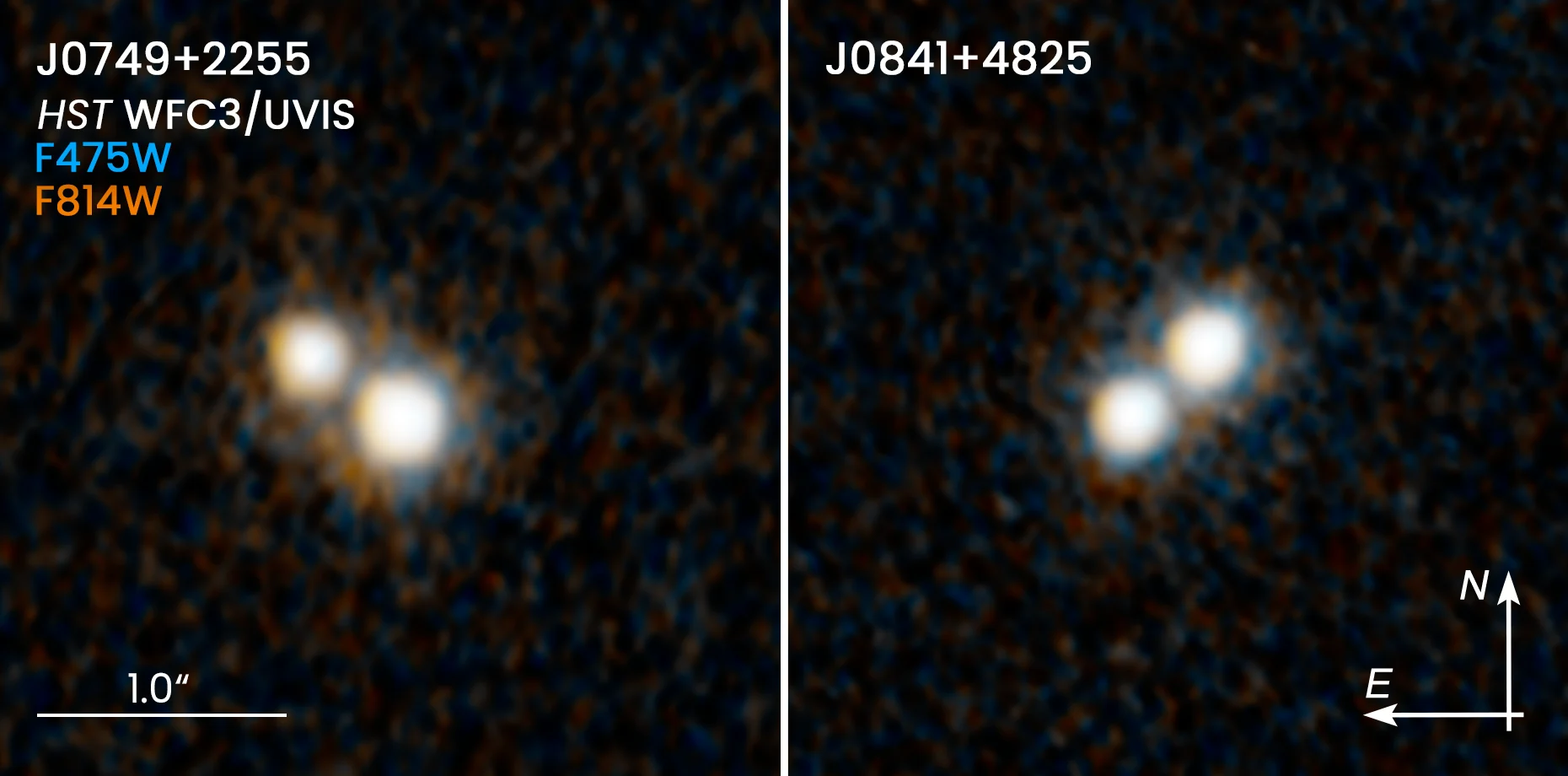 These two Hubble images reveal two pairs of quasars that existed 10 billion years ago and reside at the hearts of merging galaxies. Each of the four quasars resides in a host galaxy. Credit: NASA/ESA/STScI
The team’s results revealed that this new method offers more precise distance estimates than conventional redshift measurements. Whereas the latter have a margin of error equivalent to tens of millions of light-years, the new method can pin down the physical separation of a quasar pair to within as little as half a million light-years. While it used simulated data, the method can be applied to existing quasar-pair data, rather than requiring astronomers to collect new observations.
“Those observations can take years to obtain, if they can be obtained at all,” said Chen. “This method could let astronomers characterize a quasar pair’s true separation without that second observation. The approach is worth investigating further, because there’s a lot of potential in it.” The next step for Chen and her team is to test how the method’s precision can be improved using finer, smaller-scale features in real quasar spectra.
Further Reading: University of Alberta
About the Author

Source: Universe Today