The black holes at the hearts of galaxies get the credit and/or blame for a lot of things in their hosts. For example, they take the blame for gobbling up star-forming material, effectively “quenching” starbirth in some areas of galaxies. On the bright side, it now turns out that some of them may be commonly participating in the births of stars, too.
Thanks to a series of observations made using the Very Large Telescope in Chile, research by Harvard Center for Astrophysics graduate student Peixin Zhu, shows active galactic nuclei (AGN) in nine nearby Seyfert galaxies appear to be associated with star formation. These galaxies contain star-forming rings or arcs, as well as regions of energized gas and fast shock fronts associated with energetic outflows interacting with neighboring gas clouds. This AGN-related activity could well be playing a role in the growth and evolution of galaxies.
Peixin’s team’s study focused on galaxies that have central supermassive black holes busily accreting material from nearby regions. “Once we resolved them, we could see that they not only accrete things, but they also eject things,” said Peixin. “The injection and accretion are linked with each other.”
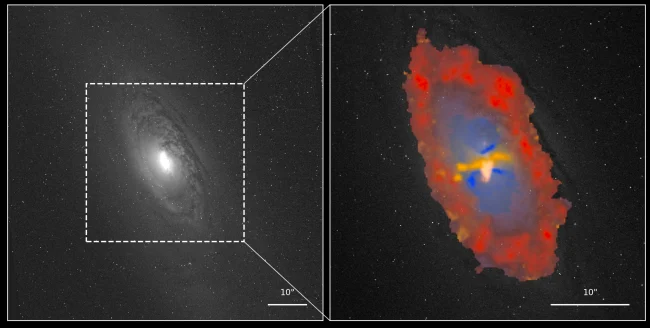
The galaxy NGC 1386, shown in grayscale on the left and zoomed in to the central region on the right. The colors represent star formation in red, black-hole radiation in blue, and shocks in yellow. Image courtesy Peixin Zhu.
The Seyfert Galaxies and Their Black Holes
The nine galaxies that the team studied lie within about 360 million light-years, and each has an active nucleus powered by the action of a supermassive black hole. They are Type 2 Seyfert galaxies, which means they can appear bright in infrared light, their emission lines are often narrow, and the velocities of their gas outflows are not as fast as in other Seyfert galaxies. They can appear as normal spirals until scientists focus in on the emissions from their hearts. The study of these active galaxies provides important insights into the evolution of galaxies and the influences their supermassive black holes have on star formation as the galaxy and black hole co-evolve.
“We’re seeing that black holes are not just consuming material at the centers of galaxies, but they’re actively reshaping their surroundings,” said Lisa Kewley, an astrophysicist at the Center for Astrophysics | Harvard & Smithsonian, director of the Center, and Zhu’s advisor. “This work helps us understand a complex feedback cycle that plays an important role in galaxy evolution.”
To study these galaxies, the team had to use special techniques combining high-resolution observations with theoretical models of actions in a Seyfert galaxy. The team also used Chandra X-ray observations to verify what they were seeing. The research allowed them to differentiate sites of star formation from black hole radiation and excitation by shock fronts moving through the galaxy from the black hole through the interstellar medium. The result of the research was the discovery of arcs of newly formed stars as well as rings of star-formation activity. These formations appeared fairly close to the galactic centers, usually within 0.8 to 6 kiloparsecs (roughly 2,600 to about 20,000 light-years).
The team also found ionized cones of black-hole radiation extending away from the galactic cores, with fast shocks radiating out perpendicular to the cones. According to Peixin, the shock behavior is generally expected with interactions between AGN jets and the surrounding interstellar medium. “The most interesting phenomena about shocks is that they always go perpendicular to where the black hole’s injected outflows go,” Peixin said. “It is very common, and we see it consistently appearing across the whole nine galaxies.”
Further Implications
As scientists study more of these active galactic nuclei in the nearby Universe, they gain insight into similar activities in galaxies in the earlier epochs of cosmic history. This is particularly true of actively growing black holes at the hearts of galaxies. They appear to go through cycles of accretion, outflow, and interaction with their hosts. Rather than acting as hungry objects negatively affecting galaxies, these black holes also play an important role in energizing the star formation behavior during the cycles of growth that galaxies experience.
The shocks emanating from such AGN may be the “jolt” needed to kickstart star formation throughout a galaxy’s history. As astronomers study more of them, they will need to take into account all the roles that shock excitation play in AGNs. In particular, future studies should focus on the mechanism that drives the shocks. Are they interactions between jets and the interstellar medium, or could other interactions be at play? Astronomers will need to gain a better understanding of gas pressures and densities in the interstellar medium, as well as insight into the energy that’s being carried away in these shocks that ultimately ends up as part of the forces that enhance rather than destroy star-forming sites in a Seyfert galaxy.
For More Information
New Study Reveals Common Pattern of Black Hole Activity Shaping Nearby Galaxies
Common Excitation Patterns of Star Formation, Active Galactic Nuclei, and Shocks in Seyfert Galaxies
About the Author

Source: Universe Today