This post was originally published on this site.
11/09/2026
18 views
0 likes
In brief
Earth’s orbital environment is a finite resource. Some of its orbits are getting crowded and increasingly churning with deadly, fast-moving pieces of defunct satellites and rockets that threaten our future in space.
Since 2017, ESA’s Space Debris Office has published an annual Space Environment Report to provide a transparent overview of global space activities and determine how well international debris-reduction measures are improving the long-term sustainability of spaceflight.
In the report, only past and ongoing activities are included in the data to ensure a firm base for any projections into the future, leaving out any project still being prepared for launch.
Below is an overview of the 2026 report, based on data collected until the end of 2025.
- The number and scale of commercial satellite constellations continue to increase each year.
- Not enough satellites leave heavily congested orbits at the end of their lives, creating a growing collision risk.
- More than three intact satellites or rocket bodies are reentering the Earth’s atmosphere every day on average. At the same time, ten new payloads are launched daily.
- A new trend has constellations change altitude significantly year-on-year.
- New report metric added in 2026: on-ground casualty risk of reentries. Even though the numbers are low compared to everyday risks in life, the chance of a casualty increased in recent years due to increased traffic.
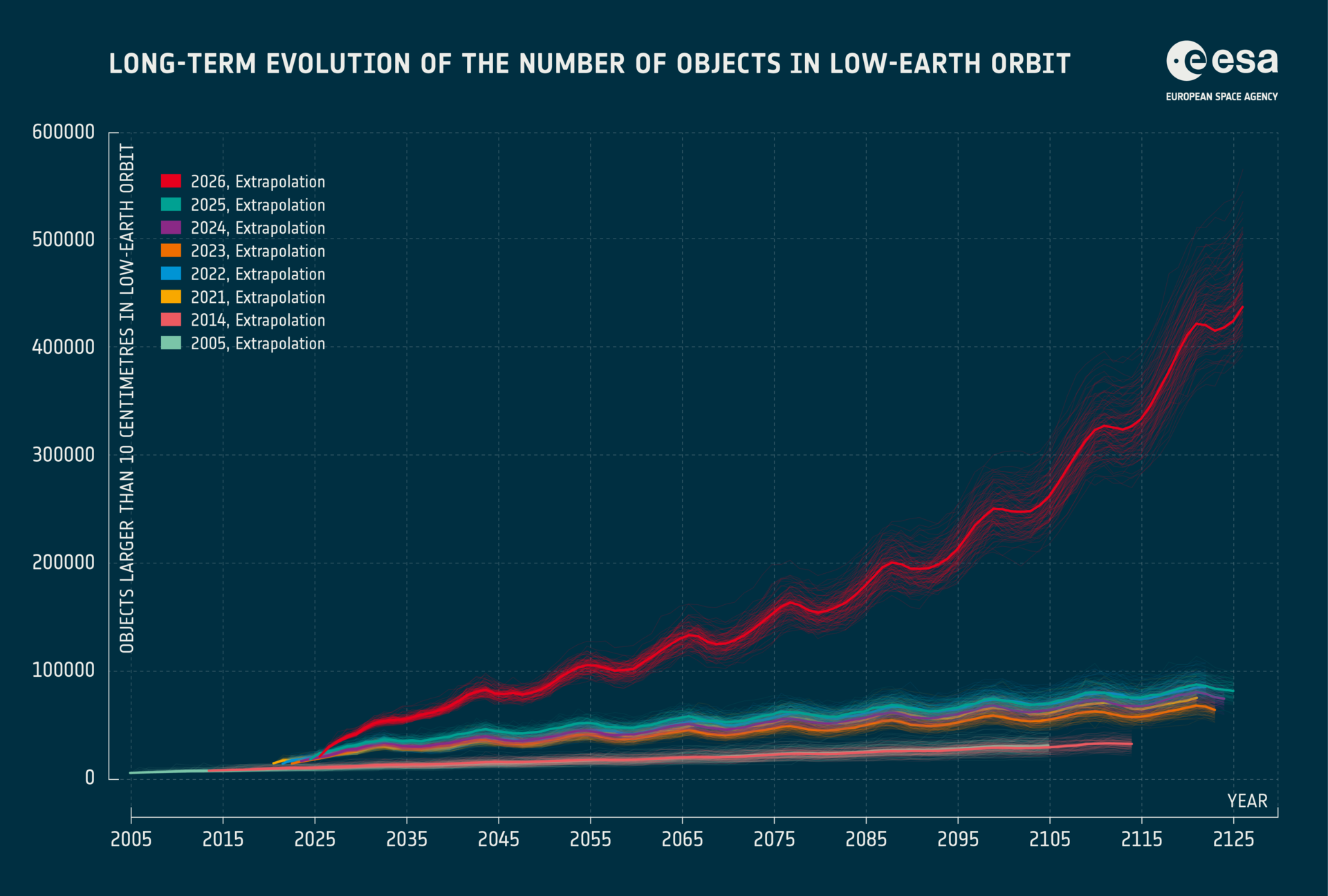
- The continued growth trends caused a worrying year-on-year development in the future projections. The expected number of objects and collisions in low-Earth orbit are skyrocketing in a runaway effect, despite the time horizon being shortened from 200 to 100 years.
- The ESA Space Environment Health Index indicates with just one number if our current behaviour in space is sustainable in the long run. In 2025, the long-term effect of our current activities in space over time got an order of magnitude worse in just one year.
- Active debris removal is required to stop the growth of the number of objects over time that is caused by space debris causing new debris on their own through collisions (Kessler syndrome).
- Some indicators show that the interest in and adherence to space debris mitigation measures is on the rise, but we need to be faster, more consistent and reliable. Without it, we are saddling future generations with a high price to pay for any activities in space.
In-depth
Growth trends continue
Space activities continue to grow at a remarkable pace. In 2025, more than 300 launches took place with over 4000 new payloads put into orbit. Large constellations and the growing use of rideshare missions mean more satellites are being deployed per launch, with single-payload missions becoming rarer.
At the same time, the debris population also continues to expand faster, with both fragmentation debris and defunct payloads contributing significantly.
A different trend is the increasing number of objects in orbit with an unidentified classification, reflecting a growing gap between detected and catalogued (i.e. detected of known origin) fragments. Indeed, as technologies improve, we can observe more objects but many of these detectable objects cannot yet be linked to a specific source or break-up event. This highlights the increasing complexity of the space environment and the need for improved monitoring and space traffic management capabilities to be able to avoid collisions and fragmentations.
Changing behaviour
A changing orbital landscape
Satellites are not necessarily staying in the same orbital bands anymore. As large constellations expand and more spacecraft are deployed, active payloads are spreading across a wider range of altitudes.
This shift underscores the importance of effective space traffic coordination and responsible end-of-life disposal. Data sharing on planned constellation deployments coupled with effective space traffic management can prevent challenges to mission planning.
Reentry rate remains high
Reentry activity remained high in 2025, driven by both rapid growth in space activity and improved compliance with debris mitigation guidelines. With around ten objects launched each day and more than three intact objects reentering daily, the number of payloads returning to Earth as part of planned end-of-life disposal continued to rise.
This reflects a positive shift towards shorter orbital lifetimes, encouraged by the transition from the 25-year to 5-year disposal target in low-Earth orbit.
Controlled reentries of rocket bodies continued to outnumber uncontrolled ones for the second year, demonstrating progress in responsible space operations.
New report metric: casualty risk on the ground
A new metric introduced in the 2026 report highlights the growing casualty risk on the ground from fragments that survive atmospheric reentry. While the probability of a casualty remains low compared with many everyday risks, the upward trend reflects the cumulative effect of more launches, more satellites and more reentries.
A reduction in risk might be achieved through more controlled reentries of payloads and the wider adoption of design-for-demise technologies, which ensure satellites burn up as completely as possible during reentry.
Projections into the future
Number of objects will skyrocket
For years, a standardised long-term evolution of objects larger than 10 centimetres has been included in our Space Environment Report to compare potential future scenarios, every line showing an upwards trend with higher numbers than the year before. Despite an improvement in mitigation efforts, we now again see a net growth of the space debris population. Combined with the increase in active satellites and constellations being launched and their estimated risk level, this has the Kessler syndrome’s runaway effect (see also below) becoming visible much earlier in time.
In fact, the prediction horizon has been reduced from 200 to 100 years into the future and still has much higher numbers than just one year ago.
The real risk: collisions causing collisions
The greatest long-term threat is not simply the addition of new objects through launching more, but the self-sustaining cycle of collisions creating fragments that trigger further collisions: the Kessler syndrome.
Even if no new satellites were launched, the debris population would continue to increase because fragmentation events generate debris faster than they can naturally reenter the atmosphere. Over time, this could make some orbital regions increasingly unsafe and potentially unusable.
Prevention is not only better than a cure, but also much more affordable. Preventing new debris through space traffic management, end-of-life disposal and Zero Debris practices remains essential, but prevention alone is no longer enough. Active debris removal must become part of the solution and soon in order to keep the final frontier of space open to the generations to come.
Health Index: long-term effects worsen 10x
Just as climate scientists use temperature as a key indicator of global warming, the space community needs a clear, quantifiable metric to assess the impact of objects and missions on orbital sustainability.
The Space Environment Health Index provides such a metric. It is a single score that reflects how healthy or stressed the orbital environment is and what the consequences will be. In 2014, a reference scenario, based on high level of implementation of space debris mitigation measures, was defined and it is adopted here as a benchmark for an acceptable evolution of the debris environment. Anything above means that there will be that many times more strain on the orbital environment than is sustainable.
The incredibly large jump of the Index from about 4 to 50 in just one year means that the already beyond sustainable effects of our space activities has worsened an entire order of magnitude within the space of just one year.
What is ESA doing about it?
ESA is active in a wide array of fields to research, prevent and mitigate the effects of space debris, many of them via the ESA Space Safety programme that works to establish a safe and sustainable future in (and from) space.
Towards Zero Debris
Getting a better view on the problem through space debris tracking and reporting is just the first step in resolving the space debris problem.
ESA has set itself the goal to significantly limit the production of debris in Earth and lunar orbits of all future missions, programmes and activities by 2030 through its Zero Debris Approach. ESA is leading by example as it works on many activities in parallel as part of this holistic approach:
- ESA has updated its debris mitigation requirements, policy and standards that govern how the Agency’s missions are designed, built, flown and disposed of, also setting the rules for any company or institution that works with ESA on its missions.
- In 2023, ESA facilitated the creation of the Zero Debris Charter by the Zero Debris community with dozens of key actors in the global space community. The Zero Debris community as well as policy working groups have since produced the Zero Debris Technical Booklet, essentially a ‘to do list’, defining the technical solutions necessary to achieve the Zero Debris Charter goals, and is working to make these a reality.
- Practical steps taken include supporting the design of zero-debris satellites and investing in the adaptation of production lines of large platforms to create the zero-debris satellites of the future.
Cleaning up orbits
A number of missions are in development at ESA and its partners to actively combat the generation of debris. This includes developing new passivation techniques, preventing in-orbit break-ups and conducting active debris removal and in-orbit servicing demonstrations.
Where possible, ESA is attempting to deorbit satellites that were designed and built well before its current guidelines came into effect. The Agency is putting great effort into removing missions such as Aeolus and Cluster from orbit in more sustainable ways than were first envisioned.
Cleaning up littered orbits by conducting active debris removal is tested with ESA’s ClearSpace-1 mission. The Agency also works towards a standardised removal interface for satellites so they can more easily be removed if ever needed with ESA’s CAT in-orbit demonstration mission.
A final aspect that is quickly gaining in relevance is the concern about atmospheric pollution caused by reentries. Synergy is urgently needed between the efforts to reduce the casualty risk on the ground through design-for-demise (ensuring spacecraft burn up completely upon reentry) and any protective measures our atmosphere might need. A first task is to collect data on the extent and details of such pollution to ensure a sound scientific basis for any mitigation measures, if needed.
A circular economy in space
A long-term ambition of ESA is creating a circular economy in space through in-orbit servicing. This means refuelling, maintaining and repairing spacecraft in space, as well as recycling and reusing resources when manufacturing directly in space.
The paradigm change from ‘disposable’ satellite to reuse and in-orbit servicing will mean a seismic shift throughout the space sector – one that offers Europe many opportunities.
About the Author