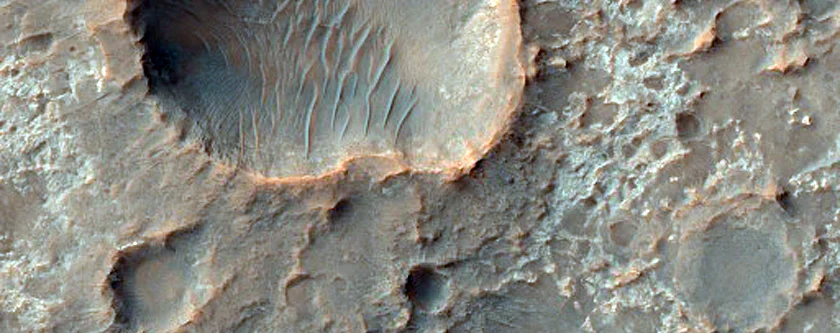
We’ve been searching for life on Mars for a long time now, but so far we’ve come up empty. The fundamental problem is a Catch-22 of two of the key ingredients for life. Life as we know it needs liquid water and reasonable temperatures, both of which are available on Mars, but hardly ever at the same time. But a new paper from lead author Anna Bognar and her team at ELTE Eötvös Loránd University and the Konkoly Observatory describes a way for life to have access to both requirements at the same time – by hiding away in salt crystals.
To understand why, let’s first look closer at the Catch-22. During the Martian night, the planet’s air cools and its relative humidity climbs. Salts scattered across the surface can absorb some of that vapor through a process known as deliquescence. However, it is also much colder than any living thing with a metabolism could survive – dropping down to -80℃, well out of range of life as we know it.
On the flip side, during the Martian day, temperatures warm up to a much more reasonable 0℃, or even higher at some points near the equator. That’s well within the operational range of known metabolism for life as we know it – after all, Canadians deal with temperatures colder than that for almost half the year. However, during this warm period, the sun also burns off all the moisture, driving relative humidity down to near zero. So while it’s warm, all the water that was trapped overnight is suddenly gone.
[embedded content]
Fraser discusses the story for the search for life on Mars.
However, one feature of those massive temperature swings, which can reach up to 150℃ in a single day, can also be used to trap some water. Materials contract and expand as they are cooled and warmed, creating a serious amount of mechanical stress on rocks undergoing that shift. For example, according to the authors’ models, halite (NaCl) salt crystals can contract by up to 1.6% between 150 K and 300 K, which can potentially open microscopic fractures and crevices. At that coldest point, in the dead of night, is also when the relative humidity peaks, and the “hygroscopic” (i.e. water-absorbing) salt pulls moisture out of the air, forming microscopic brine.
In the morning, the sun heats up that same material, the crystal expands, and it swells back to its original size, choking off the microfractures that formed during the night. That means, while the outer surface of the material dries out, there could still be water inside those microscopic channels, which would turn into liquid in the heat, but won’t be able to escape to the wider atmosphere as there’s no way out of the crevice.
That means, for a precious few hours every day during the summer at least, those microscopic cracks are filled with liquid water at temperatures that known biology can operate effectively at. But the sealed crack provides other benefits too. Even a few millimeters of material sealing over the crack could provide protection from deadly UV rays, which would otherwise sterilize any type of unprotected life on the Red Planet. But it also allows enough visible light through that, at least in theory, any microbes existing in those cracks could harvest energy through photosynthesis.
[embedded content]
There’s an ongoing debate that, if we do find life on Mars, whether it’s related to life on Earth, as Fraser discusses.
In fact, there are already examples of bacteria doing something like this on Earth. In Chile’s Atacama desert, the driest place on Earth, microscopic cyanobacteria have completely left the soil and instead taken up residence inside the pore of halite rocks, surviving on the water the salts in those rocks pull out of the air. So, in practice, at least one side of the equation works for life as we know it.
But there are some challenges still to address. Obviously there’s no guarantee that a crevice would 100% seal every day, allowing some of the water to trickle on during the day, and potentially creating a “feast or famine” cycle for the microbes attempting to scrape a living inside it. And the salt itself could be filled with perchlorates, which are deadly to most forms of Earth-bound life. Finally, while microbes in these crevices may be protected from UV radiation, they aren’t from higher energy cosmic rays, which care little for a few millimeters of protective covering.
All that is to say – while it might be theoretically possible for microbes to survive in such an environment, it is certainly unlikely. But, as Jeff Goldblum famously put it in Jurassic Park, “life, uh, finds a way”. And maybe it found a way to survive the Red Planet’s desiccation by hiding in salt crevices. If it has, we might someday find it, and in so doing, answer one of life’s great mysteries – knowing that we’re not alone.
Learn More:
A. Bognar, B.D Pal, & A. Kereszturi – Current water trapping micro-habitats on the surface of Mars
UT – Salt Deposits on Mars Might Be the Right Place to Search for Life
UT – The Time Capsule in the Salt Flat
UT – Where’s the Most Promising Place to Find Martian Life?
About the Author

Source: Universe Today