
![[Aggregator] Downloaded image for imported item #82507](https://astrobitica.com/wp-content/uploads/2026/08/DOM_09585650017763687638656_20260830_010848.webp)
Those little dust grains that fall to Earth during meteor showers or end up as part of larger meteorites found on Earth may hold surprising clues to the formation of the Sun. That’s because they record the state of the magnetic field in the protostellar nebula from which Earth (and ultimately the planets) formed.
Scientists at the Massachusetts Institute of Technology (MIT) have found records of extremely ancient magnetism imprinted in meteorite samples. They analyzed grains of material called calcium-aluminum-rich inclusions (CAIs) found in a meteorite called DOM 08006, found in Antarctica in 2008. Those inclusions formed during the first 200,000 years of the Solar System’s existence. To date, these are the oldest known material from the early Solar System. It’s likely they existed during the time when the solar nebula was still birthing the Sun, according to Professor Benjamin Weiss of MIT. Their existence is also a clue to the strength of the magnetic field in the protosolar nebula. “Other meteorites went through many different processes over this 4.5 billion year history,” he said. “They were formed in the solar nebula, then added to bodies with water, then got destroyed, moved to the asteroid belt, and then landed here. But somehow, DOM has experienced less alteration than any other meteorite.”
A cross section of the DOM 08006 meteorite, found in the Dominion Range, Victoria Land, East Antarctica. Inclusions in this meteorite show the imprint of the earliest known magnetic field in the protosolar nebula. Credit: Davidson, Jemma, et al. Geochimica and Cosmochimica Acta.
Magnetism and the Early Solar System
The story of the Solar System’s birth is a familiar one: a giant cloud of gas and dust that existed more than 4.6 billion years ago began to coalesce into regions of higher density. Eventually the cloud collapsed into a protoplanetary disk, with the infant Sun at the center. “This transition, from a spherical cloud to a protoplanetary disk, is one of the most significant events in all of solar system history,” said Weiss. “It has long been theorized that gravity caused this, but our measurements show magnetism likely played a role.”
What caused that collapse has always been something of a mystery. Gravity is the usual suspect, since it is capable of pulling material together. But was that the only thing to influence the birth of the Sun, its planets, moons, asteroids, and comets? Is it a constant force shaping planetary systems throughout the Universe?
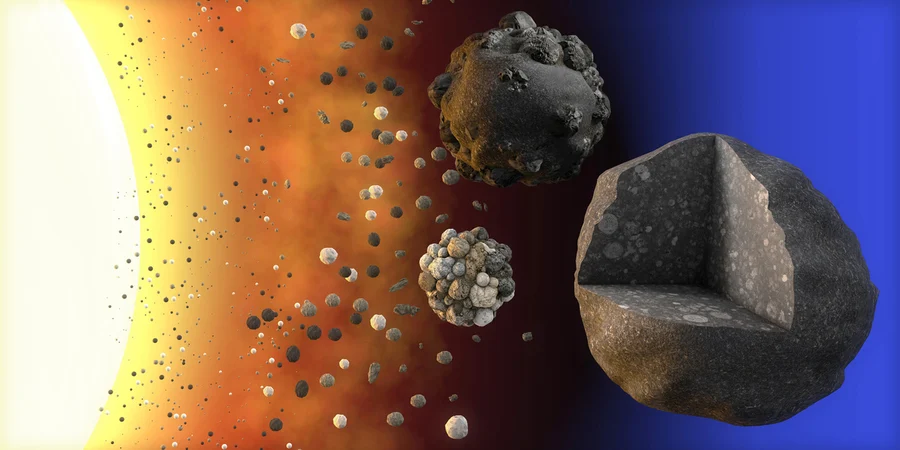
Bits of dust in the protosolar nebula eventually coalesced to form larger asteroids and meteoroids. As they did, they received an imprint from the magnetic field generated by the motions of charged materials in the cloud. Credit: MIT/Hernán Cañellas
It turns out that magnetic fields played a role. In star-forming nebulae, they arise as a result of the motion of charged particles in the cloud’s gas and dust. Like gravity, the resulting fields form an invisible force that was at work in the earliest stages of the disk evolution. For the early Solar System, the magnetic field in the disk was stronger than Earth’s field is today. And, just as on Earth, when magnetic fields are involved in the formation of rocks, traces of those early fields were imprinted onto the bits of solar system rocky material that eventually formed asteroids, planetesimals, and meteoroids that eventually fell to Earth.
Models of magnetic fields in protoplanetary disks show that such fields can have an influence on the structure of the disk, as well as on the smaller bits and pieces floating around in the disk. Scientists suggest that they stir up turbulence and outflows in the disk, as well. So, they appeared to be a part of the Solar System’s formative epoch by driving magnetized winds.
The MIT study focused on the CAIs and how their magnetic field traces formed. The team came up with two hypotheses. One is that CAIs retained magnetism when they first formed during an early epoch of disk formation or during short-lived heating events shortly after formation. The second scenario suggests that CAIs were magnetized during heating events later in the protoplanetary disk’s evolution. They were still small bits and pieces at that time, so it occurred before they got swept up into a larger body.
Where did the Magnetic Fields Originate?
The earliest magnetic fields caused by the actions of charged particles in the nebula eventually became a stronger, system-wide magnetic field. That stronger field is what got imprinted on the rocks. “We think these kinds of magnetic fields were helping to move gas from the protoplanetary disk in toward this central star, the sun,” Borlina said. “Gravity is also playing a role. But we are now showing that, if you want to fully understand how the Sun and planets formed, you should include magnetic fields in the ingredients that make them.”
Previous studies of magnetic fields in the early Solar System uncovered one that existed at 2 million years after the Sun formed. At that time, everyone assumed that the Sun was already in place, with the formation of the planets just beginning. It’s clear that the early magnetic field played an important role in the formation of the planetesimals, some of which eventually coalesced to form the planets we know today.
“Nowadays people don’t debate whether magnetism is present when planets are forming. But the debate is around the very early solar system, before planets are forming, when there’s just a disk,” said Cauê Borlina, who led the new study as an MIT graduate student and is now an assistant professor at Purdue University. “That’s where the debate still resides, and that’s where we’re operating now.”
For More Information
Meteorite Dust Holds Records of Magnetism that may Have Helped Form the Sun
Paleomagnetic Evidence for a Nebular Magnetic Field from Calcium-aluminum-Rich Inclusions
Magnetic Fields of Protoplanetary Disks
About the Author

Source: Universe Today
![[Aggregator] Downloaded image for imported item #82471](https://astrobitica.com/wp-content/uploads/2026/08/Stellar_families_in_Gaia_s_sky_pillars_20260829_180949-768x384.webp)
![[Aggregator] Downloaded image for imported item #82482](https://astrobitica.com/wp-content/uploads/2026/08/6a67783c7d752df2945a0967_Main-Katalyst_Raises_12M_to_Send_Space_Robot_to_GEO_for_Satellite_Servicing_1_20260829_222012-768x512.webp)
![[Aggregator] Downloaded image for imported item #82359](https://astrobitica.com/wp-content/uploads/2026/08/eso1629e-1024x656-1-768x492.webp)