Skip to content
cropped-file_000000006f5071f8aedc20be6316bf97.png

Astronomy • Exploration • Strategy

Primary Menu
  • Home
  • Podcast
  • Infographics
  • About
  • Contact
Light/Dark Button
Subscribe
  • Home
  • Space.com
  • Scientists just found the fastest known star in the Milky Way. It zooms around our black hole at 15,500 miles per second
  • Space.com

Scientists just found the fastest known star in the Milky Way. It zooms around our black hole at 15,500 miles per second

Astronomers have found the fastest known star in the Milky Way, a faint object racing around Sagittarius A*, the supermassive black hole at the heart of our galaxy. Dubbed S301, the star reaches about 15,500 miles (25,000 kilometers) per second at its fastest — more than 8% the speed of light."What is special about this star is that it's orbiting Sagittarius A* on a very tight orbit, taking just 8.7 years to complete it, and
Astrobitica 19/08/2026 (Last updated: 19/08/2026) 3 minutes read
[Aggregator] Downloaded image for imported item #80164

Astronomers have found the fastest known star in the Milky Way, a faint object racing around Sagittarius A*, the supermassive black hole at the heart of our galaxy. Dubbed S301, the star reaches about 15,500 miles (25,000 kilometers) per second at its fastest — more than 8% the speed of light.

“What is special about this star is that it’s orbiting Sagittarius A* on a very tight orbit, taking just 8.7 years to complete it, and is approaching the black hole at a mere 12 times the distance of Earth to the sun. That is unprecedented,” study author Felix Mang, a Ph.D. student at the Max Planck Institute for Extraterrestrial Physics in Germany, said in a statement.

The discovery gives astronomers a new way to probe the roughly 4.3-million-solar-mass black hole. General relativity predicts that a rotating black hole drags spacetime along with it, an effect known as frame dragging, or Lense-Thirring precession. That distortion should gradually alter S301’s orbit — because the star ventures so close to Sagittarius A*, those changes may become measurable within about a decade.

A view of the Milky Way's center.

This visible light wide-field view shows the rich star clouds in the constellation of Sagittarius (the Archer) in the direction of the center of our Milky Way galaxy. The entire image is filled with vast numbers of stars — but far more remain hidden behind clouds of dust and are only revealed in infrared images. This view was created from photographs in red and blue light and form part of the Digitized Sky Survey 2. (Image credit: ESO and Digitized Sky Survey 2. Acknowledgment: Davide De Martin and S. Guisard)

For the first time, we would actually be able to measure very directly the spin of a massive black hole, which would be a key test of Einstein’s theory,” said study co-author Stefan Gillessen, also of the Max Planck Institute.
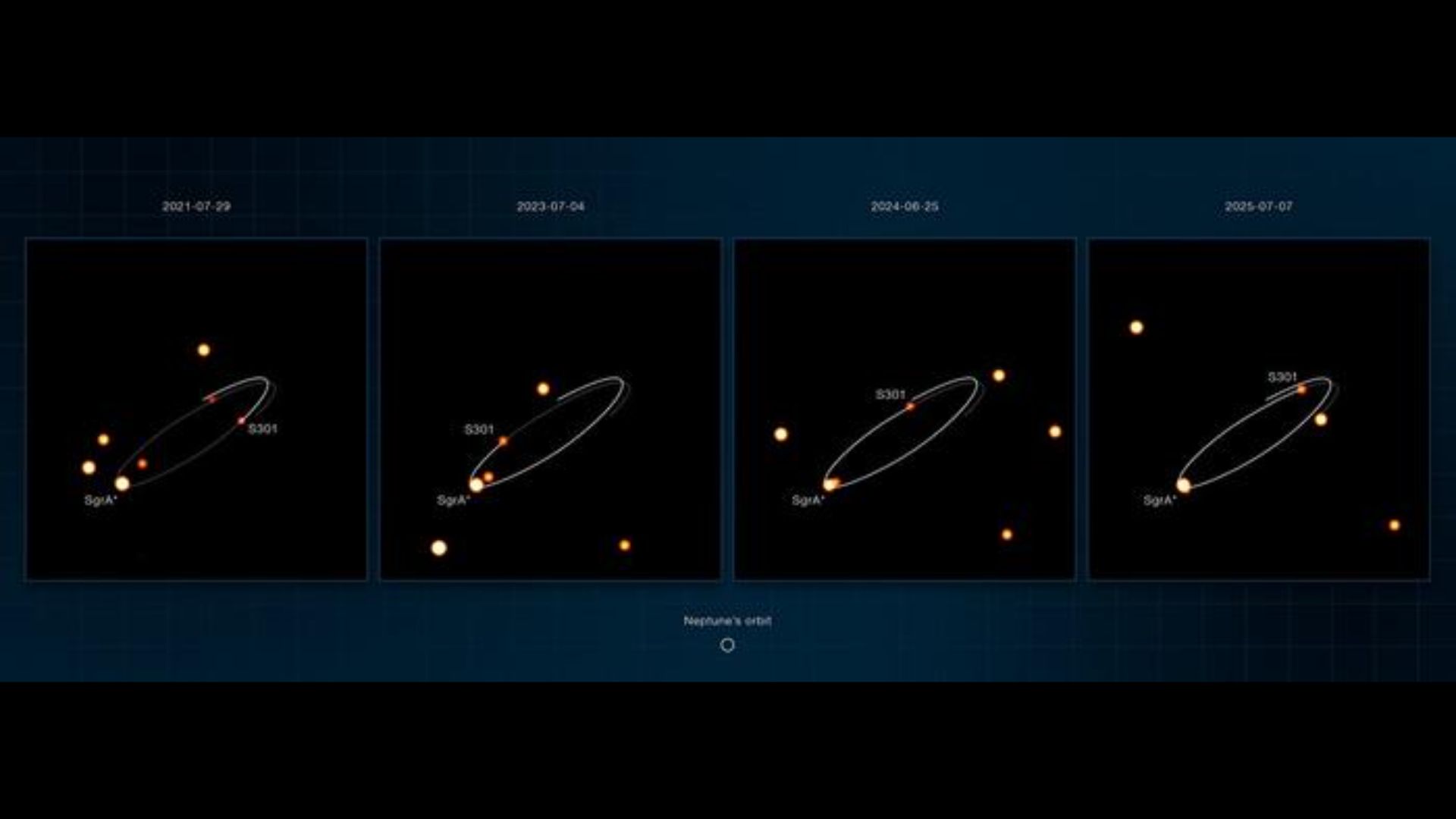
A diagram showing different views of the star.

This sequence of images, taken with the GRAVITY instrument at ESO’s Very Large Telescope Interferometer (VLTI), show several stars orbiting Sagittarius A*, the supermassive black hole at the centre of our galaxy. One of these stars, known as S301, was recently found to pass much closer to the black hole than any other known star. (Image credit: ESO/GRAVITY collaboration)

Researchers spotted S301 in 2023 using the GRAVITY instrument on the European Southern Observatory’s Very Large Telescope Interferometer in Chile, then traced it back through observations from 2021 and 2017. Its highly elongated orbit suggests S301 may once have belonged to a binary system that wandered too close to Sagittarius A*. The black hole could have captured S301 while flinging its companion outward at tremendous speed.


You may like

Astronomers plan to keep tracking S301 with GRAVITY+ and, eventually, ESO’s Extremely Large Telescope. With its next close pass expected in 2031, observations spanning two full orbits could reveal Sagittarius A*’s spin for the first time.

The team’s research was published on August 19 in the journal Nature.

Space

About the Author

Astrobitica

Administrator

Visit Website View All Posts

This post was originally published on this site

Post navigation

Previous: LandSpace becomes first commercial Chinese company to land an orbital-class booster
Next: Webb Captures the Treasure Chest at the Heart of the Carina Nebula

Related Stories

Wz2zqxutkvgmc4wyrujkh4 1920 80
  • Space.com

Rubin telescope should find more of Earth’s mysterious ‘mini-moons’ — including some we can study up close

Astrobitica 26/10/2026 0
A full moon is photographed shining in a cloudy night sky, while a light house directs its beam skyward on the water's edge.
  • Space.com

October full ‘Hunter’s Moon’ dazzles in spectacular photos from around the world

Astrobitica 26/10/2026 0
A collage of artist concepts highlighting the novel approaches proposed by the 2026 NIAC awardees.
  • Space.com

‘More missions, more often’: NASA is overhauling how it selects science missions

Astrobitica 26/10/2026 0

Download the Astrobitica Night Sky Guide for FREE!

Copyright © 2026 All rights reserved. | ReviewNews by AF themes.