
![[Aggregator] Downloaded image for imported item #76507](https://astrobitica.com/wp-content/uploads/2026/08/A5HPhpzJXxcQzG5QDYTLbU-1280-80.jpg)
New evidence has come to light showing that the mysterious ‘little red dots’ discovered in the early universe by the James Webb Space Telescope could evolve into the active centers of fully formed galaxies.
“Everything created in the early universe must evolve into something around us,” said George Rieke of the University of Arizona in a statement. “We have had little idea of what little red dots become, but these results finally show us how to find their progeny.”
Discovered by the James Webb Space Telescope (JWST) almost as soon as it became operational in 2022, little red dots have been a perplexing cosmological mystery. As their name suggests, they appear small, red and surprisingly bright. They are mostly found at redshift values suggesting they existed between 13.2 and 12.2 billion years ago. To shine so brightly at such great distances would usually imply these objects are quasars — which are luminous nuclei of galaxies powered by active supermassive black holes — but the light coming from little red dots is more like that of bloated stars. It looks to be mostly in infrared with some ultraviolet, and none of the X-rays that one would expect from an active black hole chomping down on material.
As such, researchers have come up with the hypothesis that little red dots are “black hole stars,” or vast clouds of gas heated from within by a concealed but growing supermassive black hole.
However, the population of little red dots drops off a cliff at redshifts equating to less than 12 billion years ago. Where did they all go? There are two options. Either they all died off, or they developed into objects more familiar to us.
One recent hypothesis is that little red dots turned into large globular clusters. And now, an alternative possibility has come along.
A team led by Pierluigi Rinaldi, who was at the University of Arizona’s Steward Observatory when conducting this research but is now at the Space Telescope Science Institute (STScI) in Baltimore, think it has identified a descendent of a little red dot. It appears to be in the form of a distant galaxy, catalogued as WISEA J123635.56+621424.2, which is found at a redshift of 2, meaning that we see it as it was 10.5 billion years ago.
The galaxy displays neat spiral arms around a red core. Rinaldi’s team have nicknamed it the Saguaro, after a species of cactus native to the Sonoran desert in the United States’ south-west, thanks to the galaxy’s arms and how its core resembles the red fruit produced by the cactus.
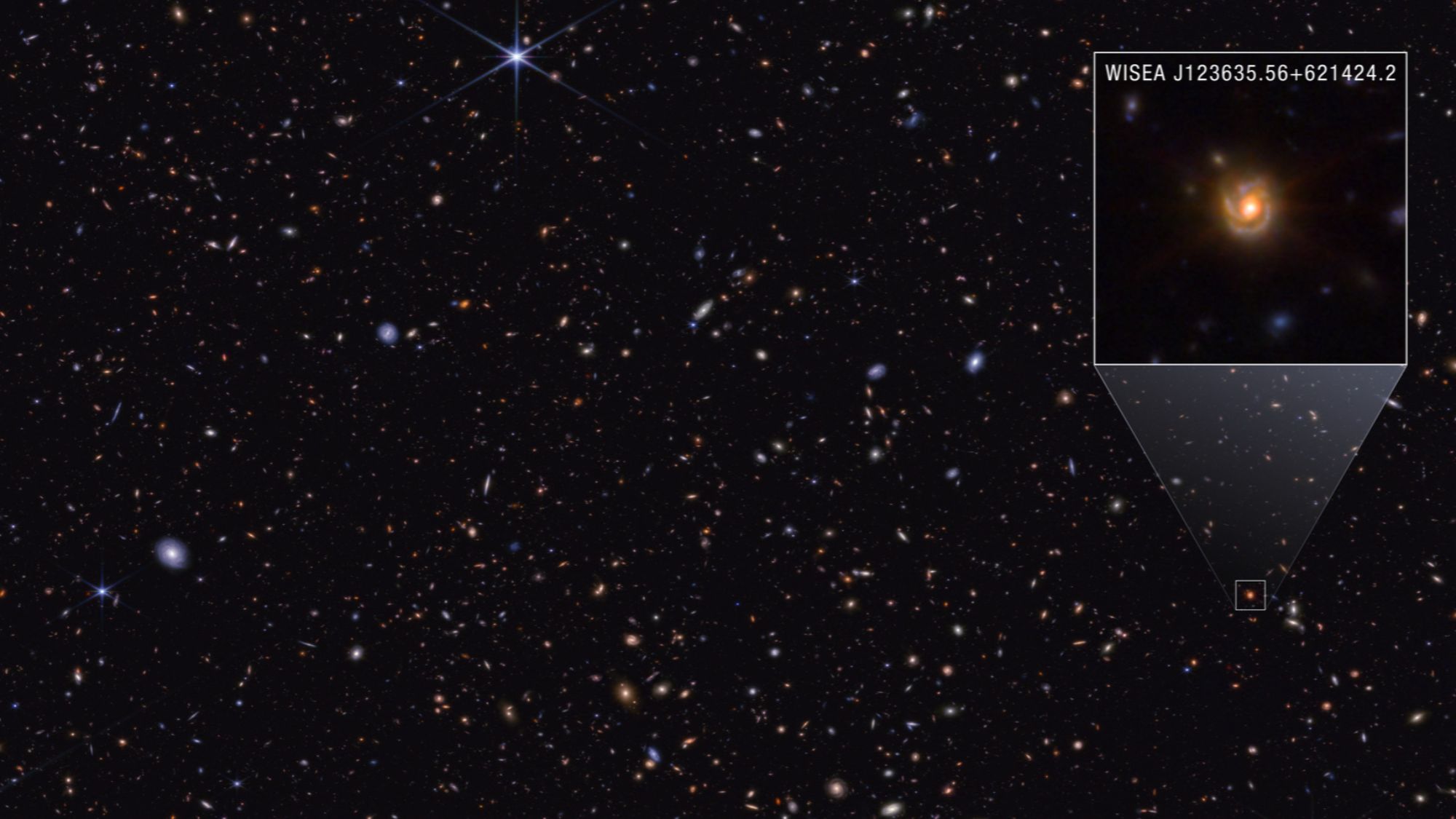
Saguaro’s core has all the hallmarks of a little red dot. It shines bright in infrared as seen by JWST, and also emits in ultraviolet as detected by the Hubble Space Telescope. Yet, NASA’s Chandra X-ray Observatory has also detected faint X-rays originating from Saguaro.
“What the X-ray observations show is that this galaxy has an active galactic nucleus, and a very obscured one at that,” Carys Gilbert of the University of Cape Town in South Africa, who participated in the study alongside Rinaldi, said in the statement. “It’s not only obscured but also X-ray weak. That kind of combination could explain the lack of X-ray emission that we see from all other little red dots. It fits the puzzle of little red dots nicely.”
This is not the first time X-rays have been seen coming from a little red dot. Earlier this year it was reported that scattered X-rays were seen breaking through from a little red dot called 3DHST-AEGIS-12014, given credence to the hypothesis that little red dots are black hole stars, where the black hole gradually consumes the “star” from the inside out, eventually carving holes through which X-rays can escape. We see 3DHST-AEGIS-12014 as it was 11.8 billion years ago, meaning that Saguaro, which existed 1.3 billion years later, is a little bit further on in its development.
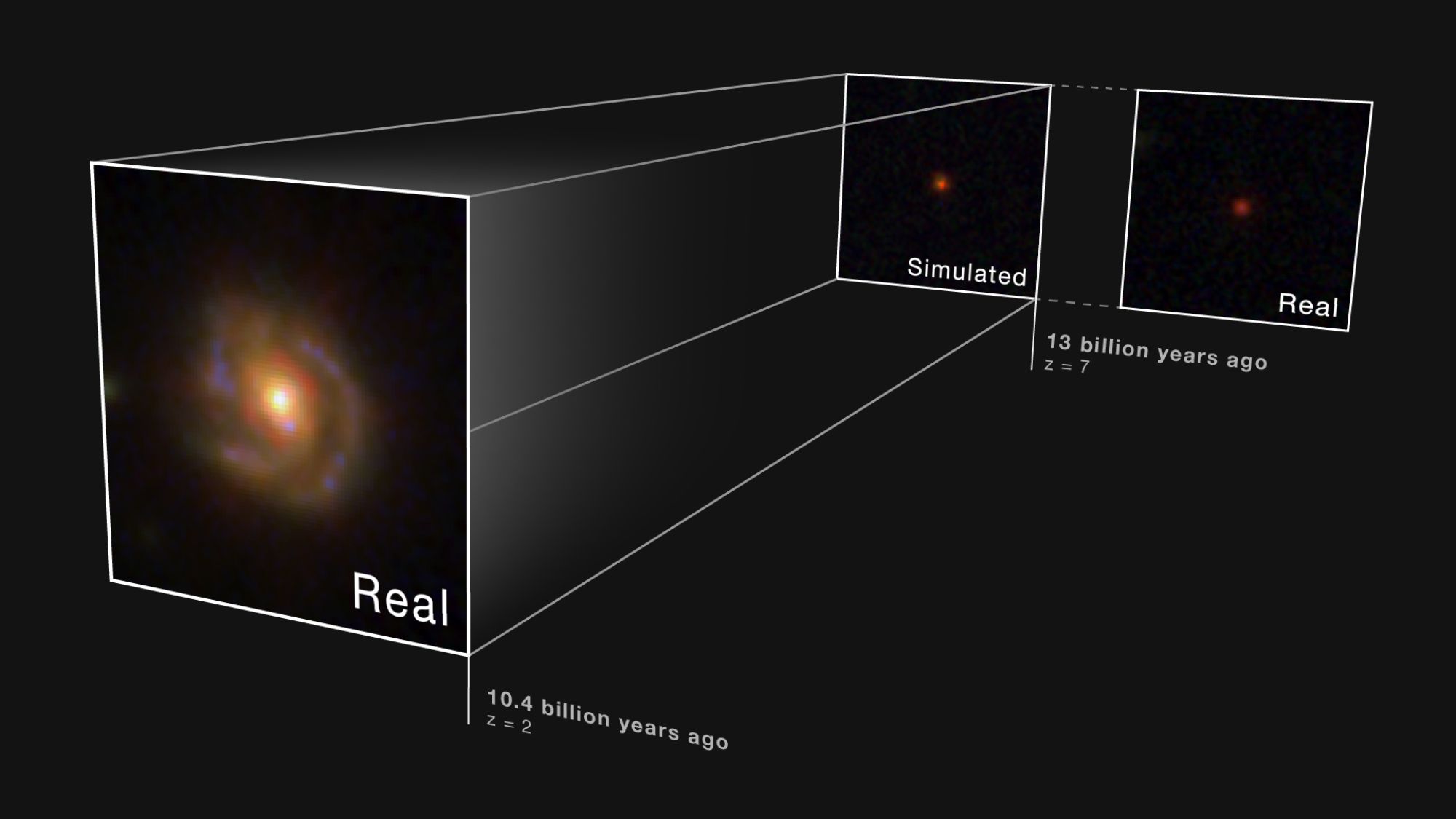
“Because the Saguaro is at lower redshift, we can see the very beautiful and bright host galaxy in high resolution and detail with Webb and Hubble,” said Harvard’s Zihao Wu, who was also part of Rinaldi’s team.
Intrigued, Rinaldi’s team simulated how Saguaro would appear to us if it existed a billion years after the big bang. Much of its galactic structure would either be less developed or simply just too faint to be seen at such distance. All that would be visible would be the nucleus, looking very much like all the other little red dots.
This implies that little red dots are not a unique population of their own, but are simply a phase in the development of galaxies with supermassive black holes. Our own Milky Way could have been a little red dot once upon a time.
Saguaro is a crucial link in the story of little red dots and how they connect with modern galaxies. While there is still much to learn, such as the beginning of their story and how they form, the middle and end of their story is now beginning to take shape.
The findings were reported on 29 July in The Astrophysical Journal.
About the Author
