
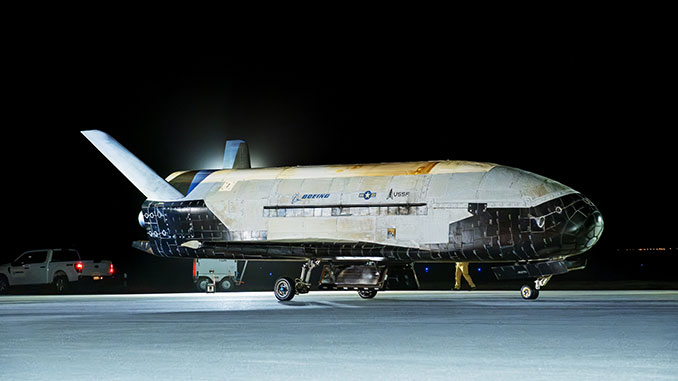
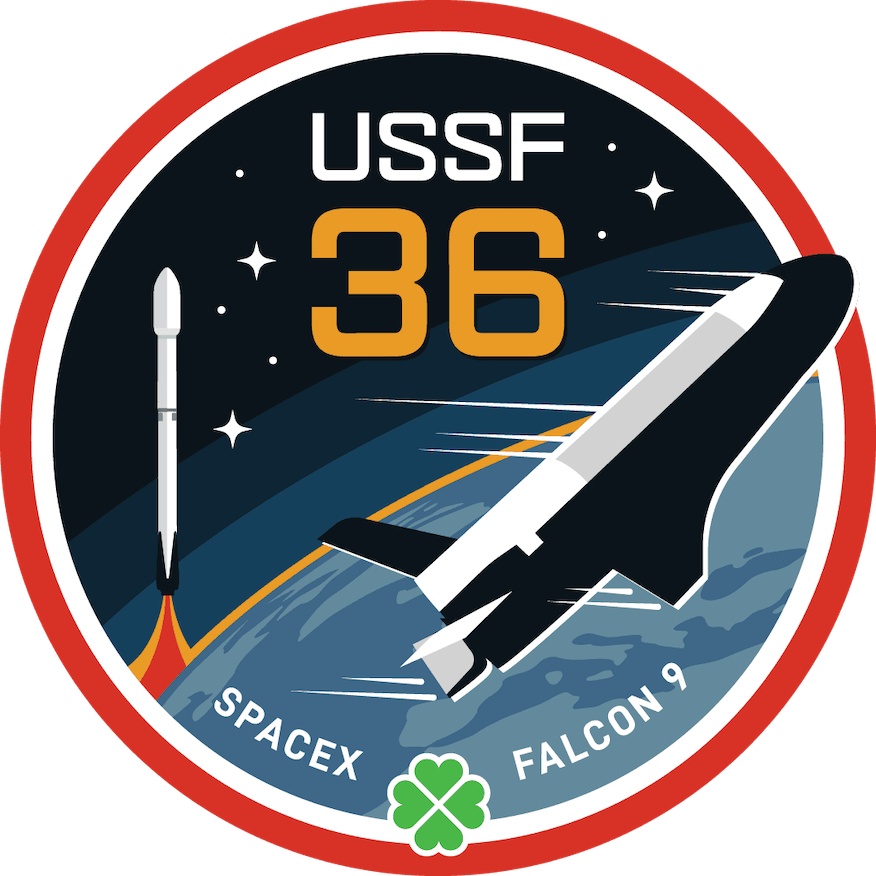
The U.S. Space Force and SpaceX are preparing to launch the Boeing-built X-37B spaceplane on its eighth mission shortly before midnight on Thursday. The winged spacecraft, flying under the mission names USSF-36 and Orbital Test Vehicle 8 (OTV-8), will launch atop a Falcon 9 rocket from pad 39A at NASA’s Kennedy Space Center at 11:50 p.m. EDT (0350 UTC).
The X-37B will be operated by the Fifth Space Operations Squadron, part of USSF Delta 9, alongside the U.S. Air Force Rapid Capabilities Office (USAF RCO).
Spaceflight Now will have live coverage beginning about an hour prior to liftoff.
Meteorologists with the 45th Weather Squadron forecast a 65 percent chance for favorable conditions for liftoff during the launch window that opens Thursday night.
SpaceX will use the Falcon 9 first stage booster with the tail number B1092, which will launch for a sixth time. Its previous missions include CRS-32, GPS III-7 SV 08 and NROL-69.
A little more than 8.5 minutes after liftoff, B1092 will aim for a landing at Landing Zone 2 (LZ-2) at Cape Canaveral Space Force Station. If successful, this will be the 13th touchdown at LZ-2 and the 490th booster landing to date.
The X-37B was encapsulated inside Falcon payload fairing on Aug. 14 and then transported to LC-39A for integration with the rest of the Falcon 9 rocket. The full stack rolled out to the pad Wednesday morning.
This is the third time that a Falcon rocket will launch one of these spaceplanes. SpaceX launched the OTV-5 mission on its Falcon 9 rocket and OTV-7 using its Falcon Heavy. The other X-37B missions were lofted by United Launch Alliance’s Atlas 5 rocket.
The more powerful Falcon Heavy was needed for the last X-37B mission in order to send the vehicle into a highly elliptical, high Earth orbit.
Taking wing
The OTV-8 mission comes after the previous seven flights racked up 4,208 days in orbit. The longest continuous mission was OTV-6, which lasted nearly 909 days.
Michelle Parker, vice president of Boeing Space Mission Systems said the company has incorporated improvements into its two reusable X-37B spaceplanes since the first flight in 2010.
“Over the course of our missions, we’ve flown several generations of batteries and solar cells that have significantly improved our power generation capability,” said. “We’ve enhanced the thermal protection tiles to improve maximum temperature capability, manufacturability, and reusability.
“Mission 7 broke new ground with fault protection, autonomy, and collision avoidance. Autonomy is going to be critical as space becomes more congested and we operate the spaceplane in multiple orbital regimes.”
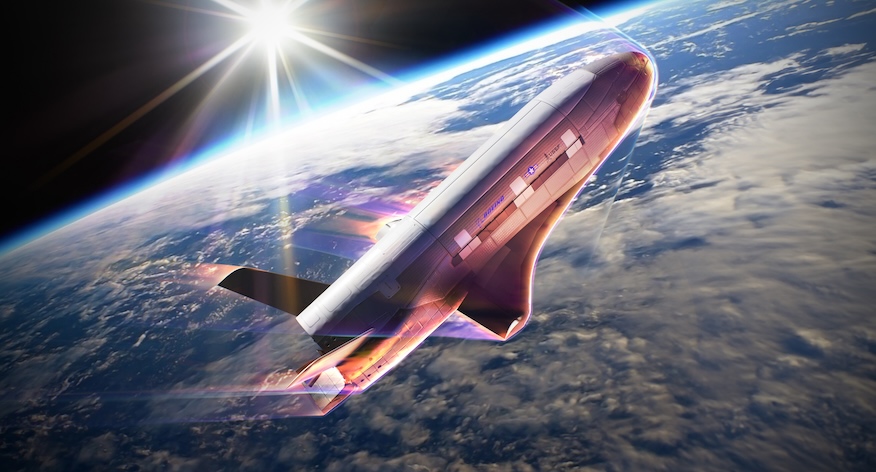
This time around, the Space Force has two areas of focus that it’s highlighting: communications and navigational accuracy.
The former will be demonstrated through a laser communications experiment, which will “mark an important step in the U.S. Space Force’s ability to leverage proliferated space networks as part of a diversified and redundant space architectures,” according to Gen. Chance Saltzman, the Chief of Space Operations for the U.S. Space Force.
“In so doing, it will strengthen the resilience, reliability, adaptability and data transport speeds of our satellite communications architecture,” Saltzman added.
The OTV-8 flight will also feature what the Space Force calls “the world’s highest performing quantum inertial sensor ever used in space.” It will demonstrate navigational capabilities without the use of GPS by instead “detecting rotation and acceleration of atoms.”
“OTV 8’s quantum inertial sensor demonstration is a welcome step forward for operational resilience in space,” said Col. Ramsey Horn, Space Delta 9 commander. “Whether navigating beyond Earth based orbits in cislunar space or operating in GPS-denied environments, quantum inertial sensing allows for robust navigation capabilities when GPS navigation is not possible.”
It’s unclear how long the X-37B will remain in space this time around. Only one mission so far lasted less than a year and that was the first flight, OTV-1, which took off Florida in April 2010 and landed in California in December of that year.
About the Author
